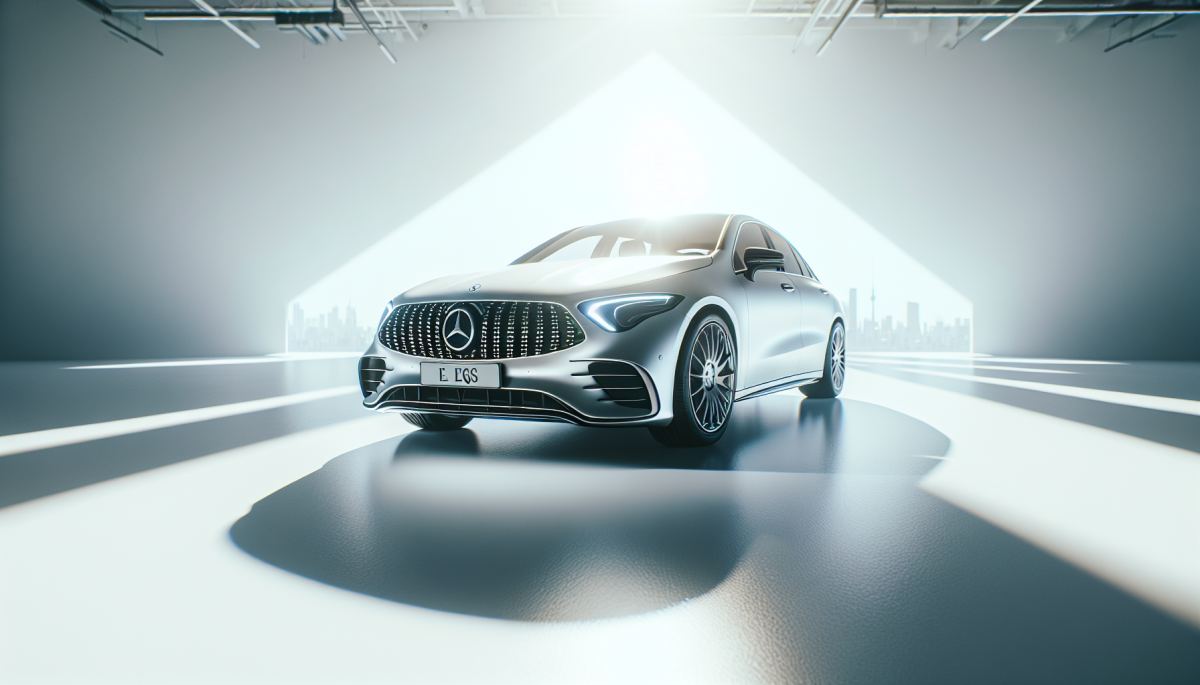
Mercedes-Benz has never been shy about planting flags. When the original EQS launched in 2021, it arrived as the company's most technologically ambitious electric vehicle, a rolling statement about what German engineering could do when freed from the constraints of a combustion drivetrain. Three years later, the Stuttgart automaker has torn much of that car apart and rebuilt it, unveiling an overhauled EQS that stretches WLTP-rated range to 926 kilometers (575 miles), introduces 800-volt charging architecture capable of pulling up to 350 kilowatts, and debuts steer-by-wire technology in a production car for the first time among German manufacturers. The cumulative effect is less a refresh than a reckoning with how quickly the electric vehicle landscape has shifted beneath Mercedes' feet.
The 13 percent range improvement over the outgoing model is meaningful, but the number that matters more is 800 volts. For years, the 400-volt architecture that underpinned most European EVs was a quiet competitive liability. Hyundai and Kia moved aggressively to 800-volt systems with the Ioniq 5 and EV6, enabling faster charging with less heat buildup and thinner cables. Porsche followed with the Taycan. Mercedes, despite its flagship ambitions, held back. The new EQS closes that gap decisively, and the 350 kW DC charging ceiling puts it in the same conversation as the fastest-charging passenger cars on the market today. At that rate, adding 300 kilometers of range in roughly 15 minutes becomes a realistic expectation rather than a marketing aspiration.
The steer-by-wire system may be the most consequential technical decision in the new EQS, and also the most quietly radical. In a conventional steering setup, there is a physical mechanical connection between the steering wheel and the front wheels. Steer-by-wire severs that link entirely, replacing it with sensors, actuators, and software. The driver's inputs are interpreted electronically and translated into wheel movement with no direct physical fallback. Toyota introduced a version of this on the bZ4X in some markets, but for a German automaker to commit to it in a production flagship is a different kind of statement, one about trust in software redundancy and regulatory confidence.

The risks are not trivial. Steer-by-wire systems require multiple layers of redundancy to meet safety standards, and any latency or software fault in the actuation chain carries consequences that a hydraulic assist failure simply does not. Mercedes is betting that its engineering and the maturity of MB.OS, its new in-house operating system, are sufficient to manage that exposure. That bet also signals something broader: the company is treating software not as a feature layer on top of hardware, but as load-bearing infrastructure. MB.OS is the same platform Mercedes intends to deploy across its electric lineup, which means the EQS is effectively a live test of whether that architecture can carry the weight of a flagship product.
None of these upgrades arrived in a vacuum. Mercedes is responding to a market that has grown far more demanding and far more crowded since 2021. Chinese manufacturers, particularly BYD and its premium offshoot Yangwang, have demonstrated that long range, fast charging, and advanced driver interfaces can be delivered at price points that undercut European luxury assumptions. The EQS, which opens for orders in Germany starting at €94,400, is not competing with a BYD Han on price. But it is competing on the perception of technological leadership, and that perception has eroded faster than most European executives anticipated.
The second-order consequence worth watching is what this upgrade cycle does to the residual value of the 2021 to 2024 EQS fleet. A 13 percent range improvement and a full architecture change in three years is a fast depreciation signal. Owners of the outgoing model now hold a car that lacks 800-volt charging, steer-by-wire, and MB.OS, in a segment where technology currency matters enormously to resale. If Mercedes continues this pace of platform revision, it risks training its own customer base to lease rather than buy, compressing the ownership horizon and changing the financial calculus of the entire luxury EV segment in ways that will take years to fully surface.
The EQS has always been a car about possibility more than practicality. Almost nobody needs 926 kilometers of range in a single charge. But the number exists to dissolve the last psychological resistance to electric ownership among buyers who can afford not to compromise. Whether that argument lands in showrooms, or whether the real competition has already moved to a different battlefield entirely, is the question Mercedes will spend the next product cycle trying to answer.




Discussion (0)
Be the first to comment.
Leave a comment