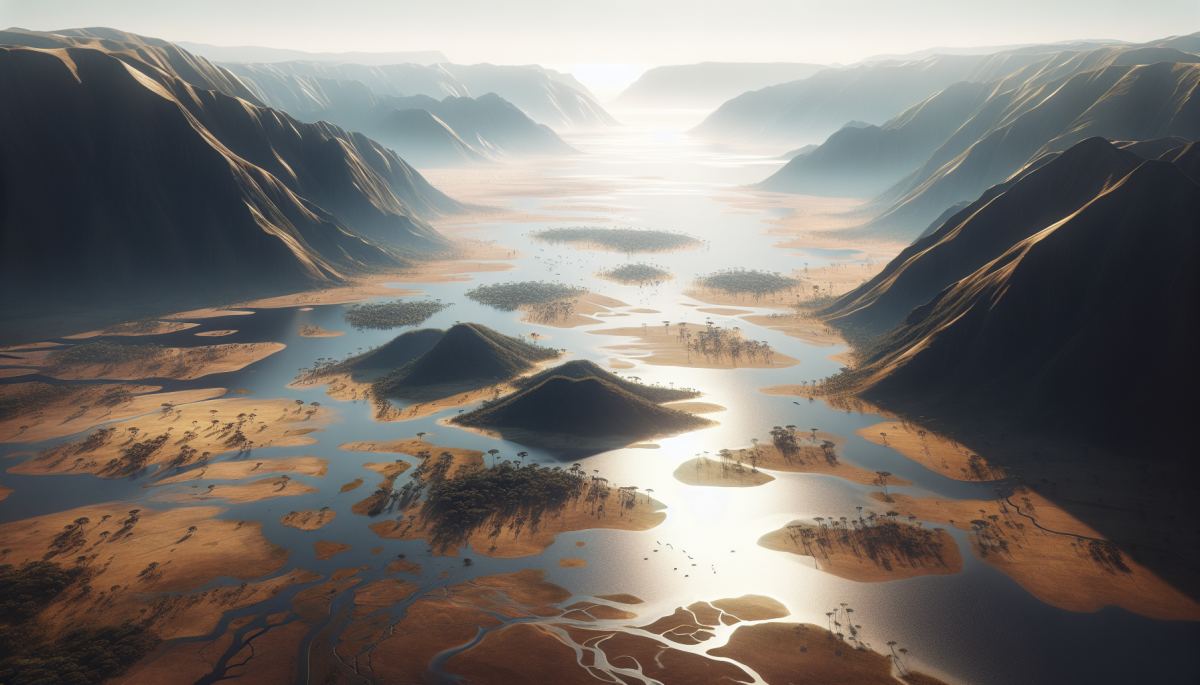
The Congo Basin holds roughly 30 percent of the world's tropical peatland carbon, a figure that climate scientists have long treated as a reassuring constant in an otherwise turbulent global carbon budget. That reassurance is now under serious strain. New research focused on Africa's largest blackwater lakes has found that carbon dioxide rising from these waters is not simply the product of recently decomposed plant matter. Some of it is ancient, drawn from peat deposits that have been sealed underground for thousands of years.
Blackwater lakes, named for the dark tannin-rich water that drains from surrounding wetlands and forests, have historically been treated as relatively passive features of tropical hydrology. They absorb organic material, cycle nutrients, and emit some carbon as part of normal biological processes. What this new research complicates is the assumption that the carbon being emitted is part of a closed, contemporary loop. When ancient peat carbon enters the equation, the system is no longer recycling. It is drawing down a finite reserve that took millennia to accumulate.
The Congo Basin peatlands, concentrated largely in the Cuvette Centrale region straddling the Democratic Republic of Congo and the Republic of Congo, were only mapped in detail in 2017. That study, published in Nature, estimated the region stores around 30 billion metric tons of carbon, equivalent to roughly three years of global fossil fuel emissions. The discovery reshaped how scientists think about tropical carbon storage. The new findings about blackwater lake emissions now raise a harder question: how stable is that storage, and under what conditions does it begin to unravel?

Peat forms when waterlogged conditions slow the decomposition of organic matter, allowing carbon to accumulate over centuries and millennia rather than cycling back into the atmosphere. The Congo Basin's peatlands have built up under conditions of consistent inundation, and their stability has always depended on that hydrology remaining intact. When water levels drop, oxygen penetrates the peat, microbial activity accelerates, and carbon that was effectively frozen in time begins to oxidize and escape.
The pathway from peat to blackwater lake to atmosphere is not a dramatic rupture. It is a slow, diffuse seepage, the kind of process that is easy to overlook precisely because it lacks the visual drama of a wildfire or a collapsing glacier. But diffuse processes operating across millions of hectares can move enormous quantities of carbon. Researchers studying similar dynamics in boreal peatlands in Canada and Siberia have documented how even modest warming or drainage can tip these systems from carbon sinks into carbon sources. The Congo Basin, long considered more climatically stable than its northern counterparts, may be less insulated from that tipping dynamic than previously assumed.
The second-order consequence worth watching here is not just the direct emissions from the lakes themselves. It is the feedback loop those emissions could initiate. As ancient carbon enters the atmosphere and contributes incrementally to warming, the regional climate of the Congo Basin faces greater pressure: longer dry seasons, more variable rainfall, and increased risk of the kind of hydrological disruption that accelerates peat decomposition further. The system, in other words, contains its own acceleration mechanism.
The political geography of the Congo Basin adds another layer of complexity. The DRC and Republic of Congo are among the least resourced nations in the world when it comes to environmental monitoring and enforcement. Deforestation, driven by subsistence agriculture, artisanal logging, and expanding infrastructure, already threatens the hydrological integrity of the peatlands from the edges inward. International climate finance has been slow to reach the region at the scale the ecosystem warrants, despite repeated calls from Congolese officials for compensation mechanisms that recognize the basin's global climate value.
The CAFI initiative, the Central African Forest Initiative, has channeled some funding toward forest protection in the region, but peatland-specific conservation remains underfunded relative to the stakes involved. If ancient carbon is already escaping through blackwater lake systems under current conditions, the trajectory under continued deforestation and climate stress is not difficult to project.
What this research ultimately forces into view is the gap between how climate models treat tropical peatlands and what is actually happening at the water's surface. Models have largely assumed these stores are stable on human timescales. The blackwater lake data suggests the timeline for concern may be shorter than that. The Congo Basin has been described as the world's second lung. The question scientists are now beginning to ask is whether that lung has already started to exhale.
References
- Dargie et al. (2017) — Age, extent and carbon storage of the central Congo Basin peatland complex
- Page et al. (2011) — Global and regional importance of the tropical peatland carbon pool
- Schuur et al. (2015) — Climate change and the permafrost carbon feedback
- CAFI — Central African Forest Initiative Overview



Discussion (0)
Be the first to comment.
Leave a comment