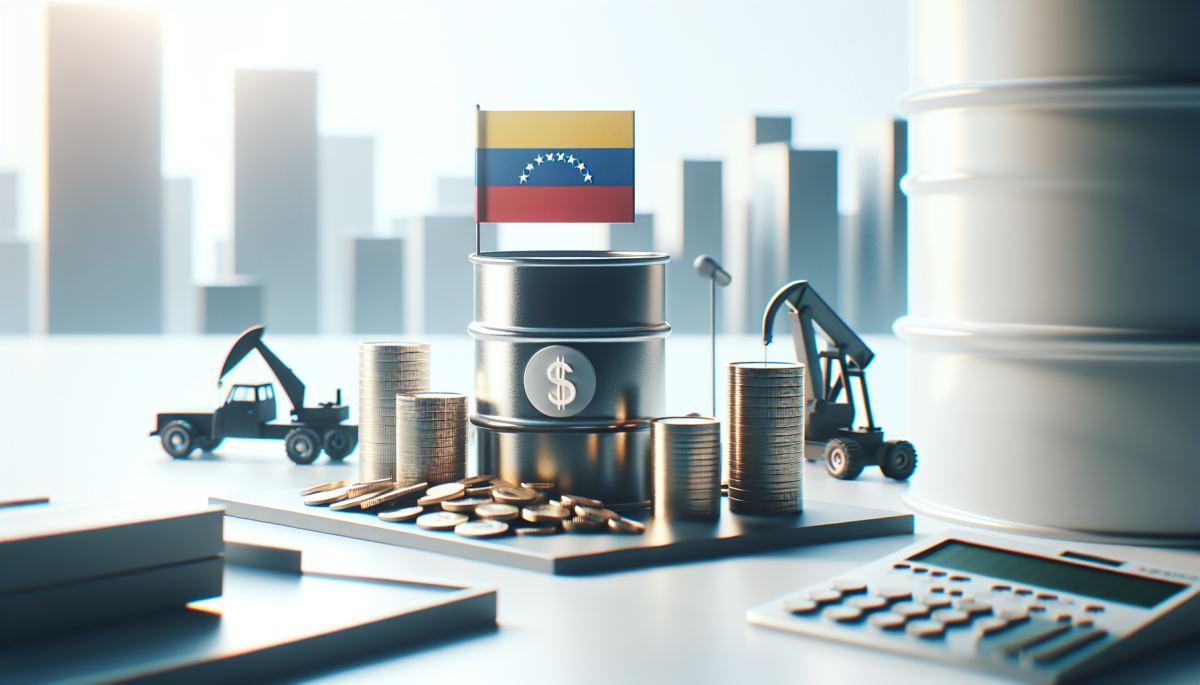
Venezuela owes money to almost everyone, and almost no one agrees on who gets paid first. Oil majors, hedge funds, Chinese state lenders, and Russian creditors have spent years circling a country whose economy has been in freefall, waiting for a moment of political clarity that keeps refusing to arrive. That moment is not coming anytime soon, and the financial architecture holding this standoff together is starting to crack in ways that will be very difficult to reverse.
The country's total external debt load is estimated at well over $150 billion, depending on how you count the obligations of state oil company PDVSA alongside sovereign bonds. China alone is owed somewhere between $10 billion and $20 billion through a series of oil-for-loans arrangements negotiated during the Chávez and early Maduro years, when Caracas was flush enough to promise future barrels as collateral. Russia's Rosneft has its own entanglements. Western bondholders, many of them distressed-debt specialists who bought Venezuelan paper at steep discounts, are sitting on legal judgments they cannot easily enforce. And American oil companies, particularly those whose assets were nationalized, have arbitration awards that have been grinding through international courts for over a decade.
What makes Venezuela's debt situation genuinely unusual, beyond its sheer scale, is the layering of sanctions, competing legal jurisdictions, and political conditions that make any conventional restructuring almost impossible to initiate. U.S. sanctions imposed during the Trump administration and largely maintained since have frozen out most of the international financial system from engaging with Caracas. That means the normal machinery of sovereign debt renegotiation, the kind that eventually worked in Argentina or Greece, simply cannot be switched on without a political agreement that Washington would have to bless.
The creditor landscape is not just complicated, it is internally contradictory. Chinese lenders, operating through policy banks like the China Development Bank and the Export-Import Bank of China, have historically preferred quiet bilateral renegotiation over public legal battles. They restructured their Venezuelan loans multiple times during the 2010s, rolling over payments rather than triggering defaults that would embarrass Beijing's broader lending diplomacy across Latin America. But that patience has limits, and the oil flows that were supposed to service those debts have slowed dramatically as Venezuelan production collapsed from over 3 million barrels per day in the early 2000s to somewhere around 800,000 barrels per day in recent years.

Hedge funds that hold defaulted PDVSA bonds, meanwhile, have been playing a longer and more aggressive game. Several have obtained court judgments in U.S. and European jurisdictions and have been attempting to attach Venezuelan assets abroad, including the U.S. refining subsidiary Citgo. Citgo has become the single most contested piece of the entire debt puzzle, a real, operating, American business that multiple creditor classes believe they have a claim on. The legal maneuvering around Citgo has become so complex that it functions almost as its own sovereign debt crisis within the larger one.
The second-order consequence that most analysts underweight is what a chaotic, uncoordinated Venezuelan default resolution would do to the broader architecture of emerging market lending. If Chinese policy banks are seen to recover less than Western bondholders, or if arbitration awards from nationalized oil assets jump the queue ahead of bilateral creditors, the precedents set could reshape how sovereign borrowing is structured across the developing world for a generation. Creditors in future deals will demand clearer seniority provisions. Borrowers will find certain financing windows more expensive or simply closed.
None of this resolves without politics, and Venezuelan politics remain as frozen as the debt itself. The Maduro government has shown no credible willingness to engage in the kind of governance reforms that would unlock sanctions relief, and the opposition remains fragmented after years of exile, repression, and failed intervention attempts. The Biden administration's brief experiment with easing some sanctions in exchange for electoral commitments produced little lasting change.
What that means practically is that the creditors are not really negotiating with Venezuela right now. They are negotiating with each other, positioning for the day when some political opening finally makes a restructuring possible, and trying to ensure that when that day comes, their particular claim is treated as senior, legitimate, and enforceable. It is a slow-motion race with no finish line in sight.
The longer the standoff continues, the more Venezuelan oil infrastructure deteriorates, which means the asset that every creditor ultimately needs, the country's capacity to produce and export petroleum, keeps shrinking. By the time a deal becomes politically possible, there may be considerably less to divide.
References
- Ulmer et al. (2023) — Venezuela's Citgo faces creditor auction after court ruling
- Kurmanaev et al. (2019) — Venezuela's Collapse Is the Worst Outside of War in Decades
- Gallagher et al. (2016) — The China Triangle: Latin America's China Boom and the Fate of the Washington Consensus
- IMF (2023) — Western Hemisphere Regional Economic Outlook
- Olivares-Caminal et al. (2011) — Debt Restructuring
Discussion (0)
Be the first to comment.
Leave a comment