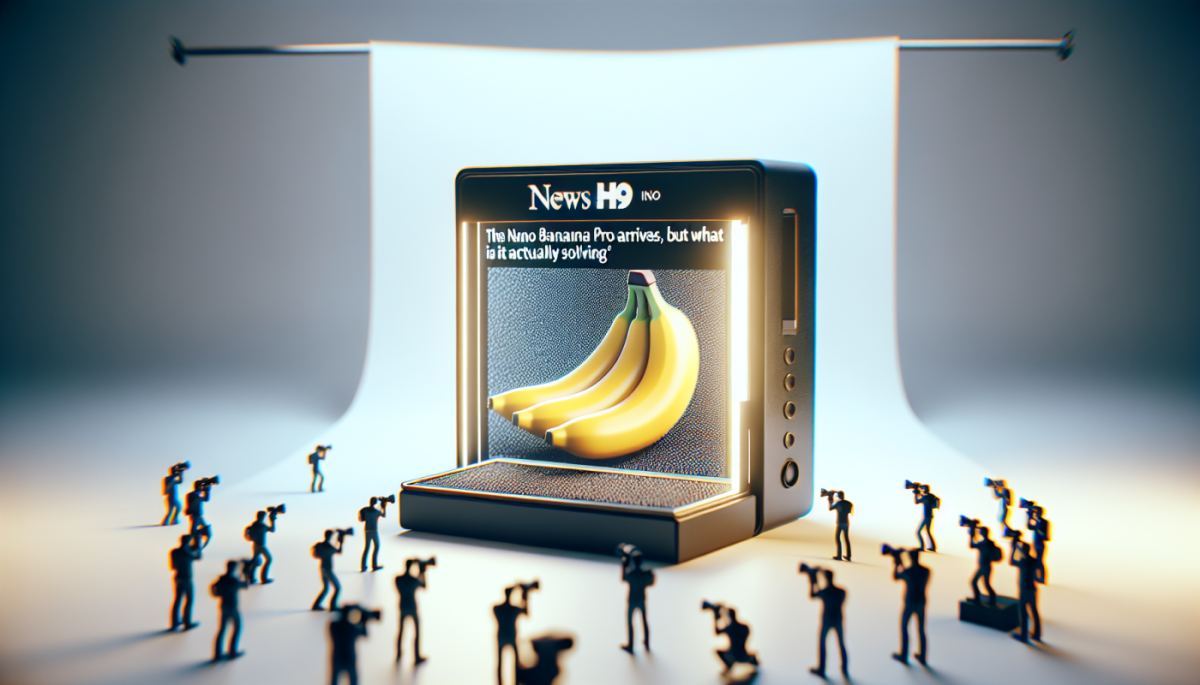
There is something quietly revealing about the moment a product gets a name like "Nano Banana Pro." The suffix alone — Pro — carries the full weight of a marketing philosophy that has come to define consumer technology: the suggestion that whatever came before was merely a rehearsal, and that the serious version has finally arrived. Whether the Nano Banana Pro lives up to that implied promise depends entirely on what problem it was designed to solve in the first place, and that question turns out to be more interesting than the product launch itself.
The announcement of the Nano Banana Pro lands in a consumer landscape that is, to put it plainly, exhausted by incremental upgrades dressed in revolutionary language. Buyers have grown sharper at reading the gap between what a product claims and what it delivers. And yet the cycle continues, because the incentives that produce it have not changed. Manufacturers face relentless pressure to refresh product lines on a cadence that suits retail calendars and investor expectations rather than genuine technological leaps. The result is a market full of "Pro" versions of things that were already functional, each one nudging specifications upward just enough to justify a new price point.
Product naming is not a trivial exercise. It is one of the most compressed forms of communication a company produces, and the choices embedded in a name like Nano Banana Pro tell you something about how the company understands its audience. "Nano" implies smallness, precision, perhaps elegance. "Banana" carries a kind of irreverence, a willingness to be playful in a category that might otherwise take itself too seriously. "Pro" then attempts to resolve the tension between those two signals by anchoring the whole thing in aspiration and seriousness. The name is doing a lot of work, possibly more work than the product beneath it.
This kind of branding strategy reflects a broader pattern in consumer goods where differentiation has become harder to achieve through engineering alone. When the underlying components available to manufacturers are largely commoditised, and when supply chains converge on the same handful of suppliers, the product story becomes the primary battleground. A name, a colour, a suffix — these carry disproportionate weight when the hardware differences between competing products are measured in fractions.
The more consequential story here may not be about the Nano Banana Pro itself but about what its existence signals for the category it enters. When a product with this kind of positioning arrives, it typically does one of two things to the competitive landscape. Either it forces rivals to accelerate their own refresh cycles, compressing timelines and increasing the pressure on engineering teams to ship before they are ready, or it sets a new floor for what consumers expect at a given price point, quietly raising the baseline without raising the ceiling.
Both outcomes carry costs that rarely appear in the launch-day coverage. Compressed development cycles have a well-documented relationship with quality control failures, support burdens, and the kind of software debt that accumulates quietly until it becomes a crisis. Meanwhile, rising consumer expectations at the entry level can hollow out the mid-range of a market, leaving manufacturers caught between a budget tier they cannot profitably compete in and a premium tier that requires investment they have not yet made.
There is also a sustainability dimension that deserves more attention than it typically receives in product launch cycles. Each new "Pro" iteration generates a wave of device replacement that has material consequences: old units discarded, new units manufactured, supply chains activated. The aggregate effect of dozens of such launches across dozens of categories each year is a volume of electronic waste and carbon expenditure that the industry has not yet found a credible way to account for publicly.
What the Nano Banana Pro ultimately represents is less a product than a pressure point — a place where market incentives, consumer psychology, competitive dynamics, and environmental costs all converge in a single SKU. Whether it succeeds commercially will be decided in the next few quarters. Whether the model it embodies is sustainable, in every sense of that word, is a question the industry is only beginning to be forced to answer seriously.
Discussion (0)
Be the first to comment.
Leave a comment