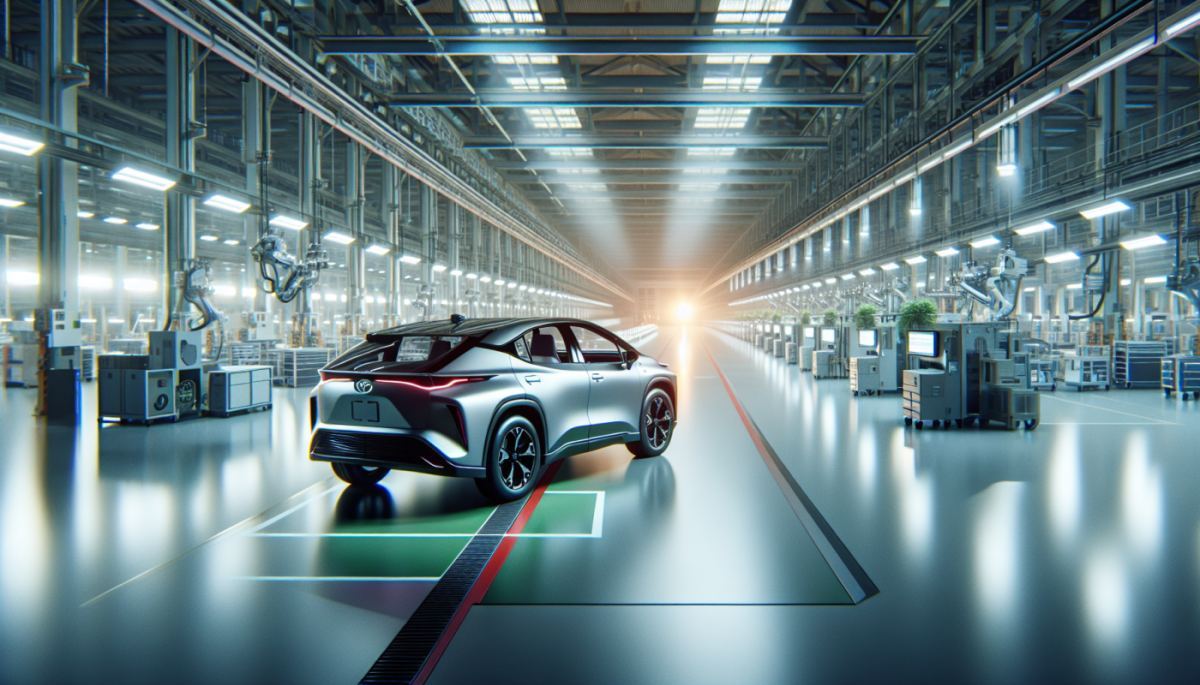
Toyota has never been the loudest voice in the electric vehicle room. While competitors spent the better part of a decade making sweeping promises about all-electric futures, the Japanese automaker hedged, doubled down on hybrids, and watched as several of those rivals quietly walked back their most ambitious EV timelines. Now, with an $800 million investment earmarked for a second electric vehicle to be built on American soil, Toyota is making a move that looks less like catching up and more like timing the market.
The investment adds to an already significant American manufacturing push. Toyota's plant in Georgetown, Kentucky, which has been producing vehicles since 1988 and remains one of the largest auto manufacturing facilities in the country, is the likely hub for this expansion. The company has previously committed billions to its North Carolina battery plant and has been steadily retooling its U.S. footprint to accommodate electrification. The $800 million figure represents a meaningful acceleration of that strategy, not a pivot away from it.

What makes this moment interesting is the competitive backdrop. Ford has scaled back EV spending. General Motors pushed out its electric truck timelines. Rivian is burning cash at a rate that makes investors nervous. Even Volkswagen, once the most vocal European challenger to Tesla's dominance, has been closing plants and renegotiating labor agreements under financial strain. Toyota, by contrast, enters this phase with its hybrid business still generating strong margins, giving it a financial cushion that pure-play EV manufacturers simply do not have.
This is where systems thinking becomes essential. Toyota's hybrid lineup, led by the RAV4 Hybrid and the Camry Hybrid, has not just survived the EV hype cycle. It has thrived during it. As charging infrastructure anxiety kept millions of American consumers from committing to fully electric vehicles, hybrids filled the gap. That sustained demand has effectively subsidized Toyota's slower, more deliberate EV buildout. The company is using combustion-adjacent profits to fund its electric future, a feedback loop that most of its competitors never had the patience or product mix to establish.
The second-order consequence here is significant. If Toyota successfully launches a second U.S.-built EV while maintaining hybrid volume, it will have demonstrated that the transition to electrification does not require abandoning profitability along the way. That proof of concept could reshape how other legacy automakers think about sequencing their own transitions, particularly those in Japan and South Korea who have been watching the American EV shakeout with understandable caution.
As for what the second vehicle actually is, Toyota has not confirmed specifics. Speculation within the industry centers on a larger SUV or a truck variant, given that American consumer appetite for sedans has been in structural decline for years. The bZ4X, Toyota's first mass-market EV in the U.S., is a compact crossover. A logical next step would be something that competes more directly with the Ford F-150 Lightning or the Chevrolet Silverado EV, both of which have faced their own production and demand challenges. A Toyota electric truck, built in Kentucky with union-adjacent labor optics, would carry considerable political and commercial weight.
There is also a regulatory dimension that cannot be ignored. The Inflation Reduction Act's EV tax credit structure heavily favors vehicles assembled in North America with batteries sourced from domestic or allied-nation supply chains. Toyota's investment in its North Carolina battery facility, combined with this new $800 million manufacturing commitment, positions the company to qualify its vehicles for those credits in ways that imported models cannot. In an era where trade policy is volatile and tariffs on foreign-made vehicles remain a live political issue, building locally is not just good optics. It is a structural hedge.
Toyota's approach has always been methodical to the point of frustrating analysts who wanted faster announcements and bolder timelines. But methodical has a way of looking prescient in retrospect. The company that invented the modern hybrid with the Prius in 1997 is now investing in its second American-made electric vehicle at precisely the moment when the EV market is separating durable players from overextended ones.
The real question going forward is not what the second vehicle will be. It is whether Toyota's patient capital strategy becomes the template that reshapes how the entire industry thinks about the pace of electrification, and whether the companies that moved fastest will end up having moved too soon.
References
- Wayland, M. (2024) — Toyota plans to invest $1.3 billion in Kentucky plant for new three-row electric SUV
- U.S. Department of Energy (2023) — Federal Tax Credits for New Clean Vehicles Purchased in 2023 or After
- Colias, M. (2024) — Ford Scales Back EV Spending as Losses Mount
- Toyota Motor Corporation (2024) — Toyota North America Newsroom
Discussion (0)
Be the first to comment.
Leave a comment