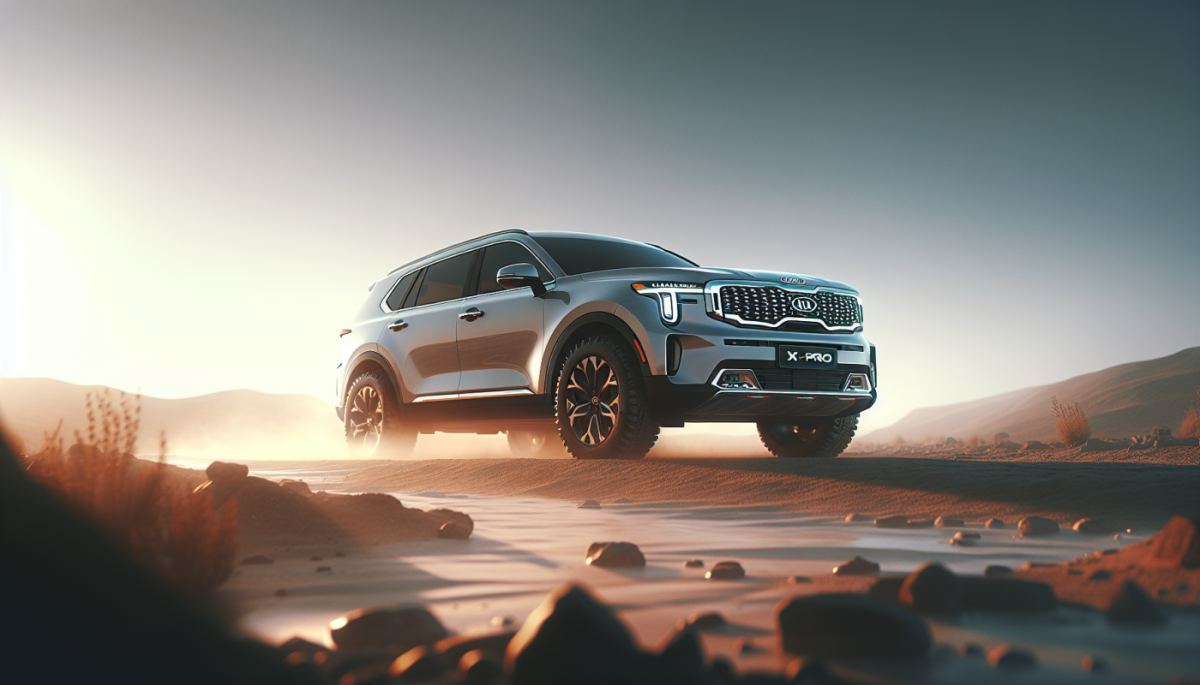
There is something quietly revealing about the way car manufacturers now compete. Kia has taken the Telluride, its best-selling three-row family hauler, and bolted on skid plates, all-terrain tires, and a suite of terrain-management modes to produce the 2027 X-Pro trim. The result is a vehicle engineered to ford creeks and claw up sandy inclines, destined mostly for school pickup lines and grocery runs. That gap between capability and use is not a design flaw. It is the entire point.
The Telluride X-Pro arrives with meaningful hardware upgrades over the standard model. The suspension has been tuned for greater ground clearance, the underbody is shielded for rock and debris encounters, and the all-terrain rubber gives the vehicle a planted, purposeful stance that communicates adventure even when parked outside a suburban Starbucks. On actual off-road terrain, the X-Pro performs with genuine competence. Water crossings that would give a standard crossover pause, loose sandy climbs that demand careful throttle management, and rutted fire roads that test body control all fall within its repertoire. The terrain modes cycle through settings that adjust throttle response, traction distribution, and stability intervention to match the surface underfoot. It works. The engineering is honest.
The more interesting question is why Kia built this version at all, given that the company and virtually every automotive journalist covering the segment will acknowledge openly that most buyers will never use these capabilities. The answer sits at the intersection of aspiration marketing and competitive pressure. Ford's Bronco Sport, the Toyota 4Runner, and Subaru's Outback Wilderness have collectively trained a generation of family-vehicle buyers to associate off-road credibility with trustworthiness, durability, and a certain self-image. You do not need to wheel your SUV through a riverbed to want a vehicle that could. The capability functions as a kind of psychological insurance policy.
Kia understands this dynamic acutely. The Telluride has been one of the most decorated family SUVs on the American market since its debut, winning praise for its interior quality, space, and value positioning against more expensive three-row competitors from Hyundai's own Genesis brand, Ford, and Chevrolet. Adding an X-Pro tier extends the model's reach upmarket while giving the brand a halo story to tell. The off-road credibility earned by the X-Pro reflects back onto the entire Telluride lineup, making even the base trim feel more rugged by association. It is a well-worn playbook, but Kia executes it with more restraint than most. The X-Pro does not feel like a costume. The hardware upgrades are substantive enough that the vehicle earns its badging on the trail.
What the Telluride X-Pro story points toward, though, is a broader shift in how family vehicles are being positioned and, by extension, how roads and outdoor spaces may be used in the coming decade. When manufacturers equip mass-market family SUVs with genuine off-road hardware and market them aggressively to buyers who have never driven on unpaved surfaces, they are not simply selling cars. They are cultivating a new category of occasional off-roader: the curious, capable, but largely untrained driver who now has the equipment to venture somewhere they previously would not have gone.
Land managers at national forests and Bureau of Land Management sites have already begun documenting increased pressure on dispersed camping areas and backcountry roads as capable crossovers and SUVs proliferate. The feedback loop here is worth taking seriously. More capable vehicles lower the perceived barrier to off-road access. More people venture onto trails. Trail degradation accelerates. Land managers respond with closures or permit requirements. The very access that the X-Pro's marketing celebrates becomes more restricted over time, a self-defeating cycle driven partly by the success of vehicles like this one.
None of that diminishes what Kia has built. The 2027 Telluride X-Pro is a genuinely impressive machine that delivers on its promises when tested against real terrain. But the more durable story here is not about approach angles or skid plate thickness. It is about what happens when aspiration and accessibility converge at scale, and whether the landscapes being marketed as destinations can absorb the attention that a well-engineered, well-priced family SUV is about to send their way.
Discussion (0)
Be the first to comment.
Leave a comment