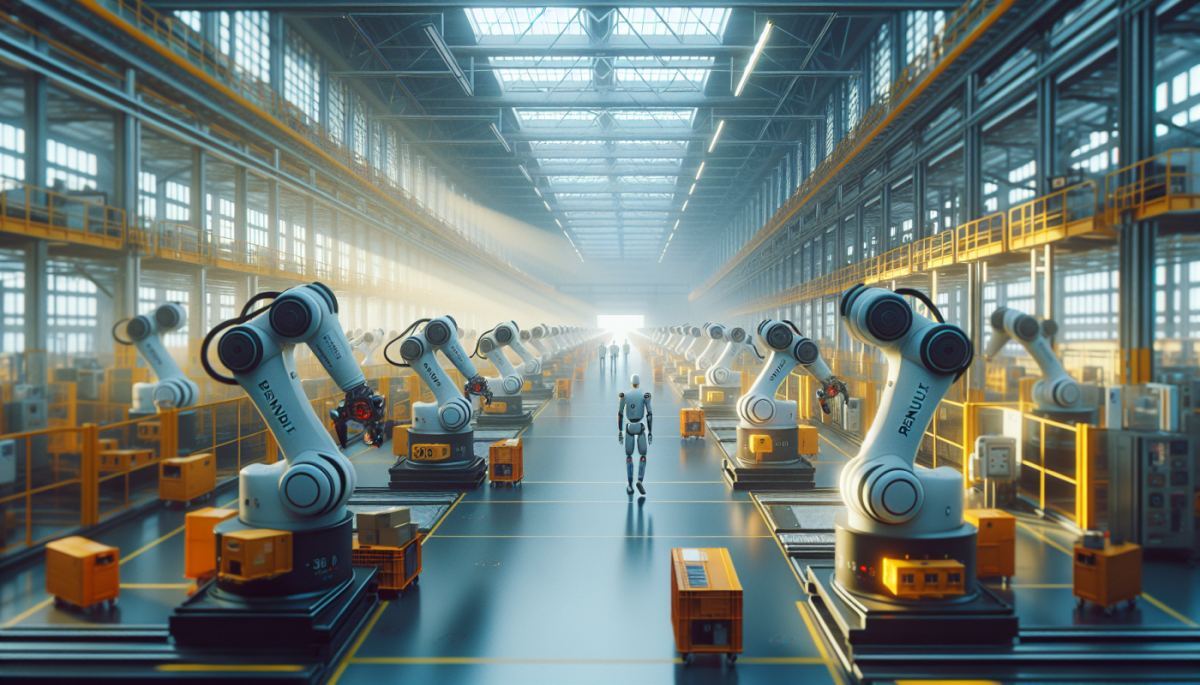
There is a particular kind of labor that industrial economies have never quite solved: repetitive, physically punishing, and just complex enough that traditional automation cannot handle it. Renault, the French automaker with a long history of betting on manufacturing innovation, appears to have found a candidate answer. At its Douai facility in northern France, the company is deploying 350 humanoid robots to handle the kind of backbreaking assembly work that has worn down human bodies for generations.
The Douai plant is not a peripheral operation. It is one of Renault's flagship electric vehicle production sites, a factory the company has invested heavily in as part of its pivot toward EVs under the Renaulution strategic plan. Placing humanoid robots at the center of that facility is not a publicity stunt. It is a signal about where the company believes the economics of manufacturing are heading.
What makes this deployment genuinely different from the robotics announcements that have cluttered the technology press for the past several years is the word "already." Tesla's Optimus robot, which has attracted enormous media attention and Elon Musk's characteristic hyperbole, remains largely a prototype performing carefully staged demonstrations. Renault's machines are on the floor, doing the work. That gap between demonstration and deployment is where most robotics ambitions go to die, and Renault appears to have crossed it.
To understand why this matters, it helps to understand what humanoid robots are actually being asked to do in an automotive factory. The tasks that have resisted conventional robotic automation are not the ones requiring brute force or precision welding. Those were solved decades ago. The stubborn remainder involves working in confined spaces, handling irregularly shaped components, and performing sequences of movements that require the kind of spatial adaptability that the human body evolved over millions of years to provide. A humanoid form factor, with two arms, a torso that can bend, and hands that can grip, is not an aesthetic choice. It is an engineering response to the shape of the problem.
For workers, those same tasks have represented a slow accumulation of physical damage. Musculoskeletal injuries are among the most common and costly in automotive manufacturing, and they tend to cluster precisely around the jobs that robots have historically been unable to take. There is a grim irony in the fact that the hardest work to automate has also been the hardest on human bodies. If humanoid robots genuinely absorb that category of labor, the health consequences for the workers who remain shift considerably, even as the employment consequences become more complicated.
Renault's move also arrives at a moment of particular pressure on European manufacturing. Energy costs remain elevated compared to pre-2022 levels, Chinese EV manufacturers are competing aggressively on price, and the transition to electric vehicles has disrupted the skills and supply chains that European automakers spent a century building. In that context, a technology that can reduce injury-related downtime, operate across shifts without fatigue, and potentially be redeployed as production needs change looks less like a futuristic experiment and more like a survival strategy.
The second-order consequence worth watching here is not the one most commentators reach for first. The obvious story is job displacement, and that concern is legitimate and deserves serious policy attention. But the less examined dynamic is what happens to the robotics industry itself when a major manufacturer moves from 10 or 20 pilot units to 350 deployed machines.
Scale changes everything in hardware. At 350 units, Renault becomes a reference customer, a source of real-world performance data, and a proof point that other manufacturers will study carefully. The companies supplying those robots gain the kind of operational feedback that no laboratory can replicate. Failure modes that only appear after thousands of hours of use get identified and corrected. Software improves. Unit costs begin their descent down the learning curve. The deployment at Douai, in other words, is not just a manufacturing decision. It is an accelerant for the entire humanoid robotics sector.
That acceleration has its own cascading logic. As costs fall and reliability improves, the threshold for deployment drops, and the range of industries that can justify the investment widens. Automotive is the entry point, but logistics, construction, and elder care have all been identified as sectors where humanoid robots could eventually operate at scale.
Renault may not have set out to define the trajectory of a technology. But by choosing deployment over demonstration, the company has done something that press releases and prototype videos cannot: it has introduced consequence. And consequence, in complex systems, has a way of compounding.
Discussion (0)
Be the first to comment.
Leave a comment