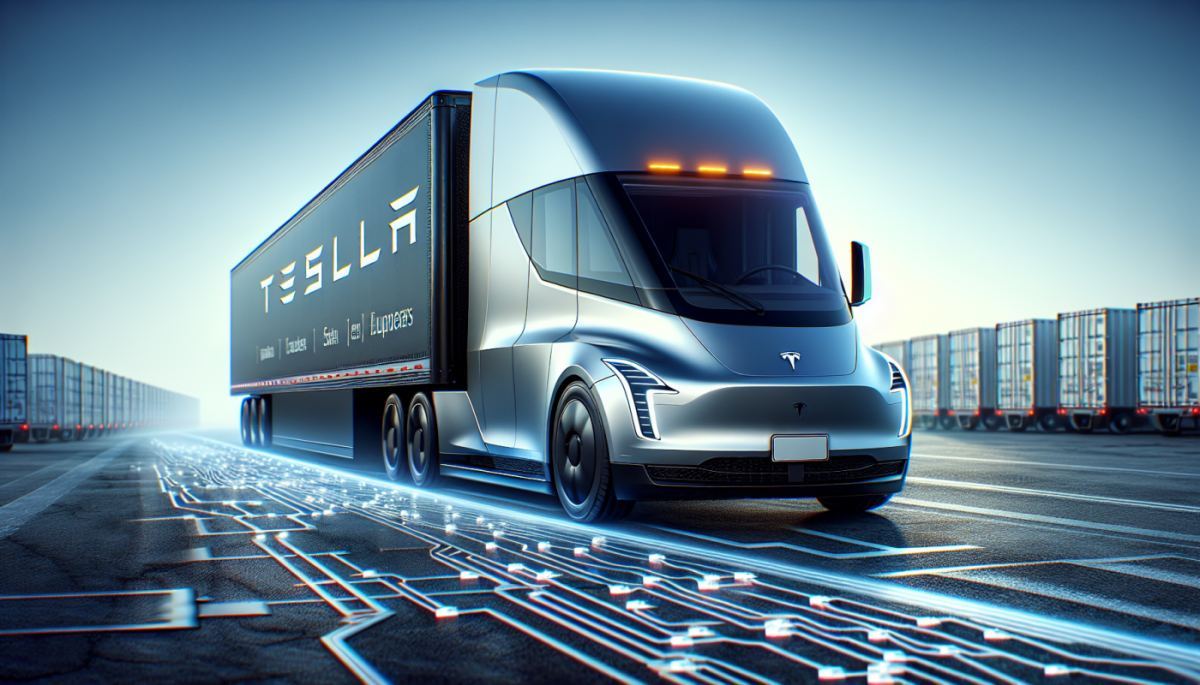
Jay Leno has spent decades around machines that push limits, so when he singles out a vehicle's financial logic over its headline specification, it's worth paying attention. The comedian and car enthusiast recently weighed in on the Tesla Semi, and his take cuts against the usual marketing narrative. Yes, the truck can travel 500 miles on a single charge. But Leno's argument is that the number on the battery spec sheet is almost beside the point. What will actually move fleets to adopt this truck, he contends, is the dramatically lower cost of keeping it running.
That framing matters more than it might initially seem. The trucking industry is not driven by enthusiasm or novelty. It is driven by margins that are notoriously thin, fuel budgets that can consume a third or more of operating costs, and fleet managers who answer to spreadsheets rather than press releases. Diesel prices have been volatile for years, swinging with geopolitical events and refinery capacity in ways that make long-term cost planning genuinely difficult. An electric drivetrain, by contrast, offers something diesel cannot: a more predictable and structurally lower energy cost per mile, combined with fewer moving parts and reduced maintenance overhead.
The Tesla Semi's operating cost advantage comes from several compounding factors. Electric motors have far fewer components than internal combustion engines, which means fewer scheduled maintenance intervals, fewer fluids to change, and less wear on braking systems thanks to regenerative braking. Tesla has claimed the Semi can achieve energy consumption as low as under two kilowatt-hours per mile when loaded, and at current commercial electricity rates in much of the United States, that translates to a per-mile energy cost that undercuts diesel significantly. For a long-haul operator running hundreds of thousands of miles per year across a fleet, those savings are not marginal. They are structural.
PepsiCo, one of the first large-scale adopters of the Tesla Semi, began operating a fleet of the trucks in late 2022 and has reported favorable early results on energy efficiency. The company's experience has been closely watched by logistics analysts precisely because it represents a real-world stress test rather than a controlled demonstration. When a company with Pepsi's operational scale and cost discipline commits to a technology, it signals something beyond brand enthusiasm.

Leno's instinct to focus on running costs rather than range also reflects a broader truth about how disruptive technologies actually achieve adoption. The first wave of interest in any new platform tends to cluster around performance metrics, the things that are easy to measure and compare. But sustained, systemic adoption happens when the economics become undeniable. This is how LED lighting displaced fluorescent, how natural gas displaced coal in power generation, and how smartphones eroded the market for dedicated cameras. The superior experience matters, but the cost curve is what closes the deal at scale.
If Leno's read is correct and the Semi's economic case proves durable across more fleets, the second-order consequences for the trucking ecosystem could be significant and somewhat underappreciated. Independent owner-operators, who make up a substantial portion of U.S. freight capacity, face a different calculus than large corporate fleets. They typically cannot absorb the higher upfront cost of an electric truck as easily, and access to charging infrastructure along non-hub routes remains uneven. If large fleets accelerate electrification while smaller operators remain on diesel, the cost gap between them could widen over time, potentially accelerating consolidation in an industry that is already trending that way.
There is also a feedback loop worth watching on the infrastructure side. More electric semi adoption creates demand for high-capacity charging corridors, which in turn makes the economics of electrification more viable for smaller operators, which drives further adoption. Tesla has been building out its own Semi charging network, called the Megacharger network, but the pace and geographic coverage of that buildout will shape how quickly the virtuous cycle can actually turn.
Leno is not an economist or a logistics analyst. But sometimes the clearest observations come from people who are simply paying attention without an institutional stake in the answer. His instinct that the Semi's staying power lies in its cost structure rather than its range spec points toward a dynamic that fleet operators are quietly running the numbers on right now. The question is not whether electric trucks can go far enough. It is whether the savings compound fast enough to reshape an industry that has run on diesel for a century.

Discussion (0)
Be the first to comment.
Leave a comment