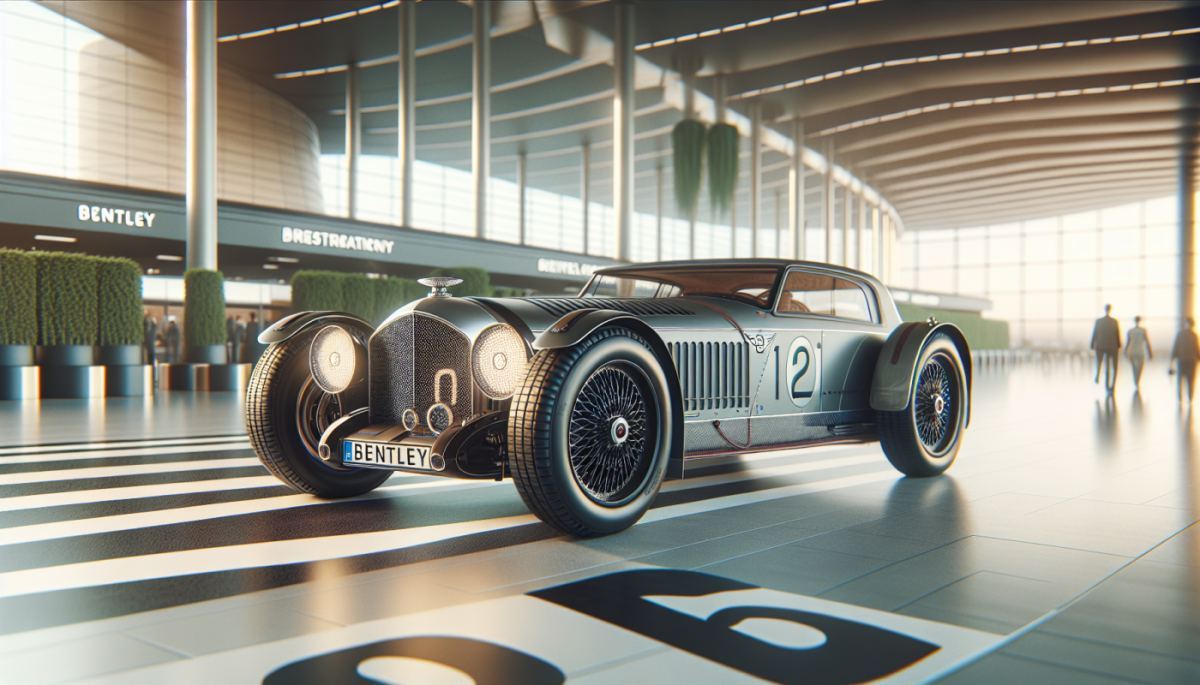
There is something quietly poetic about a brand preparing to abandon the internal combustion engine by reaching back a century for its identity. Bentley, the British luxury marque that has spent the better part of its 105-year history defining itself through the sound and fury of large-displacement engines, is reportedly set to reveal its first fully electric vehicle before the end of this year. And if the naming speculation holds, it will arrive wearing the name of Woolf Barnato, a man who raced Bentleys in the 1920s and helped save the company from financial collapse in the same decade.
Barnato was not merely a driver. He was a chairman, a financier, and one of the so-called Bentley Boys, the group of wealthy, daring men who turned the marque into a motorsport legend at Le Mans. He won the 24 Hours of Le Mans three times, in 1928, 1929, and 1930, each time as a driver rather than a passive investor. He also famously raced the Blue Train, a luxury express service running from Cannes to Calais, in 1930, beating it to London in his Bentley Speed Six. The story became myth. Naming an electric SUV after him would be, depending on your perspective, either a brilliant act of brand continuity or a rich irony, given that Barnato's legacy is inseparable from the roar of petrol engines.
Bentley's decision to lean into its heritage at this particular moment is not accidental. The luxury automotive segment is navigating one of its most disorienting transitions in living memory. Buyers at the top of the market have historically purchased not just vehicles but narratives, and the narrative of electrification has struggled to carry the same emotional weight as decades of hand-built, twin-turbocharged excess. Rolls-Royce launched its first EV, the Spectre, in 2023, and leaned heavily on craftsmanship language to smooth the transition. Bentley appears to be taking a different route, anchoring its electric future to a specific human story rather than an abstract promise of sustainability.
This is a meaningful strategic choice. Naming a car after a person, particularly one as vivid and historically grounded as Barnato, does something that a model number or a nature-themed moniker cannot. It creates a character. It implies continuity. It tells the buyer that whatever is under the bonnet, the spirit of the thing has not changed. Whether that argument holds up under scrutiny is another matter, but in the luxury segment, perception often outpaces engineering reality.
Bentley's parent company, Volkswagen Group, has faced considerable turbulence in recent years, with cost-cutting pressures and a broader reckoning over the pace of EV adoption across its portfolio. Bentley had previously outlined an ambition to go fully electric by 2030, a timeline that has since been softened as market conditions shifted. The reveal of this SUV before year's end represents a significant moment not just for the brand but for VW Group's ability to demonstrate that its premium marques can execute on electrification without sacrificing the identity that justifies their price points.
The deeper consequence here is less about one car and more about what it signals for how legacy luxury brands manage cultural memory during technological rupture. If Bentley's Barnato-named EV is received warmly, it will validate a playbook that other heritage marques are watching closely. Aston Martin, Ferrari, and Lamborghini are all navigating versions of the same dilemma, each trying to determine how much of their identity is tied to combustion and how much can survive the transition intact.
There is also a subtler feedback loop at work. By invoking Barnato, Bentley is implicitly making a claim about what its brand actually is. Not an engine configuration. Not a specific technology. But a disposition toward performance, daring, and a certain theatrical relationship with speed. If that argument lands, it gives the company enormous flexibility going forward. If it does not, if buyers feel the name is being used to paper over a fundamental identity crisis, the backlash could be sharper precisely because the emotional stakes were raised so explicitly.
Woolf Barnato once raced a train across France on a bet. The question now is whether his name can win a different kind of race, one measured not in miles per hour but in the slower, harder contest for cultural legitimacy in an industry rewriting its own rules in real time.
Discussion (0)
Be the first to comment.
Leave a comment