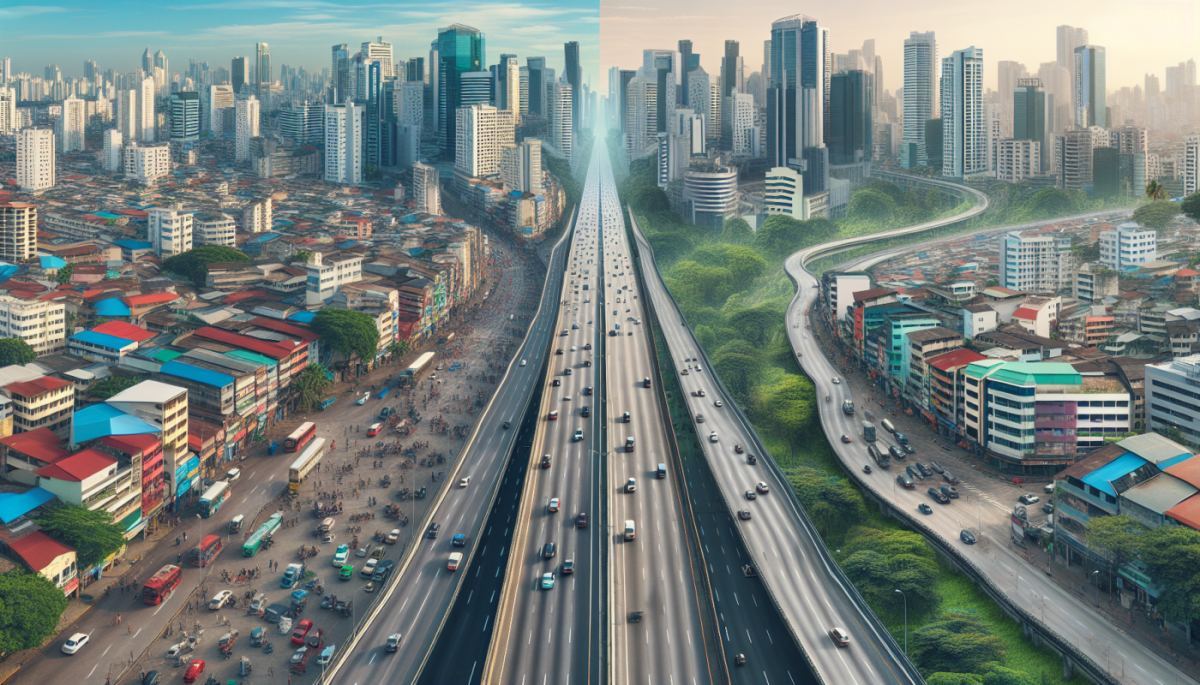
For decades, the highway was the great promise of the modern city: a ribbon of concrete that would compress distance, accelerate commerce, and bind metropolitan regions together. Engineers celebrated them. Politicians cut ribbons over them. And yet a growing body of evidence suggests that within the neighborhoods they slice through, highways are doing something quietly devastating to the social lives of the people who live beside them.
A new study published in the Proceedings of the National Academy of Sciences adds significant weight to this argument. Researchers found that urban highways substantially reduce social connections between nearby residents, with the effect most pronounced at distances under five kilometers. That is not a trivial radius. Five kilometers is the range within which most people form their closest friendships, find their community anchors, and build the informal networks that determine everything from job opportunities to mental health outcomes. It is, in other words, the geography of everyday life.
What makes this finding particularly striking is that it inverts the highway's founding logic. These roads were built to connect. They were sold to cities as instruments of integration, pulling suburbs into the orbit of downtowns and linking neighborhoods to employment centers. But the study suggests that at the human scale, the effect runs in precisely the opposite direction. A highway does not just carry traffic. It carries noise, pollution, and danger. It creates what urban planners call a "barrier effect," a psychological and physical wall that discourages pedestrians from crossing, fragments walking routes, and signals to residents on either side that the space between them is hostile territory.
The barrier effect is not a new concept in urban theory. Jane Jacobs wrote about the deadening influence of arterial roads on street life as far back as 1961 in The Death and Life of Great American Cities. What this PNAS research contributes is a more granular, data-driven confirmation of something that community advocates and displaced residents have long understood intuitively: that the highway does not merely pass through a neighborhood. It reorganizes it, often along lines that reflect and reinforce existing inequalities.
In the United States and across much of the Global North, urban highway construction in the mid-twentieth century was disproportionately routed through low-income communities and communities of color. The social costs were immediate and visible: homes demolished, churches razed, street grids severed. But the longer-term costs, the erosion of social capital, the weakening of the informal ties that help people weather economic shocks and personal crises, have been harder to quantify. Studies like this one begin to put numbers on a wound that many communities have been describing for generations.
The mechanism is worth dwelling on. Social connection at the neighborhood scale depends on what sociologists call "weak ties," the acquaintances you make at the corner store, the parents you meet at the school gate, the neighbors whose names you learn over years of proximity. These relationships are not formed across six lanes of fast-moving traffic. They require walkable streets, shared public space, and the kind of low-stakes, repeated encounters that highways systematically eliminate. When a highway bisects a neighborhood, it does not just cut the road network. It cuts the social one.
The timing of this research matters. Cities across the world are currently debating what to do with aging urban highway infrastructure. In the United States alone, the Biden-era infrastructure law allocated billions toward highway removal projects, with cities like Rochester, New York and New Orleans actively planning to tear down elevated freeways that have divided their downtowns for half a century. Similar conversations are happening in Seoul, which removed an elevated highway to restore the Cheonggyecheon stream, and in cities across Spain and France where urban motorways are being converted into boulevards.
The PNAS findings give these projects a social science foundation that goes beyond aesthetics or air quality. If highways measurably reduce the density of human relationships within a five-kilometer radius, then removing them is not merely an urban design choice. It is a public health intervention, one with potential consequences for loneliness, civic participation, and community resilience.
The second-order effects of that realization could be significant. If policymakers begin treating social connectivity as a measurable infrastructure outcome, the cost-benefit calculus for future road projects changes considerably. A highway that saves commuters twenty minutes but severs thousands of social ties may not, on balance, be the efficient investment it appears. The question cities will increasingly face is not just how fast people can move through them, but whether the infrastructure designed to enable movement is quietly making it harder for people to stay.



Discussion (0)
Be the first to comment.
Leave a comment