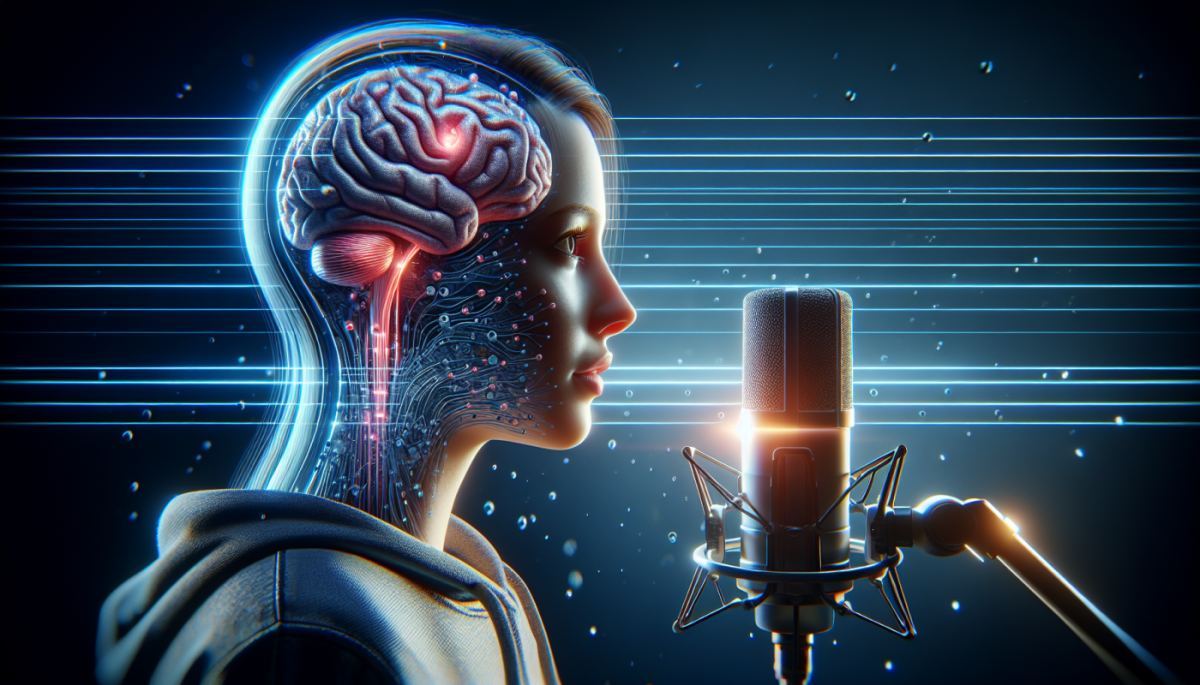
For decades, the experience of hearing voices in schizophrenia was treated as one of psychiatry's most baffling mysteries, something to be managed rather than mechanically understood. New research is beginning to change that. Scientists now believe that auditory hallucinations may stem from a specific failure in the brain's predictive machinery, a system that normally allows us to recognize our own inner speech as our own, and that in some people, appears to misfire in a way that makes private thoughts feel like external intrusions.
The core of the finding is elegant in its logic. When a healthy brain generates inner speech, the kind of silent verbal thinking most people experience constantly, it simultaneously produces a kind of neural forecast. The brain essentially predicts the sensory consequences of its own activity and uses that prediction to suppress its response to the expected signal. It's the same mechanism that explains why you can't tickle yourself: your brain anticipates the sensation and dampens it before it registers as surprising. In people who experience auditory hallucinations, that suppression doesn't happen. Instead of quieting down in response to inner speech, brain activity ramps up, treating the internally generated voice as if it were coming from somewhere, or someone, outside the self.
The implications of this are not merely academic. If hallucinations are the product of a broken prediction signal rather than some diffuse and untraceable dysfunction, then they become, at least in principle, something that could be detected before they fully emerge. Researchers believe this discovery could help identify early warning signs for psychosis, potentially catching the condition at a stage when intervention is far more effective than it tends to be once full psychosis has set in.
The predictive processing framework that underlies this research has been gaining traction in neuroscience for years. The basic idea, associated with theorists like Karl Friston at University College London, is that the brain is not a passive receiver of sensory information but an active prediction machine, constantly generating models of what it expects to perceive and updating those models when reality doesn't match. Most of the time, this system runs silently and efficiently in the background. When it breaks down, the consequences can be profound.
In the context of schizophrenia, the theory suggests that the brain's internal model of "self-generated" versus "externally generated" signals becomes unreliable. The voice a person hears is, in a neurological sense, real, in that it is genuinely produced by their own neural activity. What's missing is the tag that would normally mark it as self-produced. The result is an experience that feels indistinguishable from hearing another person speak, which is precisely what makes it so disorienting and, for many people, so frightening.
This framing also helps explain why auditory hallucinations are so resistant to simple reassurance. Telling someone that the voice they hear isn't real runs directly against what their sensory system is reporting. The brain isn't malfunctioning in a way that produces noise or distortion. It's functioning according to its own internal logic, just with a corrupted input about the origin of the signal.
Perhaps the most consequential second-order effect of this research is what it could mean for early intervention in psychosis. Schizophrenia typically emerges in late adolescence or early adulthood, and the period between the first subtle symptoms and a formal diagnosis can stretch for years. During that window, sometimes called the prodromal phase, the brain may already be showing measurable signs of the predictive misfiring that eventually produces full hallucinations. If researchers can develop reliable biomarkers based on how the brain responds to its own inner speech, clinicians could potentially screen for psychosis risk in a way that is far more precise than current behavioral assessments allow.
That possibility is still some distance from clinical reality. Translating a laboratory finding about neural suppression into a practical diagnostic tool requires validation across large and diverse populations, and the history of psychiatry is littered with promising biomarkers that didn't survive contact with the complexity of real patients. But the direction of travel is meaningful. Understanding hallucinations as a systems failure, a breakdown in the feedback loop between prediction and perception, rather than as a symptom without a mechanism, opens up new targets for both pharmacological and non-pharmacological treatment.
The brain, it turns out, may not be haunted by foreign voices so much as confused by its own. That distinction, subtle as it sounds, could reshape how medicine approaches one of its oldest and most misunderstood conditions.
References
- Friston et al. (2016) — Active inference and auditory hallucinations
- Powers et al. (2017) — Pavlovian conditioning-induced hallucinations result from overweighting of perceptual priors
- Shergill et al. (2014) — Functional magnetic resonance imaging of inner speech in schizophrenia
- Corlett et al. (2019) — Hallucinations and Strong Priors



Discussion (0)
Be the first to comment.
Leave a comment