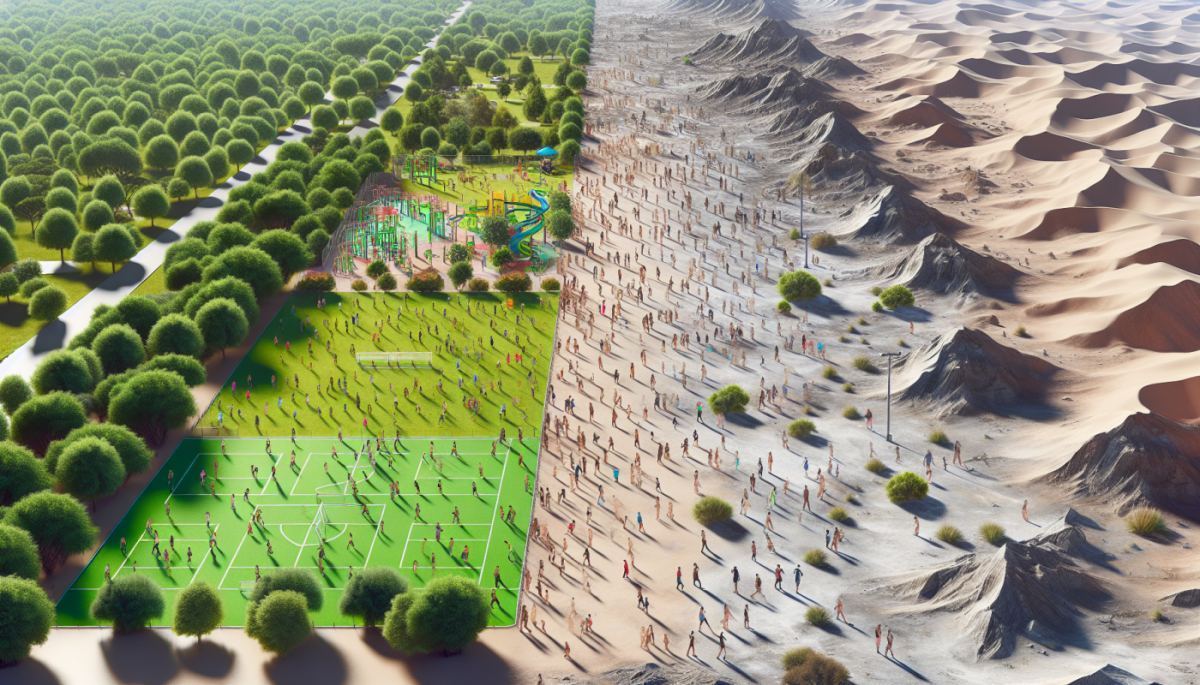
The conversation about physical inactivity in America has long been framed as a personal failing. People are told to move more, sit less, take the stairs. What that framing consistently ignores is the environment those people are actually living inside. Where you are born, where you can afford to live, and how your neighborhood was designed decades before you arrived all shape your relationship with movement in ways that no amount of individual motivation can fully override.
The United States has quietly sorted itself into what researchers increasingly call fitness deserts and opportunity deserts, places where the infrastructure for an active life simply does not exist. No sidewalks connecting homes to schools. No parks within walking distance. No bike lanes. Grocery stores reachable only by car. These are not random oversights. They are the accumulated result of zoning decisions, highway construction priorities, suburban development models, and decades of car-centric planning that treated walkability as a luxury rather than a public health necessity.
The consequences show up in the data with uncomfortable clarity. Communities with low walkability scores tend to have higher rates of obesity, cardiovascular disease, and type 2 diabetes. Life expectancy in the United States already varies by more than 20 years depending on county, and access to safe, convenient physical activity is one of the variables threading through that gap. The built environment is not the only factor, but it is one of the most stubborn because it is expensive and slow to change.
Public health researchers have spent years documenting what they call the passive activity effect, the idea that people in walkable, bikeable, transit-connected neighborhoods accumulate meaningful physical movement simply by going about their daily lives. They walk to the train. They cycle to the market. They take routes that require their bodies to do something. This is not exercise in the deliberate, gym-membership sense. It is movement baked into the architecture of ordinary existence.
In contrast, residents of car-dependent suburbs and rural areas with no pedestrian infrastructure face a structural disadvantage that is easy to underestimate. Getting active requires a separate, intentional act, driving to a gym, finding time for a dedicated workout, carving out a slot in a schedule already stretched by long commutes. For working parents, shift workers, or anyone managing multiple jobs, that intentional act is often the first thing to disappear under pressure. The environment is not neutral. It is either working for your health or quietly working against it.
This is where the systems thinking becomes important. Low-income communities are disproportionately located in areas with poor walkability, fewer parks, and less recreational infrastructure. Those same communities also tend to have higher rates of the chronic diseases that physical inactivity accelerates. The health burden then feeds back into economic productivity, healthcare costs, and the tax base available to fund the very infrastructure improvements that could interrupt the cycle. It is a feedback loop with no obvious exit point unless intervention comes from outside the system.
Some cities have begun taking this seriously. Urban planners and public health officials have started collaborating on what is sometimes called health-in-all-policies thinking, embedding walkability, green space access, and active transportation into decisions that were previously made purely on traffic flow or development economics. The 15-minute city concept, which holds that residents should be able to reach essential services on foot or by bike within a quarter hour, has gained traction in urban planning circles in Europe and, more tentatively, in parts of North America.
But retrofitting car-dependent sprawl is genuinely hard. It requires political will, sustained funding, and a willingness to challenge the property and development interests that benefit from the current arrangement. It also requires acknowledging something that American public discourse resists: that health outcomes are not simply the product of individual choices but of the systems those individuals are embedded in.
The deeper second-order consequence here is generational. Children who grow up in active-friendly environments develop movement habits, spatial confidence, and physical baselines that carry forward into adulthood. Children who grow up in fitness deserts often do not. The health gap being measured in adults today was partly written into the neighborhoods built for their parents. The neighborhoods being built or neglected right now are already writing the health story of the next generation, whether anyone is paying attention or not.



Discussion (0)
Be the first to comment.
Leave a comment