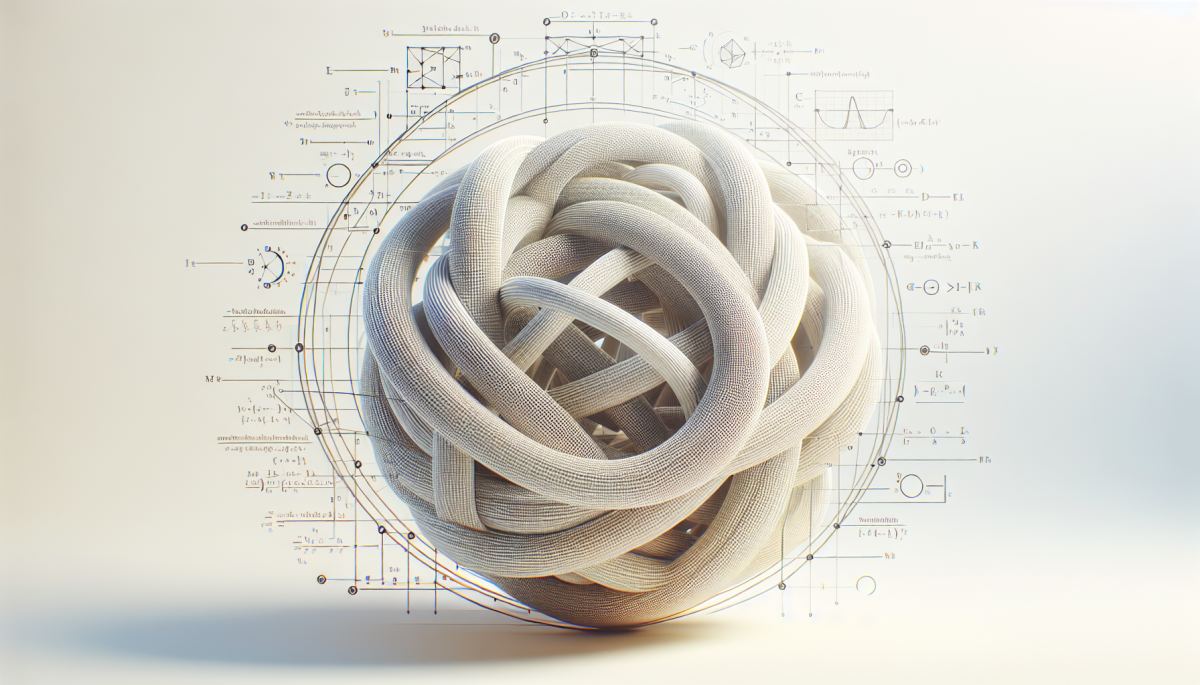
Knots have frustrated mathematicians for well over a century, not because they are hard to tie, but because they are extraordinarily hard to tell apart. Two knots that look completely different on paper can, after enough twisting and pulling, turn out to be identical. And two that appear nearly the same can be fundamentally, irreducibly distinct. The central challenge of knot theory has always been finding reliable ways to distinguish one knot from another, and for most of that history, the tools available have been frustratingly incomplete.
That may be changing. Researchers have recently developed what some are calling a "QR code" for knots: a newly discovered mathematical invariant that encodes the structure of a knot in a far richer and more precise way than previous methods allowed. The analogy is apt. Just as a QR code packs a dense grid of information into a small square that can be read unambiguously, this new invariant compresses the essential identity of a knot into a form that mathematicians can compare, analyze, and potentially decode in ways that older invariants could not support.
To understand why this matters, it helps to appreciate just how slippery knot classification has been. A mathematical knot is essentially a closed loop in three-dimensional space, a circle that has been tangled up before its ends are joined. The question mathematicians care about is whether two such loops are "equivalent," meaning one can be continuously deformed into the other without cutting. This sounds simple, but the number of possible knots grows explosively with complexity, and for decades the field has lacked invariants powerful enough to cleanly separate them all.

The tools that existed before were useful but limited. The Alexander polynomial, developed in the 1920s, was a landmark achievement, but it famously cannot distinguish a knot from its mirror image in all cases. The Jones polynomial, discovered in 1984 by Vaughan Jones, was a major leap forward and earned Jones a Fields Medal, yet it too has blind spots. Entire families of distinct knots can share the same Jones polynomial, meaning the invariant sees them as identical even when they are not. The search for a "complete" invariant, one that assigns a different value to every topologically distinct knot, has been one of the deepest open problems in low-dimensional topology.
The new invariant appears to capture structural information that its predecessors missed, essentially reading the knot at a finer resolution. Researchers are cautious about claiming completeness, but early results suggest it can distinguish knots that previously looked the same to every known tool. That is a significant threshold to cross.
The implications reach well beyond pure mathematics. Knot theory has deep and sometimes surprising connections to physics, particularly to quantum field theory and the study of DNA. In molecular biology, enzymes called topoisomerases physically manipulate the topology of DNA strands, and understanding how those knots form and resolve is directly relevant to how cells replicate and how certain cancer drugs work by jamming those enzymes. A more powerful classification system for knots could sharpen the mathematical language biologists use to describe those processes.
In physics, knot invariants are intimately connected to topological quantum field theories, a framework that has become increasingly important in the design of topological quantum computers. These systems store information in the braided paths of exotic particles called anyons, and the stability of that information depends on topological properties that are, at their core, knot-theoretic. Better invariants mean better mathematical descriptions of those systems, which could inform how researchers engineer them.
There is also a second-order effect worth watching carefully. Mathematical invariants do not just describe objects; they shape which questions researchers think to ask. When a new invariant arrives that is genuinely more powerful than its predecessors, it tends to reorganize the entire field around itself. Researchers begin testing it against unsolved problems, using it to probe conjectures that were previously inaccessible, and discovering new structure that the old tools had hidden. The Jones polynomial did exactly that in the 1980s, sparking a decade of unexpected connections between topology, physics, and representation theory. If this new invariant is as powerful as early results suggest, a similar reorganization may already be underway.
The history of mathematics is full of moments where a better measuring tool did not just answer old questions but revealed that the old questions had been slightly wrong all along. This may be one of those moments.


Discussion (0)
Be the first to comment.
Leave a comment