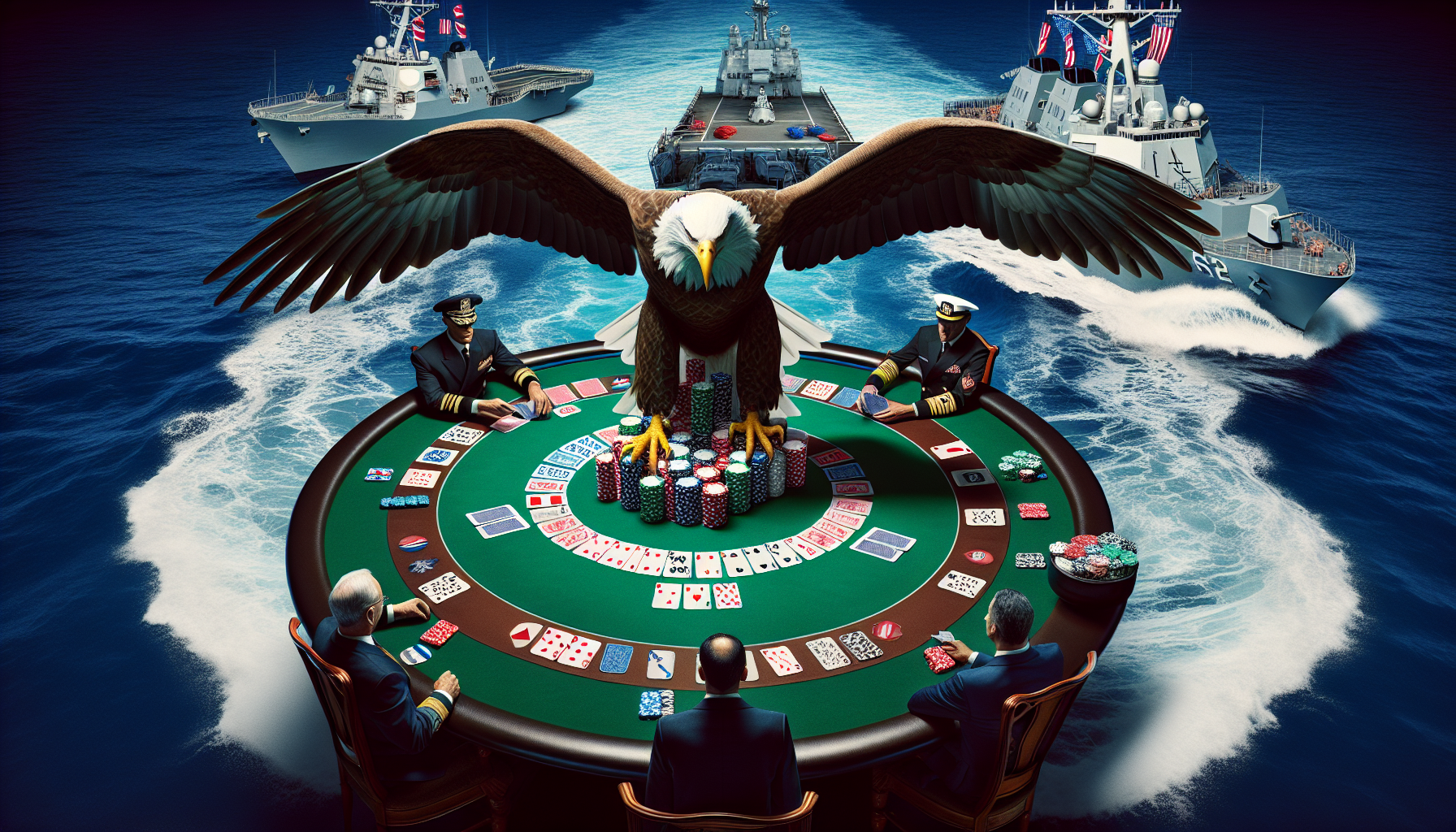
Donald Trump wants gratitude. Standing before cameras after authorizing strikes against Houthi targets in Yemen, the president declared that China, Japan, and South Korea should be "thanking" the United States for protecting the shipping lanes their economies depend on. It was a revealing moment, not just for its bluntness, but for what it exposed about the increasingly transactional logic now governing American foreign policy and the fragile architecture of global maritime security.
The Bab el-Mandeb strait, the narrow chokepoint connecting the Red Sea to the Gulf of Aden, carries an estimated 12 to 15 percent of global trade. For export-dependent economies like South Korea and Japan, that corridor is not a geopolitical abstraction. It is the physical pathway through which energy imports arrive and manufactured goods depart. China, despite its complicated relationship with the Houthi-aligned axis, routes enormous volumes of cargo through those same waters. Trump's point, stripped of its performative edge, contains a real structural truth: the United States has long subsidized a global commons that benefits everyone while bearing a disproportionate share of the military cost.
But the framing of gratitude misses the more consequential question, which is whether that arrangement is still sustainable, and what happens to the system when the guarantor starts demanding payment.
Trump claimed that "numerous" nations had pledged to help protect vessels in the region, though the specifics remained vague. The United Kingdom and Germany, two of Washington's closest NATO partners, pointedly refused to be drawn into a broader conflict, a posture that reflects both domestic political caution and a deeper European wariness about being pulled into open-ended military commitments in the Middle East. That reluctance is understandable. It is also strategically significant.
When the original Operation Prosperity Guardian was assembled in late 2023 under the Biden administration to counter Houthi drone and missile attacks on commercial shipping, the coalition looked impressive on paper but proved thin in practice. Several countries quietly asked to have their names removed from the participant list. Others contributed surveillance assets rather than firepower. The gap between rhetorical solidarity and operational commitment has been a persistent feature of multilateral maritime security efforts, and there is little reason to believe the current moment is different.
This matters because the Houthis have demonstrated a remarkable ability to absorb strikes and continue operations. Previous rounds of American and British bombardment degraded their capabilities temporarily but did not fundamentally alter their strategic calculus. If the goal is to restore freedom of navigation, the military instrument alone has a poor track record of achieving it.
The deeper systems-level consequence here is one that rarely surfaces in the immediate coverage. When the United States signals, even implicitly, that it expects compensation or political concessions in exchange for providing maritime security, it introduces a new variable into the calculations of every nation that depends on open sea lanes. Japan and South Korea, both treaty allies with significant American military presences on their soil, now face a subtle but real pressure to demonstrate their value to Washington in ways that go beyond existing alliance commitments. That pressure does not disappear when the news cycle moves on.
For China, the dynamic is more complex and potentially more destabilizing. Beijing has its own interests in Red Sea stability and has engaged diplomatically with Houthi leadership, though with limited results. If Washington frames its military operations as a service for which China owes thanks, it simultaneously makes it harder for Beijing to cooperate quietly and easier for Chinese officials to frame American actions as self-interested rather than stabilizing. The rhetorical move that feels satisfying domestically can corrode the informal understandings that make crisis management possible.
There is also a shipping industry dimension worth watching. Major carriers including Maersk and Hapag-Lloyd have been rerouting vessels around the Cape of Good Hope since late 2023, adding roughly ten days and significant fuel costs to Asia-Europe voyages. Some have begun cautiously testing Red Sea routes again. If the current strikes trigger an escalatory response from the Houthis rather than deterrence, those companies face another round of costly rerouting decisions, and the inflationary pressure on goods prices that had been easing could return.
The question Trump's framing leaves unanswered is the one that will define the next decade of maritime security: if America is no longer willing to be the world's free security provider, what institution, coalition, or arrangement takes its place? The answer, so far, is silence.



Discussion (0)
Be the first to comment.
Leave a comment