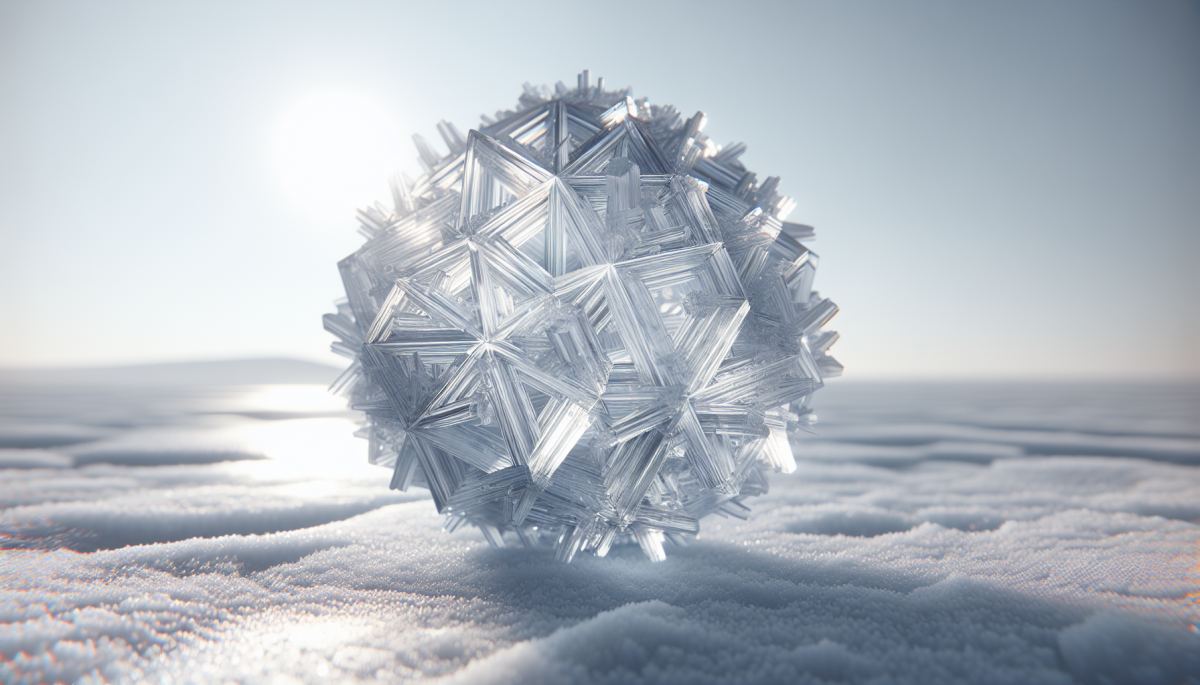
Water is the most studied molecule in science, and yet it keeps surprising us. Researchers have now identified what appear to be the most structurally complex forms of ice ever characterized, adding new entries to a catalog that has grown steadily stranger over the decades. According to computational simulations, the full inventory of possible ice structures may be far larger than anyone previously assumed, with dozens or potentially hundreds of exotic arrangements still waiting to be found.
Most people know ice as the hexagonal crystalline solid that forms in a freezer or falls from the sky. That is ice Ih, the familiar phase. But water molecules, with their lopsided charge distribution and capacity for hydrogen bonding, can arrange themselves in a remarkable variety of ways depending on pressure, temperature, and the conditions under which freezing occurs. Scientists have now confirmed at least 20 distinct crystalline phases of ice, each with its own geometry, density, and physical properties. The newly discovered forms push that structural complexity to new extremes, featuring unit cells containing hundreds of water molecules locked into intricate, almost architectural configurations.
What makes this more than a curiosity is the method driving discovery. Rather than stumbling onto new phases in the lab, physicists are increasingly using machine-learning-assisted simulations to map the energy landscape of water across a vast range of conditions. These models can predict stable and metastable structures that no experiment has yet produced, essentially generating a theoretical atlas of ice that experimentalists can then try to navigate toward. The simulations suggest that the known phases represent only a fraction of what is thermodynamically possible.
The diversity of ice is not merely academic. Many of the exotic high-pressure phases are directly relevant to planetary science. The interiors of ice giant planets like Uranus and Neptune are thought to contain water under pressures millions of times greater than Earth's atmosphere, where phases like ice VII, ice X, and superionic ice, in which oxygen atoms form a rigid lattice while hydrogen ions flow freely like a liquid, may dominate. Understanding which phases exist and how they behave under those conditions shapes models of planetary heat flow, magnetic field generation, and even the potential habitability of ocean worlds like Europa and Enceladus.
Closer to home, the structural complexity of ice has implications for atmospheric chemistry, cryopreservation biology, and the behavior of water in geological formations. Ice at grain boundaries, interfaces, and nanoscale confinements often behaves differently from bulk ice, and identifying the full range of possible structures helps researchers understand phenomena like frost heave, glacial dynamics, and the way antifreeze proteins work in cold-adapted organisms.
The feedback loop here is worth noting. As machine learning tools become more capable of exploring configurational space, they generate candidate structures faster than laboratory techniques can verify them. This creates a growing gap between theoretical prediction and experimental confirmation, one that requires new synthesis methods, better high-pressure apparatus, and more sensitive diffraction techniques to close. The discovery of complex ice phases is therefore also a story about the changing relationship between computation and experiment in materials science, a shift that is accelerating across chemistry and physics more broadly.
There is a second-order consequence here that deserves attention. As the catalog of ice phases expands, so does the implicit realization that other simple molecules, substances long considered well understood, may harbor similar hidden complexity. Water is uniquely well studied, which means its surprises are especially visible. But the same simulation techniques applied to ammonia, methane, or carbon dioxide under extreme conditions may reveal analogous forests of undiscovered phases. The tools built to map ice are, in effect, tools for reopening settled questions across the physical sciences.
The history of ice research is a useful corrective to the assumption that familiarity implies completeness. Ice II was identified in 1900. Ice XV was confirmed only in 2009. Each new phase has required scientists to revise their understanding of how hydrogen bonds organize under stress, and each revision has rippled outward into adjacent fields. The newest, most complex forms continue that tradition, suggesting that the phase diagram of water, one of the oldest objects of scientific inquiry, is still very much a work in progress.
If the simulations are right, the most complex ice ever found today will eventually look simple by comparison.
References
- Millot et al. (2019) — Nanosecond X-ray diffraction of shock-compressed superionic water ice
- Salzmann et al. (2021) — Advances in the experimental exploration of water's phase diagram
- Quanta Magazine (2023) — Physicists Discover the Most Complex Forms of Ice Yet
- Prakapenka et al. (2021) — Structure and properties of two superionic ice phases



Discussion (0)
Be the first to comment.
Leave a comment