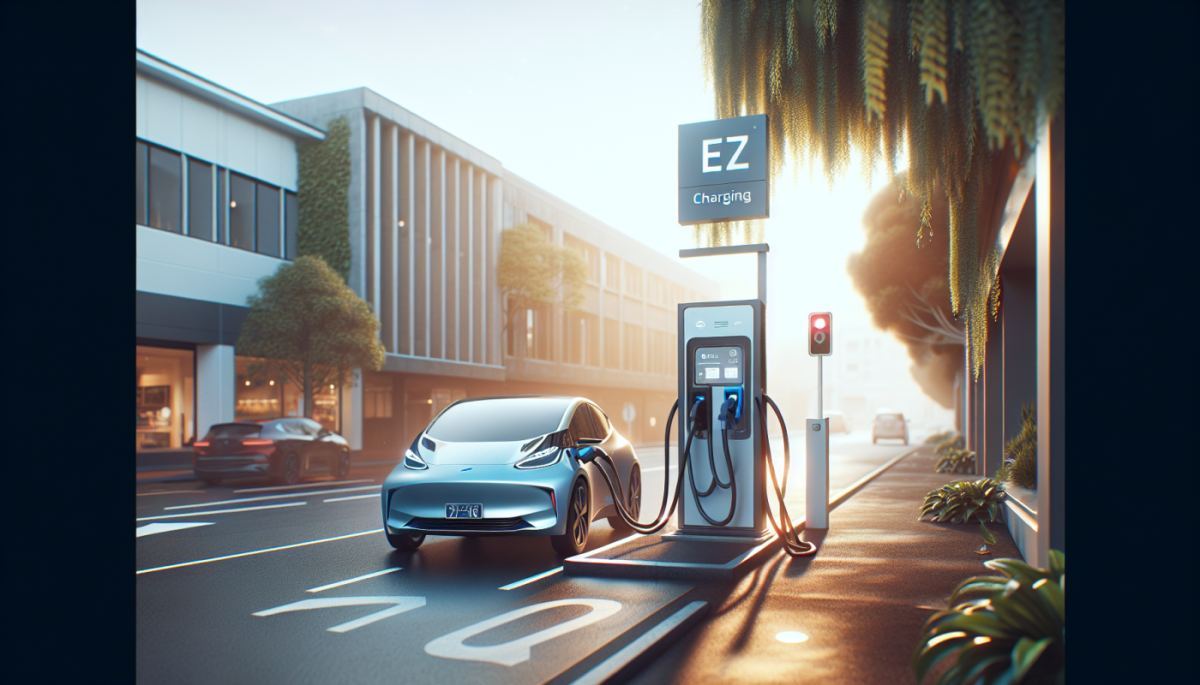
New Zealand's government has struck a co-funding agreement with private companies aimed at doubling the country's electric vehicle charging network, a move that signals a deliberate attempt to break one of the most stubborn feedback loops in transport policy: people won't buy EVs without chargers, and investors won't build chargers without EV drivers.
The deal arrives against the backdrop of what officials have described as a fuel crisis, a moment that tends to concentrate minds in ways that years of climate policy often cannot. When petrol prices spike, the calculus for ordinary drivers shifts, and governments that have been quietly nudging people toward electrification suddenly find a receptive audience. New Zealand's timing here is not accidental.
The charging infrastructure gap has long been the central anxiety of EV adoption, and for good reason. Range anxiety, the fear of being stranded without a charge, is not entirely irrational in a country like New Zealand, where long stretches of highway connect cities and towns across both the North and South Islands. Doubling the number of chargers does not just add convenience; it changes the psychological risk profile of owning an electric vehicle. That shift in perception can be more powerful than any subsidy.

What makes the co-funding model particularly interesting is the structural logic behind it. By pairing public money with private investment, the government is essentially de-risking early infrastructure deployment for commercial operators who might otherwise wait for the market to mature before committing capital. This is a classic case of using public funds to move a market past a tipping point rather than to replace the market altogether. The private sector brings operational efficiency and ongoing maintenance incentives; the public sector absorbs enough of the upfront uncertainty to make the numbers work.
New Zealand has been building toward this moment for several years. The country introduced a clean car discount scheme and has been steadily expanding its EV fleet, though uptake has remained uneven across income groups and regions. Rural communities, in particular, have lagged behind urban centers where charging options are more plentiful and second vehicles make range anxiety less acute.
The second-order consequences of rapidly expanding charging infrastructure extend well beyond the transport sector. A denser charging network changes the economics of fleet electrification for businesses, logistics operators, and local councils, entities that have often cited infrastructure gaps as the reason for delaying transitions. Once those fleets begin to shift, demand for grid capacity grows, which in turn creates pressure on electricity generators and network operators to invest in resilience and renewable generation. The EV transition, in other words, is not a single policy lever but a cascade of interdependent decisions across energy, urban planning, and industrial procurement.
There is also a distributional question that tends to get lost in the enthusiasm around charging rollouts. If new chargers are concentrated in urban centers and along major tourist routes, the benefits will flow disproportionately to wealthier, urban EV owners. A genuinely systemic approach would require the co-funding agreement to include geographic equity provisions, ensuring that regional and rural communities are not left waiting for a second wave of investment that may never arrive on commercial terms alone.
Fuel price shocks have historically produced short bursts of interest in alternatives followed by a return to old habits once prices stabilize. The risk for New Zealand's government is that it is building infrastructure for a demand surge that may prove temporary if global oil markets ease. The more durable strategy is to use this window not just to install chargers but to lock in behavioral change through complementary policies: workplace charging incentives, updated building codes requiring EV-ready parking, and financing schemes that bring EVs within reach of lower-income households.
What New Zealand is attempting is less a simple infrastructure project and more a deliberate rewiring of the conditions under which millions of individual transport decisions get made. Whether the chargers arrive fast enough, and in the right places, to sustain that momentum is the question that will define whether this deal is remembered as a turning point or a missed opportunity.

Discussion (0)
Be the first to comment.
Leave a comment