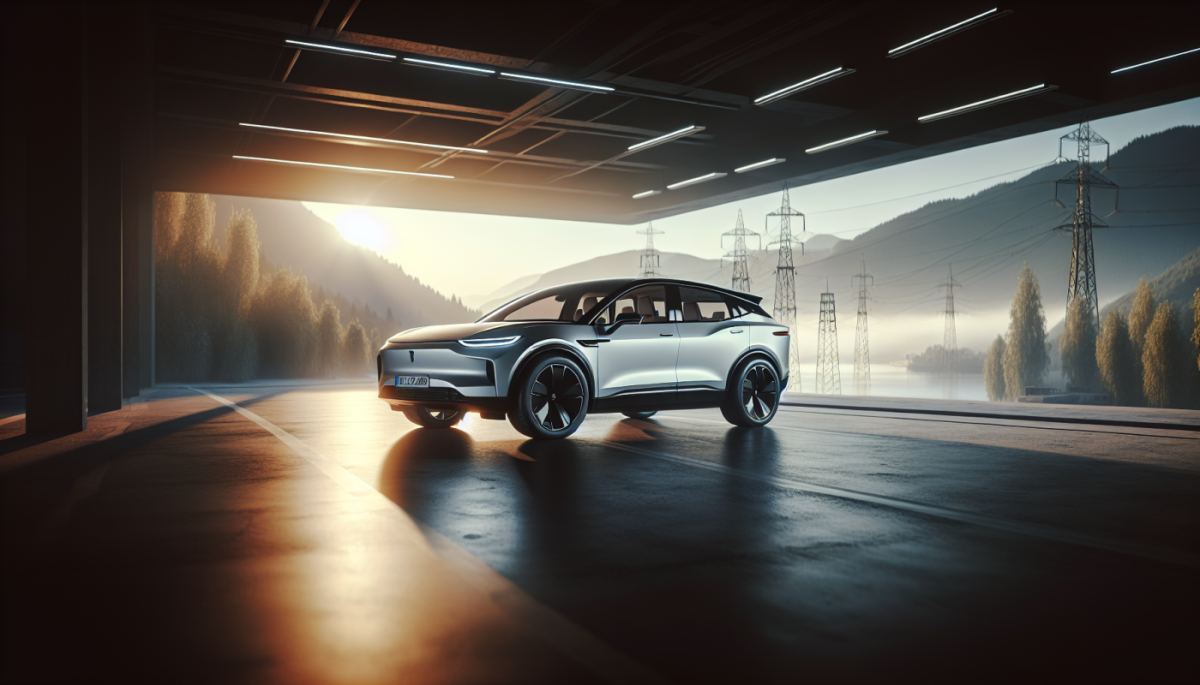
Subaru has never been a brand that chases headlines. Its reputation was built on all-wheel drive wagons, loyal owners who put 200,000 miles on their Outbacks, and a kind of quiet reliability that made it the unofficial car of outdoor enthusiasts and veterinarians alike. So when the company announces a 420-horsepower electric SUV at the New York Auto Show, it is worth pausing to understand what that actually means, not just for Subaru, but for the broader family vehicle market that is quietly undergoing one of its most significant transformations in decades.
The new electric SUV, larger than Subaru's existing Solterra and designed with family capacity in mind, represents a calculated bet that the brand's core buyers are finally ready to make the jump to battery power. Subaru has historically lagged behind rivals like Toyota and Honda in electrification, and its partnership with Toyota on the Solterra platform was widely seen as a stopgap rather than a long-term strategy. A purpose-built, high-output electric SUV changes that calculus considerably.
The 420-horsepower figure is not incidental. It places this vehicle in direct competition with the Ford Mustang Mach-E GT, the Hyundai Ioniq 5 N, and the Kia EV6 GT, all of which have demonstrated that performance and practicality are no longer mutually exclusive in the electric segment. For Subaru, a brand whose Symmetrical All-Wheel Drive system has been a cornerstone of its identity, the transition to electric motors actually makes engineering sense. Dual-motor electric setups can deliver torque to each axle with a precision that no mechanical differential can match, meaning Subaru's AWD promise could, in theory, be better fulfilled by electricity than by combustion.

Here is where the systems dynamics get interesting. Subaru's ownership base is among the most loyal in the automotive industry. According to IHS Markit data cited by industry analysts, Subaru consistently ranks near the top for owner retention rates, sometimes exceeding 60 percent. That loyalty is both an asset and a constraint. Subaru owners trust the brand, but they also have deeply held expectations about what a Subaru is supposed to feel like, how it is supposed to be priced, and what it is supposed to represent.
Electric vehicles, particularly high-performance ones, tend to carry premium price tags that can strain that relationship. If this new SUV lands above $55,000 or $60,000, Subaru risks pricing out the very buyers who made it successful. The brand has never competed in the luxury segment, and attempting to do so under the banner of electrification could fracture the identity it has spent decades building. Conversely, if Subaru prices it aggressively to retain its middle-market positioning, margins will be thin at a time when EV profitability remains elusive for most manufacturers.
There is also a second-order effect worth watching. Subaru's dealer network, which is smaller and more regionally concentrated than those of domestic rivals, may not be uniformly prepared for the service demands of high-voltage, high-performance electric vehicles. Training technicians, installing fast chargers, and managing battery warranty claims requires infrastructure investment that smaller dealerships often struggle to absorb. If service quality dips during the transition, the loyalty that Subaru has carefully cultivated could erode faster than the company expects.
The choice of the New York Auto Show as the reveal venue is itself a signal. New York draws media, attracts urban and suburban buyers, and carries a different demographic weight than, say, the Chicago or Detroit shows. Subaru is clearly targeting a buyer who lives near a city, has a family, wants space, and is open to going electric but has not yet found a vehicle that feels like it was made for them specifically.
That is a real and underserved market. The current crop of large electric SUVs skews either toward the ultra-premium, think Rivian R1S and Cadillac Escalade IQ, or toward the value-focused mainstream where range and feature compromises are more visible. A family-oriented electric SUV from a brand with genuine AWD credibility, priced somewhere in the middle, could find meaningful traction if Subaru executes well.
The deeper question is whether Subaru can use this moment to redefine what its brand means for the next generation of buyers, or whether the weight of its own legacy will slow the transition. Automakers that have successfully navigated electrification have generally done so by treating the shift as a values evolution rather than a product swap. Subaru has the brand equity to do exactly that. Whether it has the organizational will is something the market will answer over the next few years, one charging session at a time.
Discussion (0)
Be the first to comment.
Leave a comment