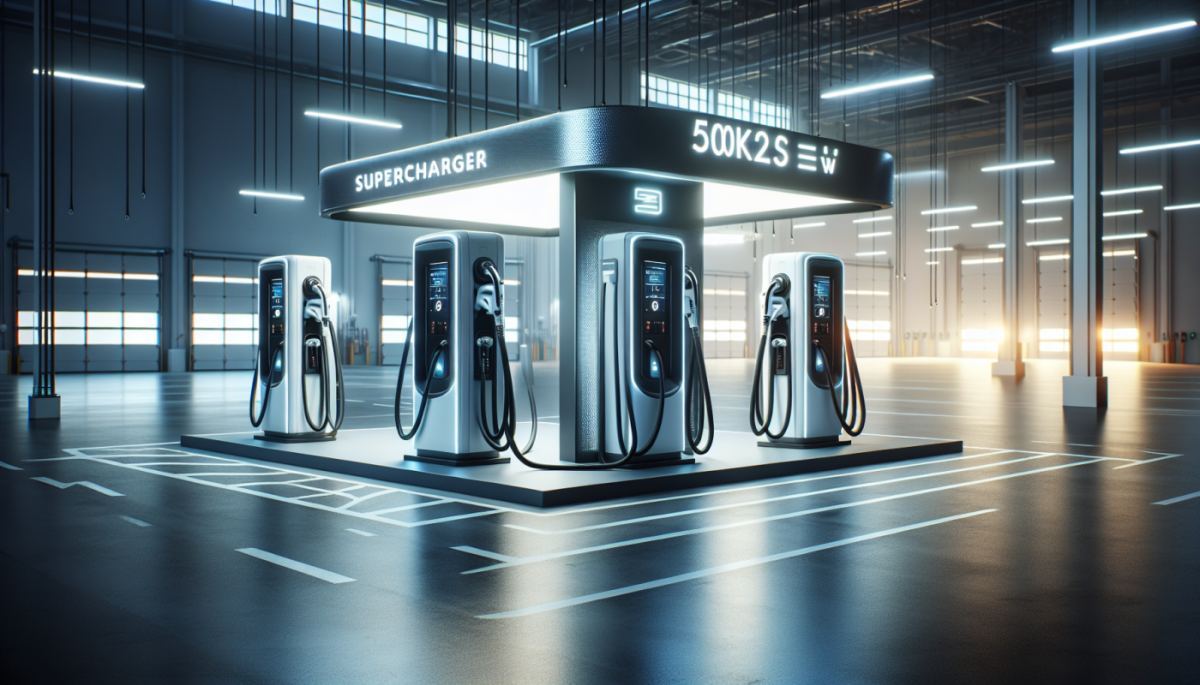
Tesla has quietly made a decision that will reshape the economics of electric vehicle charging for years to come. The company has ended production of its 250 kW Supercharger cabinets and will now manufacture only 500 kW V4 units, doubling the peak charging capacity available at its stations. The move affects not just Tesla drivers but the broader EV ecosystem, given that Tesla's Supercharger network has become the de facto standard infrastructure backbone across North America and much of Europe.
On the surface, this looks like a straightforward hardware upgrade. Faster charging means less time tethered to a stall, which means higher throughput per station, which means better economics for Tesla's energy division. But the decision carries a deeper logic that goes well beyond convenience metrics.
The shift to 500 kW cabinets is partly a response to the changing composition of vehicles that need to use the network. Electric trucks, both commercial and consumer, carry battery packs that dwarf those in passenger cars. Ford's F-150 Lightning, Rivian's R1T, and especially the Tesla Semi all require significantly more power delivery to charge in commercially viable timeframes. A 250 kW ceiling that was perfectly adequate for a Model 3 in 2019 starts to look like a bottleneck when a Semi pulls in needing to replenish hundreds of kilowatt-hours before a driver's mandated rest period ends.
There is also a competitive pressure that rarely gets named directly. ChargePoint, Electrify America, and BP Pulse have all been expanding their high-power networks, and several European operators are already deploying 400 kW and above hardware. Tesla's Supercharger network retained its reputation for reliability and speed partly because it was always ahead of the curve on hardware. Falling behind on peak power output, even temporarily, would erode one of the network's most durable selling points at precisely the moment when non-Tesla vehicles are flooding onto it through the NACS adapter rollout.
That last point deserves more attention than it typically receives. Since Tesla opened its Supercharger network to other manufacturers, the user base has expanded dramatically. Ford, GM, Rivian, and others have either adopted the NACS connector standard or are actively transitioning to it. This means Tesla's infrastructure decisions are no longer internal product choices. They are effectively industry-wide infrastructure policy. When Tesla standardizes on 500 kW hardware, it is setting a floor for what "fast charging" means across the American EV market.
Here is where the systems consequences get genuinely interesting. A network of 500 kW cabinets, deployed at scale, represents a qualitatively different kind of electrical load than what utilities have historically planned around. A single V4 cabinet drawing 500 kW, multiplied across a busy Supercharger station with a dozen or more stalls, can pull several megawatts from the local distribution grid in real time. Utilities in many regions are already navigating the strain of electrification across heating, industrial loads, and transportation simultaneously.
The push toward higher-power charging also accelerates the business case for on-site battery storage at Supercharger locations. Tesla has already deployed Megapack units at some stations precisely to buffer peak demand and reduce utility demand charges. As 500 kW becomes the standard, that pairing stops being a premium option and starts becoming a financial necessity. This creates a feedback loop: faster chargers drive demand for grid storage, grid storage makes faster chargers economically viable in more locations, and the combined footprint of charging plus storage starts to make each Supercharger station look less like a gas station and more like a small distributed energy node.
For drivers, the near-term story is straightforwardly positive. Vehicles capable of accepting higher charge rates will spend less time at stations. For grid planners and utility regulators, the story is considerably more complicated, and the pace of Tesla's hardware decisions is moving faster than most utility infrastructure planning cycles can comfortably absorb.
The real question is not whether 500 kW is enough. Battery technology and vehicle demand curves suggest that 1 MW charging corridors for heavy transport are already being piloted in parts of Europe. Tesla's decision today is less an endpoint than a waypoint, and the infrastructure built around it will need to be flexible enough to absorb whatever comes next.


Discussion (0)
Be the first to comment.
Leave a comment