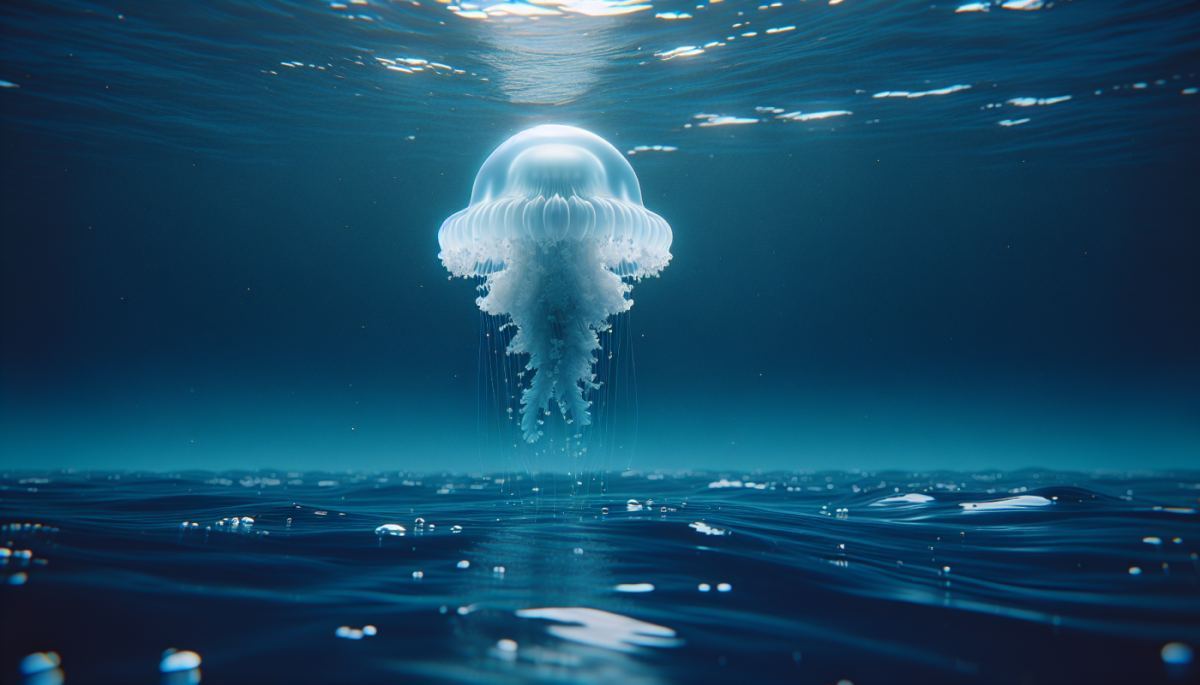
For decades, scientists have treated the circadian clock as one of biology's great universals. From fruit flies to fungi to humans, the core molecular machinery that governs daily rhythms has looked remarkably similar: a set of interlocking proteins that rise and fall in roughly 24-hour cycles, keeping organisms synchronized with the rotation of the Earth. The assumption, reasonable given the evidence, was that this system evolved once and spread. A pea-size jellyfish hauled up off the coast of Japan has now complicated that story considerably.
Researchers studying Cladonema pacificum, a tiny hydrozoan jellyfish, discovered that its circadian clock operates through a molecular mechanism that differs meaningfully from the one found in most animals. The jellyfish keeps time, but it does so differently, suggesting that biological timekeeping has evolved more than once and that the clocks we know best may represent only a fraction of the solutions life has found to the same problem.
The finding, reported in connection with work published in Quanta Magazine, emerged somewhat by accident. Biologists were not hunting for a novel clock; they were studying the animal's biology more broadly when the anomaly surfaced. That kind of serendipity is increasingly rare in an era of hypothesis-driven, grant-constrained science, which makes the result all the more striking. It is a reminder that organisms collected from understudied marine environments still carry surprises that no amount of computational modeling would have predicted.
Circadian biology is not a niche concern. The molecular clock governs sleep, metabolism, immune function, cell division, and the timing of gene expression across virtually every tissue in the human body. Disruptions to circadian rhythms are associated with metabolic disease, cancer susceptibility, psychiatric disorders, and accelerated aging. The 2017 Nobel Prize in Physiology or Medicine went to Jeffrey Hall, Michael Rosbash, and Michael Young precisely for decoding the molecular gears of this system in fruit flies, work that turned out to translate with eerie precision to mammals.
Because the clock seemed so conserved across animal life, researchers have largely assumed that studying a handful of model organisms, flies, mice, zebrafish, gives a complete enough picture. The Cladonema finding challenges that assumption at its root. If a jellyfish sitting near the base of the animal family tree evolved a distinct timekeeping mechanism, then the diversity of biological clocks across the roughly 35 recognized animal phyla may be far greater than anyone has mapped. Cnidarians, the group that includes jellyfish, corals, and sea anemones, diverged from the lineage leading to vertebrates more than 600 million years ago. That is an enormous span of evolutionary time in which alternative solutions to the same environmental pressure, the daily light-dark cycle, could have accumulated.
The deeper systems-level consequence here is about scientific infrastructure rather than just biology. Research funding, model organism databases, and drug development pipelines are all built on the assumption that a small number of representative species can stand in for the rest of life. When a single incidental finding from a net cast off the Japanese coast reveals a mechanistic divergence that no one was looking for, it raises an uncomfortable question: how many other fundamental biological processes have we mapped incompletely because we stopped looking once the first plausible mechanism was found?
Marine invertebrates have long been underrepresented in molecular biology, partly because they are difficult to culture in the lab, partly because funding tends to follow organisms with direct biomedical relevance, and partly because the deep assumption of conservation made the search feel redundant. Jellyfish in particular occupy an awkward position: they are ecologically important, increasingly dominant in warming and overfished seas, and biologically ancient, yet they remain poorly understood at the molecular level relative to their evolutionary significance.
The Cladonema discovery fits into a slow but accelerating reappraisal of marine biology as a source of fundamental insight. The green fluorescent protein that transformed cell biology worldwide came from a jellyfish. Compounds derived from sea sponges and tunicates have driven entire classes of cancer therapeutics. Each of these breakthroughs arrived not from a targeted search but from researchers willing to look at unfamiliar organisms without a predetermined answer in mind.
What the jellyfish clock suggests, then, is not merely that one small animal keeps time differently. It suggests that the inventory of life's solutions to fundamental problems is still open, still being written, and that the next rewrite may already be sitting in a collection jar somewhere, waiting for someone to notice.
References
- Callaway, E. (2017) — Circadian clocks win the Nobel Prize in Physiology or Medicine
- Reppert, S. M. & Weaver, D. R. (2002) — Coordination of circadian timing in mammals
- Nishiwaki-Ohkawa, T. & Yoshimura, T. (2020) — Molecular basis for circadian clockwork in non-model organisms
- Tsimring, L. S. et al. (2006) — Entrainment of a population of synthetic genetic oscillators


Discussion (0)
Be the first to comment.
Leave a comment