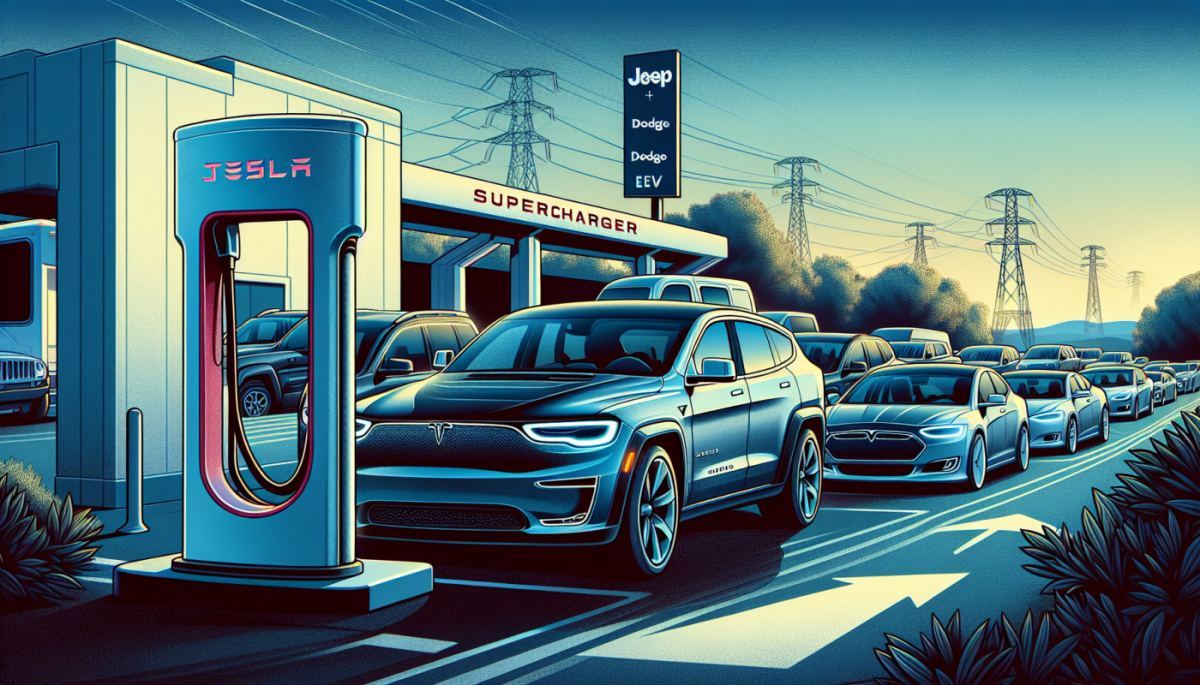
For years, the Tesla Supercharger network functioned less like public infrastructure and more like a private club. You drove a Tesla, you got access. Everyone else made do with a patchwork of slower, less reliable alternatives. That arrangement is now unraveling in ways that are reshaping the entire American EV landscape, and the latest development makes that clearer than ever: Jeep, Dodge, and Ram electric vehicle owners can now plug into Tesla's Supercharger network, giving Stellantis drivers access to what remains the largest and most dependable fast-charging system in the United States.
The move follows a broader industry realignment that began when Ford announced a Supercharger access deal with Tesla in May 2023, a decision that sent shockwaves through Detroit and ultimately pulled General Motors, Rivian, Polestar, and others into the same orbit. Stellantis, the transatlantic automaker that owns Jeep, Dodge, Ram, Chrysler, and Fiat among others, has now joined that coalition. The practical implication is significant: Tesla operates roughly 17,800 Supercharger stations across North America, with more than 65,000 individual connectors, dwarfing any competing network in both scale and uptime reliability. For an EV buyer weighing a Jeep Wrangler 4xe successor or a Ram 1500 REV against a competitor, charging confidence matters enormously.
What makes this moment worth examining beyond the headline is the systems dynamic quietly accelerating beneath it. Tesla built the Supercharger network as a vertical integration play, a way to remove range anxiety as a barrier to buying its own vehicles. The company spent billions constructing that infrastructure with no expectation of sharing it. When Elon Musk opened the network to other automakers, the stated rationale involved accelerating EV adoption broadly, but the economic logic was equally compelling: idle chargers generate no revenue, and a proprietary standard that the rest of the industry adopts becomes a durable competitive moat of a different kind.
The North American Charging Standard, or NACS, which originated as Tesla's proprietary connector, has now been formally adopted by SAE International as an industry standard. That transition means the charging port Tesla designed for its own cars is becoming the default plug for the American EV market, the same way USB-C eventually displaced a dozen competing connectors in consumer electronics. Stellantis vehicles will require a NACS adapter to use Superchargers currently, but new models are expected to ship with the connector built in, cementing the standard's dominance.
The second-order consequence here is one the legacy charging networks, particularly Electrify America and EVgo, are already feeling. If every major automaker is steering its customers toward Superchargers as the premium option, the competitive pressure on alternative networks intensifies sharply. Electrify America, which was created as a condition of Volkswagen's diesel emissions settlement and has struggled with reliability complaints, now faces a market where the dominant charging experience is controlled by a competitor. That could accelerate consolidation in the charging infrastructure space, or it could push networks like Electrify America to dramatically improve reliability just to remain relevant to the shrinking pool of non-NACS vehicles still on the road.
For the average Stellantis customer, the calculus is more immediate and less abstract. Ram's electric pickup, the 1500 REV, enters a brutally competitive segment where Ford's F-150 Lightning and the Chevrolet Silverado EV are already established. Both of those trucks now carry the implicit endorsement of Supercharger access. Jeep's electric ambitions, which include the Recon and Wagoneer S, face similar dynamics in a market where buyer hesitation about charging infrastructure remains one of the most cited reasons for not purchasing an EV.
Access to Superchargers does not solve every problem. Stellantis has faced its own turbulence recently, including production slowdowns, executive departures, and pressure from investors over its EV transition pace. Charging access is a necessary condition for EV competitiveness, but it is not sufficient on its own. The vehicles still have to be priced right, built reliably, and delivered on time.
Still, the direction of travel is unmistakable. The American EV charging landscape is consolidating around a network that Tesla built, a standard that Tesla designed, and an ecosystem that Tesla controls. The irony is that this outcome, a de facto Tesla charging monopoly blessed by the rest of the industry, may end up doing more for EV adoption than any government mandate yet written. Whether that concentration of infrastructure power eventually draws regulatory scrutiny is a question the industry has not yet had to answer.
References
- Shepardson, D. (2023) — Ford strikes deal with Tesla for EV charging network access
- SAE International (2023) — SAE International Standardizes North American Charging Standard Connector
- Ferris, R. (2023) — GM joins Ford in adopting Tesla's EV charging standard
- U.S. Department of Energy (2024) — Alternative Fueling Station Counts by State
Discussion (0)
Be the first to comment.
Leave a comment