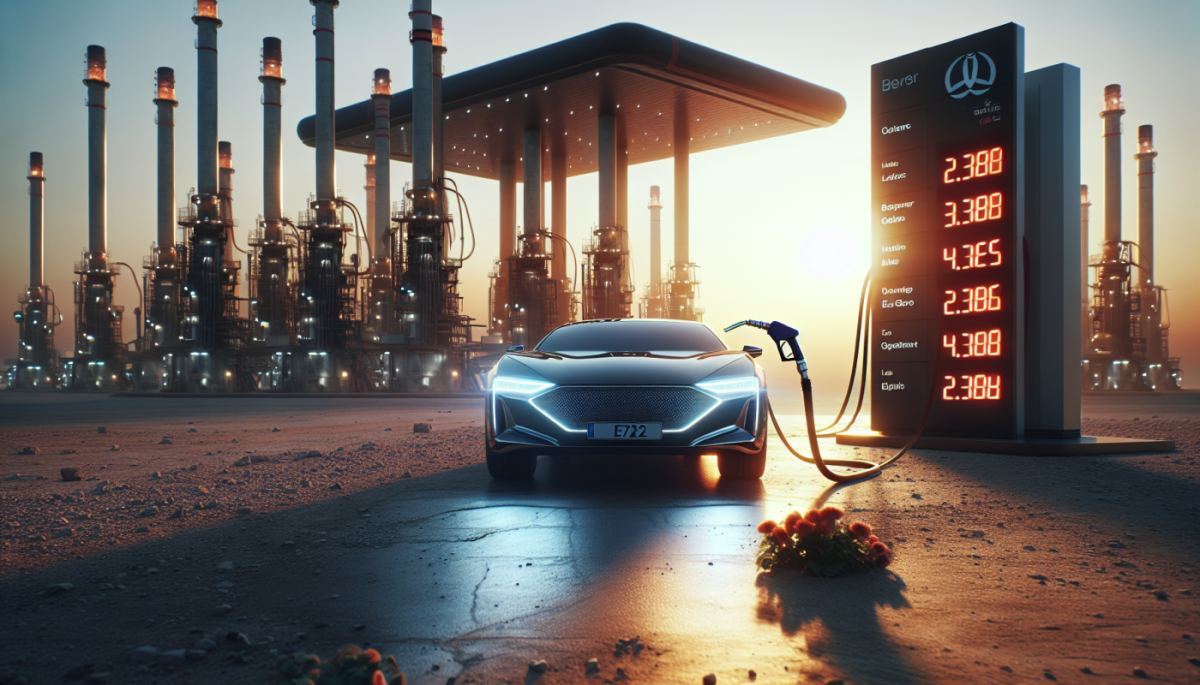
When oil markets shudder, the pain has never been distributed equally. But a new study quantifying just how unequal that pain has become puts a sharp number on what many EV advocates have long argued in theory: gas car drivers are absorbing roughly five times the financial hit from an Iran-linked oil price shock than their electric counterparts. That gap is no longer a rounding error. It is a structural fault line running through the consumer economy.
The mechanics are straightforward enough. Electric vehicles draw their energy from the grid, which in most markets is priced through long-term utility contracts and a diversified mix of generation sources. Gasoline, by contrast, is a direct derivative of crude oil, and crude oil is one of the most geopolitically sensitive commodities on earth. When tensions flare in the Strait of Hormuz, roughly 20 percent of the world's seaborne oil passes through that chokepoint, and the price signal travels almost instantly to the pump. EV drivers, insulated behind a layer of grid infrastructure and energy diversification, feel little more than a tremor. Gas drivers feel the full quake.
What makes this particular moment significant is not just the price differential but the timing. Global EV adoption is accelerating, with the International Energy Agency reporting that electric cars accounted for one in five vehicles sold in 2023. That means a growing slice of the driving population is effectively decoupled from the oil market's volatility. The remaining gas car owners, disproportionately concentrated in lower-income brackets where older, less fuel-efficient vehicles are the norm, are left holding an increasingly expensive bag every time a geopolitical crisis erupts in a major oil-producing region.
Here is where systems thinking reveals something the headline numbers miss. As oil shocks repeatedly punish gas car drivers while leaving EV owners comparatively unscathed, the financial case for switching to electric strengthens with every crisis. This creates a self-reinforcing dynamic: each spike in oil prices functions, paradoxically, as a marketing event for EV manufacturers. Tesla, Hyundai, and BYD do not need to run advertisements during a Middle East escalation. The gas station does it for them.
But the feedback loop has a darker second rotation. The drivers least able to absorb fuel price shocks are also the least able to afford a new electric vehicle, even as prices fall. The average new EV in the United States still carries a price premium over its gasoline equivalent, and used EV inventory, while growing, remains thin in many markets. This means the population most financially exposed to oil volatility is also the population most structurally locked out of the technology that would protect them from it. The shock absorber is available, but not to the people who need it most.
Policymakers have tried to address this through purchase incentives like the US Inflation Reduction Act's $7,500 EV tax credit, but those credits have income caps and apply primarily to new vehicles. The second-hand market, where working-class buyers actually shop, remains largely unsupported in most jurisdictions. The result is a two-tier transport economy that oil shocks are actively widening rather than simply revealing.
There is also a longer-term signal embedded in this story that energy analysts are watching carefully. Oil markets are not just pricing the current Iran situation. They are pricing a future in which demand destruction from electrification is real but uneven, and in which the remaining oil-dependent consumers are increasingly price-inelastic because they have no near-term alternative. That is a recipe for sustained volatility rather than a smooth energy transition. As the EV-adopting upper half of the market exits the oil demand pool, the remaining pool becomes smaller, more concentrated, and more susceptible to supply disruptions. Paradoxically, a partially electrified transport sector could produce more dramatic price spikes for those still on gasoline, not fewer.
The five-times figure in this study is striking, but it may actually understate the trajectory. If oil demand continues to soften at the top of the income distribution while geopolitical risk in producing regions remains elevated, the asymmetry between gas and electric drivers will not stabilize at a factor of five. It will keep growing, quietly, with every barrel that passes through the Strait of Hormuz.

Discussion (0)
Be the first to comment.
Leave a comment