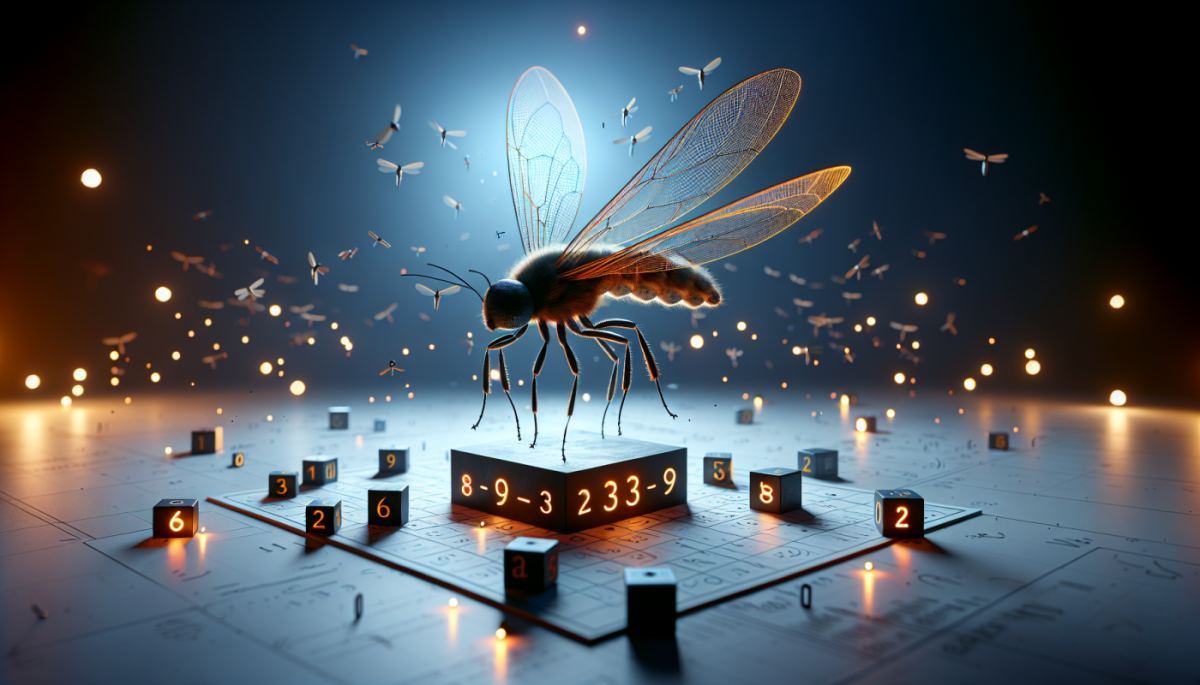
There is something quietly unsettling about a field of fireflies blinking in perfect unison. It feels like it should require coordination, a conductor, some central intelligence issuing commands. But there is no conductor. Each firefly is acting alone, responding only to what it can see, and yet the whole meadow pulses as one. For decades, scientists have known this happens. Engineers have now worked out, with mathematical precision, exactly how.
The new findings reveal that fireflies follow a set of rules so simple they border on elegant. Each insect adjusts the timing of its own flash based on the flashes it observes from its neighbours, nudging its internal rhythm slightly forward or backward depending on where it is in its own cycle when it perceives a flash from another. No firefly knows what the group is doing. No firefly is trying to synchronise. The collective behaviour emerges entirely from these local, repeated, pairwise adjustments. What looks like choreography is actually just arithmetic, running simultaneously across thousands of individuals.
The challenge was never observational. Naturalists have documented firefly synchrony for well over a century, and the phenomenon was famously theorised through the work of mathematician Art Winfree and later Yoshiki Kuramoto, whose 1975 model of coupled oscillators became one of the most cited frameworks in nonlinear dynamics. The Kuramoto model captured the general principle beautifully: oscillators that are weakly coupled to one another will tend, under the right conditions, to lock into a shared rhythm. But the model was abstract. It described populations of oscillators with access to the entire group's behaviour simultaneously, which is not how a firefly in a Tennessee forest actually works.
Real fireflies have limited vision. They respond to neighbours, not to the crowd. The network of interactions is local, sparse, and constantly shifting as insects move through the dark. Translating Kuramoto's elegant mathematics into something that accounts for these constraints, and then validating it against actual insect behaviour, is a genuinely hard problem. The engineers who cracked it did so by combining high-resolution field observations with computational modelling, essentially reverse-engineering the decision rules from the outputs they produced.
What they found is that the timing of the response matters enormously. A firefly that receives a flash early in its own cycle will delay its next flash slightly. One that receives a flash late in its cycle will accelerate. This asymmetry is not random. It is precisely tuned, and it is what drives the system toward coherence rather than chaos. The mathematics governing this behaviour belong to a class of dynamical systems that engineers already use to analyse power grids, neural circuits, and wireless communication networks.
That last point is where the story stops being about insects and starts being about infrastructure. Power grids are, at their core, synchronisation problems. Generators across a network must maintain the same frequency or the system becomes unstable. As grids absorb more renewable energy sources, particularly solar and wind, which do not naturally oscillate the way spinning turbines do, maintaining that synchrony becomes harder. The classical solutions involve centralised control systems, but those are expensive, vulnerable to failure, and increasingly inadequate at the scale modern grids require.
Decentralised synchronisation, of the kind fireflies perform, offers a different architecture entirely. If each node in a network can achieve global coherence by responding only to its immediate neighbours, using simple, local rules, then the need for central coordination dissolves. The firefly findings give engineers a validated, biologically tested mathematical framework for designing exactly that kind of system. The same logic could extend to swarms of autonomous drones that need to coordinate without a central controller, or to distributed computing systems that require timing alignment across thousands of processors.
There is a broader systems principle at work here that deserves attention. Complex, stable, global order can arise from simple, local, repeated interactions, provided the feedback rules are correctly specified. The firefly is not a metaphor for this principle. It is a proof of concept, one that evolution has been running and refining for millions of years. The fact that engineers are only now fully decoding the mathematics is less a commentary on scientific slowness than on the genuine difficulty of the problem.
As decentralised systems become more central to how humanity manages energy, communication, and computation, the meadow at dusk starts to look less like a nature documentary and more like a design brief.
Discussion (0)
Be the first to comment.
Leave a comment