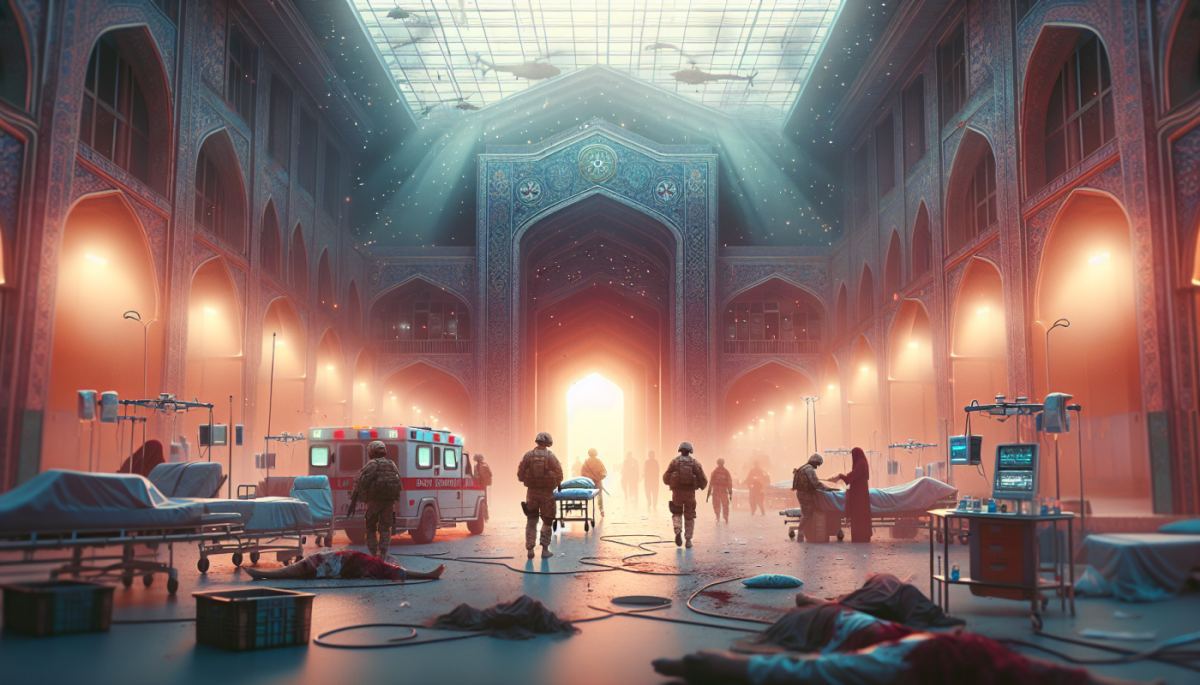
The smoke had barely cleared over Kabul before the accusations began. A strike on a hospital in the Afghan capital has left hundreds feared dead, and the Taliban wasted little time pointing the finger at Pakistan. Whether or not that attribution holds under scrutiny, the attack has landed at a moment when the relationship between Islamabad and the Taliban government is already stretched to something close to breaking point.
For years, Pakistan cultivated the Taliban as a strategic asset, offering sanctuary, diplomatic cover, and quiet logistical support through two decades of American occupation. The calculation was straightforward: a friendly government in Kabul would give Pakistan strategic depth against India and reduce the influence of a state Islamabad has long viewed with suspicion. That investment has not paid the expected dividends. Since the Taliban's return to power in 2021, cross-border tensions have risen sharply, driven largely by the Taliban's refusal to act decisively against Tehrik-i-Taliban Pakistan, the militant group known as the TTP, which has used Afghan soil to launch attacks inside Pakistan with increasing frequency and lethality.
The hospital strike, if confirmed as a Pakistani operation, would represent a dramatic escalation in that deteriorating dynamic. Striking civilian infrastructure, and a hospital in particular, crosses a threshold that makes diplomatic repair extraordinarily difficult. It also hands the Taliban a propaganda gift of considerable value, allowing a government that struggles with international legitimacy to cast itself as the victim of foreign aggression rather than the perpetrator of domestic repression.
The deeper story here is one of strategic miscalculation compounding over time. Pakistan assumed that ideological alignment and years of material support would translate into political compliance. The Taliban, however, have always been a movement defined by a fierce, almost theological commitment to Afghan sovereignty. They accepted Pakistani assistance when it suited them and have shown little inclination to subordinate Afghan interests to Islamabad's security preferences. The TTP question is the sharpest expression of this divergence. From the Taliban's perspective, acting against the TTP risks fracturing their own coalition, since the two movements share fighters, ideology, and in some cases family ties. From Pakistan's perspective, tolerating TTP sanctuaries in Afghanistan is simply not a sustainable position as domestic attacks mount and public pressure on the military grows.
This structural incompatibility was always present beneath the surface of the relationship. What has changed is that both sides are now running out of patience and room to manoeuvre. Pakistan's military establishment faces internal pressure to demonstrate it can protect Pakistani citizens. The Taliban face their own legitimacy pressures, governing a country in economic freefall with no formal international recognition, and they cannot afford to be seen capitulating to a neighbour's demands.
The second-order consequences of a sustained military confrontation between Pakistan and Taliban-governed Afghanistan would ripple well beyond the two countries. Afghanistan's already catastrophic humanitarian situation, in which the United Nations has repeatedly warned of mass starvation and a collapsed health system, would worsen dramatically if conflict disrupts the fragile supply corridors that keep aid flowing. The hospital strike itself is a grim illustration of how quickly civilian infrastructure becomes a casualty when state and non-state actors begin trading blows across a porous border.
For regional powers watching closely, including China, which has invested carefully in relationships with both Islamabad and Kabul, and Iran, which shares a long border with Afghanistan and hosts millions of Afghan refugees, an escalating Pakistan-Taliban conflict creates instability that no neighbouring government wants to manage. Beijing in particular has worked to position itself as a stabilising broker in the region and would likely apply quiet pressure on both sides, though its leverage over the Taliban is less certain than its influence in Islamabad.
There is also a feedback loop worth watching inside Pakistan itself. Military strikes abroad, particularly ones that produce images of destroyed hospitals and civilian casualties, have a history of generating blowback that strengthens the very militant networks they are meant to degrade. If the TTP is able to frame Pakistani military action in Afghanistan as a war on Muslims, recruitment and domestic sympathy could increase rather than diminish.
The attack on Kabul's hospital may or may not prove to be the moment this conflict tips into something harder to contain. But the underlying forces driving it, strategic miscalculation, incompatible security interests, and the slow collapse of a relationship built on false assumptions, have been building for years. The question now is whether either government has the political capacity to step back from the edge, or whether the logic of escalation has already taken over.
Discussion (0)
Be the first to comment.
Leave a comment