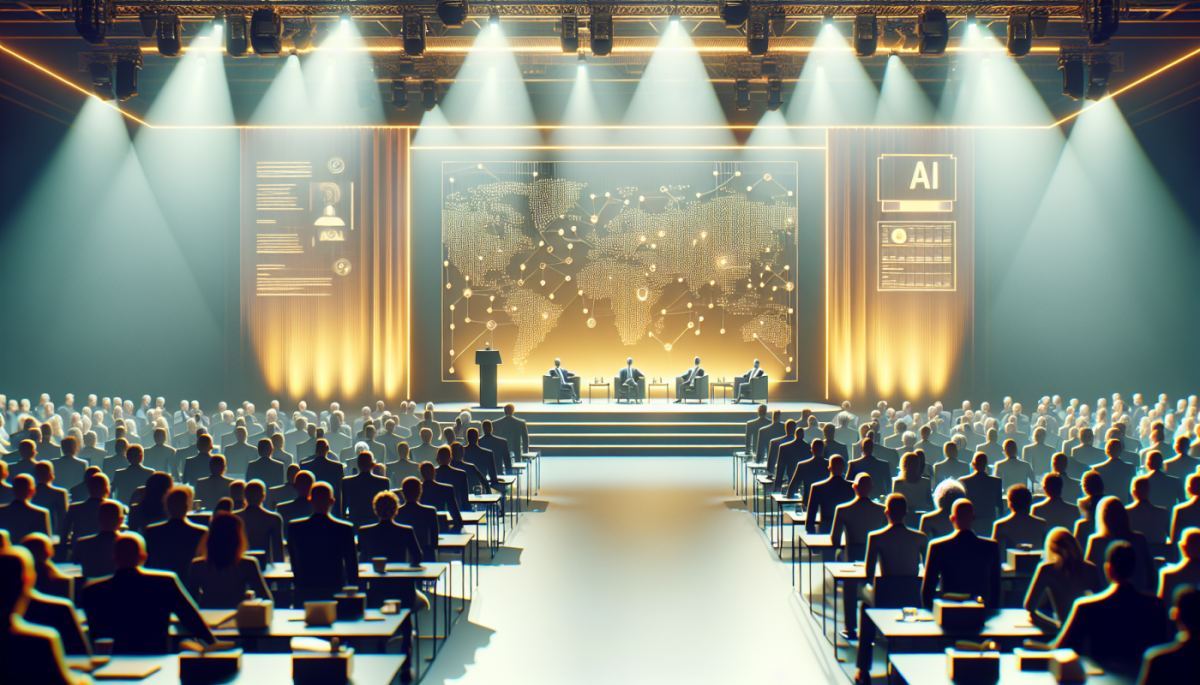
Every year, the Neural Information Processing Systems conference functions less like an academic gathering and more like a pressure gauge for the entire AI industry. What gets presented at NeurIPS tells you not just where the technology is, but where the money, the anxiety, and the ambition are all pointing at once. At NeurIPS 2024, Google DeepMind arrived with a cluster of research threads that, taken individually, look like incremental progress. Taken together, they sketch something more consequential: a deliberate push toward AI systems that can perceive, reason, and act within the physical and digital world with far less human hand-holding than before.
Three broad themes defined DeepMind's presence at the conference. The first was adaptive AI agents, systems capable of adjusting their behavior in response to novel environments rather than simply pattern-matching against their training data. The second was 3D scene understanding and creation, a domain that sits at the intersection of computer vision, spatial reasoning, and generative modeling. The third was a set of innovations in how large language models are trained, touching on efficiency, alignment, and the structural choices that shape what a model ultimately becomes. None of these are new problems. What's new is the sophistication of the proposed solutions and the speed at which they are converging.
The push toward adaptive agents is arguably the most consequential thread in DeepMind's current research agenda. For years, the dominant paradigm in AI has been the foundation model: train something enormous on vast data, then fine-tune it for specific tasks. That approach has produced remarkable results, but it has also exposed a fundamental ceiling. A model that has memorized patterns cannot reliably navigate situations that fall outside those patterns. An agent that can adapt, that can update its internal model of the world in real time and revise its strategy accordingly, is a categorically different kind of system.
What DeepMind is working toward here has deep roots in reinforcement learning, the branch of AI research the company has championed since the AlphaGo era. But the current work is less about winning games and more about operating in open-ended environments where the rules are not fixed and the rewards are ambiguous. This is, not coincidentally, a description of most real-world tasks. The second-order consequence worth watching is what happens when adaptive agents are deployed in domains like logistics, drug discovery, or financial modeling, where the feedback loops between AI decisions and environmental outcomes are tight and fast. An agent that learns from its environment can optimize powerfully, but it can also optimize in directions its designers did not anticipate.
The 3D scene creation work addresses a different but related bottleneck. Most generative AI today operates in two dimensions, producing images, text, or audio. The physical world, and increasingly the virtual worlds that matter commercially, are three-dimensional. Teaching AI systems to understand and generate coherent 3D environments is not just a technical challenge; it is a prerequisite for any serious application in robotics, augmented reality, architectural design, or autonomous vehicles.
DeepMind's research in this area reflects a broader industry recognition that spatial intelligence has been the missing layer in AI capability. A system that can generate a photorealistic image of a room cannot necessarily tell you where the door is relative to the window, or how the light would change if you moved the lamp. Bridging that gap requires models that internalize geometry, not just appearance. The commercial implications are significant, but so are the risks: highly capable 3D generative models will eventually make synthetic environments indistinguishable from real ones, with consequences for everything from evidence in legal proceedings to the basic epistemology of visual media.
On the training side, DeepMind's LLM innovations point toward a future where the cost and carbon footprint of building frontier models comes down even as their capabilities go up. Efficiency gains in training are easy to celebrate, but they also lower the barrier to entry for actors with fewer resources and fewer scruples about safety practices. Progress in AI safety and progress in AI capability are not always running at the same speed, and the gap between them is where most of the serious risk lives.
What NeurIPS 2024 ultimately revealed is that the frontier of AI research is no longer primarily about scale. The next phase is about architecture, adaptability, and the subtle choices baked into how these systems learn. Those choices, made in research labs and conference papers, will shape what AI can and cannot do for the next decade. The question is whether the people making them are thinking carefully enough about the world those systems will enter.
Discussion (0)
Be the first to comment.
Leave a comment