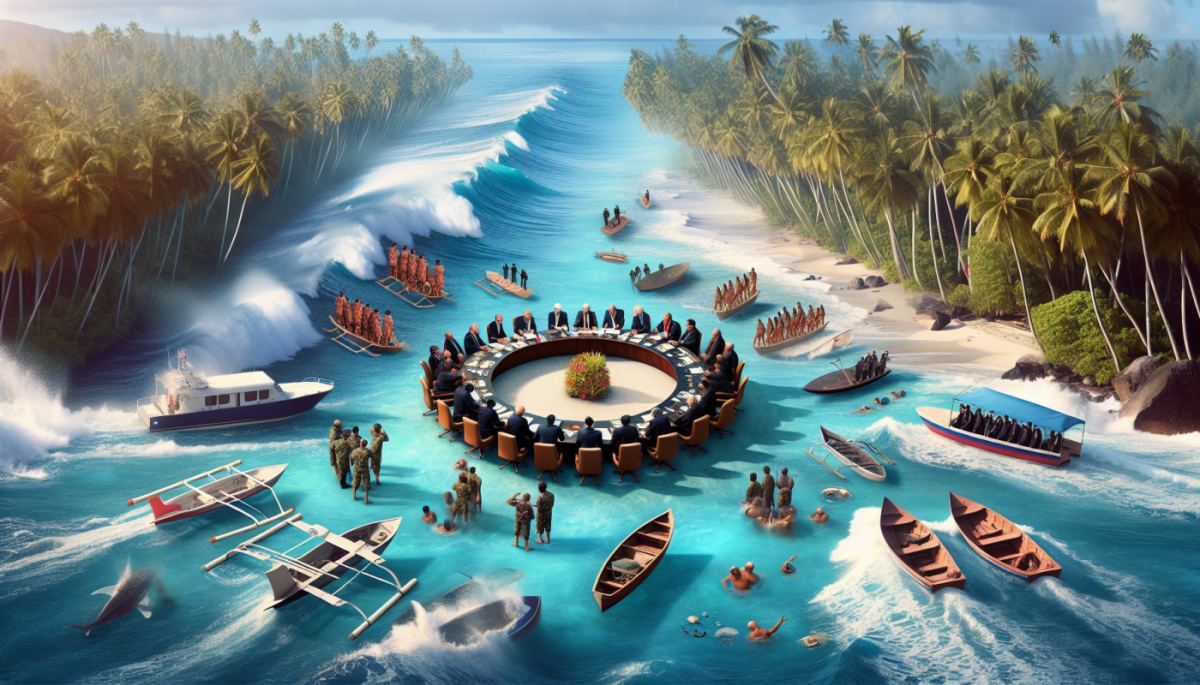
There is a particular kind of political theatre that requires no staging, no spin doctors, and no prepared remarks. The Pacific Islands have it in abundance. Ahead of COP31, scheduled for 2026 in Australia, the governments of Fiji, Tuvalu, and Palau are inviting world leaders to witness what decades of carbon emissions have already done to their shores. Pre-COP meetings will be held in Fiji and Tuvalu in October, with a separate event in Palau in August. The message embedded in these invitations is not subtle: come and see what your inaction looks like from the ground.
This is a deliberate strategy, and it is worth understanding why it is being deployed now. The Pacific Islands have long occupied an unusual position in global climate diplomacy. They are among the least responsible for the emissions driving climate change, contributing a negligible fraction of global greenhouse gases, yet they face some of the most immediate and irreversible consequences. Tuvalu, a nation of roughly 11,000 people spread across nine atolls, sits on average less than two metres above sea level. Palau's coral reefs, which underpin both its ecology and its economy, have experienced repeated mass bleaching events tied directly to ocean warming. Fiji has watched cyclones intensify in ways that would have seemed extraordinary a generation ago.
For years, these nations argued their case through data, through legal frameworks, through impassioned speeches at the UN General Assembly. In 2023, Tuvalu made global headlines by signing a treaty with Australia that would allow its citizens to migrate as the islands become uninhabitable, a deal that was simultaneously a diplomatic achievement and a quiet admission of defeat. The shift now toward experiential diplomacy, toward physically placing decision-makers in the landscape of climate consequence, reflects a hard-won understanding that numbers alone do not move people. Presence does.
There is a growing body of research in behavioural science suggesting that abstract statistical harm registers very differently in the human brain than direct sensory experience. A finance minister who has stood on a Tuvaluan beach and watched the tide consume what used to be dry land carries that image into budget negotiations in a way that a briefing document simply cannot replicate. The Pacific hosts are betting on this asymmetry. They are, in effect, trying to convert the geography of vulnerability into a form of soft power.
The timing relative to COP31 matters enormously. Australia, as the host nation, has staked considerable diplomatic capital on positioning itself as a credible climate actor after years of being one of the developed world's most conspicuous laggards. The Albanese government's legislative commitments have shifted the optics, but the substance is still contested, particularly around continued approvals for new fossil fuel projects. Having Pacific leaders visibly engaged and emotionally invested in the pre-COP process creates a form of accountability that is difficult to quietly sidestep. If world leaders accept the invitations and make the journey, they arrive in Sydney or wherever the formal negotiations are held carrying the weight of what they saw. If they decline, that refusal becomes its own statement.
The deeper systemic consequence of this strategy may not be felt at COP31 at all. By institutionalising site visits to climate-affected regions as part of the pre-negotiation process, the Pacific nations are potentially establishing a precedent that other vulnerable regions, the Sahel, Bangladesh, the Arctic communities, could adopt and amplify. A world in which climate diplomacy routinely includes mandatory exposure to frontline conditions would be structurally different from the current model, where negotiations happen in convention centres insulated from consequence.
There is also a feedback loop worth watching within Pacific domestic politics. These events are not only directed outward at foreign leaders. They are signals to Pacific populations that their governments are fighting, that the international stage has not forgotten them, that the slow erasure of their homelands is being resisted through every available channel. That internal legitimacy matters for governments navigating the extraordinarily difficult politics of managed retreat, where leaders must simultaneously argue that their nations deserve to survive and prepare their people for the possibility that they will not.
The ocean does not wait for diplomatic calendars. But in August and October, for a few days at least, the diplomatic calendar will come to the ocean. What the visitors choose to do with what they see is the question that will outlast the meetings themselves.
Discussion (0)
Be the first to comment.
Leave a comment