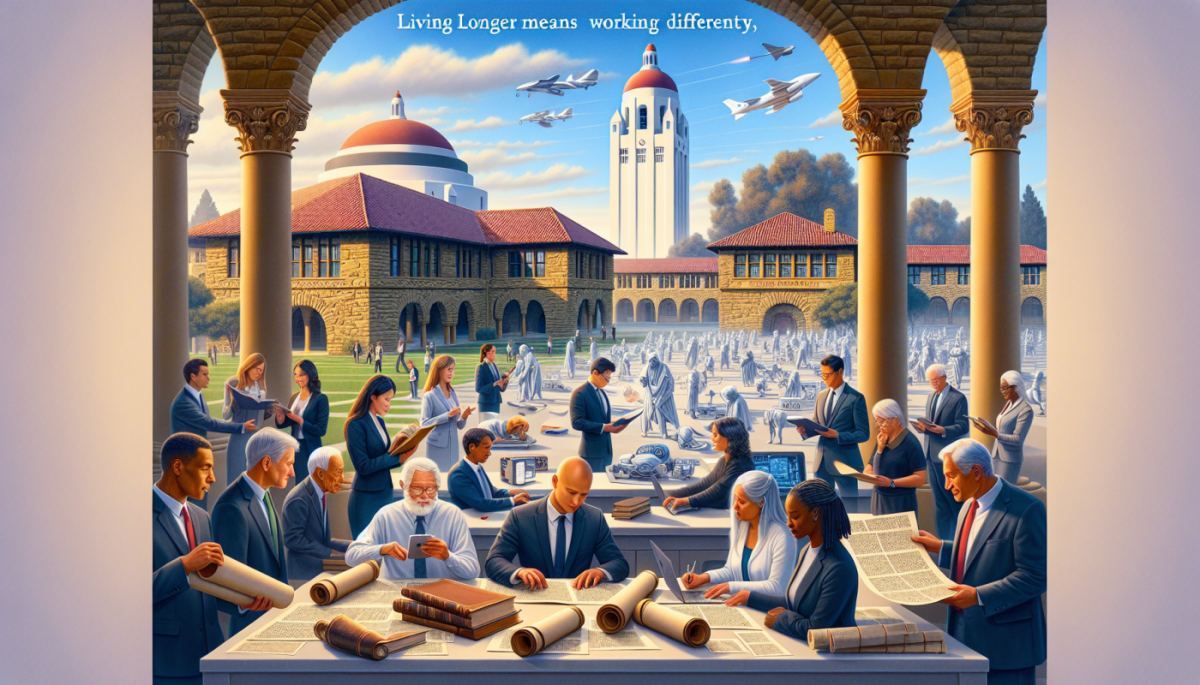
The Stanford Center on Longevity is convening its Century Summit 2026 around a premise that sounds simple but carries enormous structural weight: as human lifespans extend, the institutions built around a shorter life are starting to crack. Work, education, and retirement were all designed for a world where most people lived to their mid-seventies. That world is dissolving.
The Summit's three focal themes, longevity, learning, and the future of work, are not separate conversations dressed up in the same conference lanyard. They are a single feedback loop. Longer lives create pressure on career structures. Career structures that no longer fit create pressure on education systems. Education systems that were built for the young are poorly equipped to serve the old. And so the loop tightens.
For most of the twentieth century, life was organized around what researchers sometimes call the "three-box model": education first, then work, then retirement. Each box had its lane, its institutions, its financing logic. A child went to school, an adult went to work, an elder went to rest. The Stanford Center on Longevity has spent years documenting why that architecture is failing, and the Century Summit is, in part, a public reckoning with how deep the failure goes.
When a life extends to ninety or beyond, the three-box model does not simply stretch. It breaks. A retirement funded for fifteen years cannot sustain thirty. A degree earned at twenty-two cannot remain professionally relevant for sixty years of working life. The skills gap that employers complain about is not merely a pipeline problem or a training budget problem. It is a temporal problem: the pace at which industries transform now outstrips the pace at which a single credential, earned once, can carry a person.
This is where the learning theme of the Summit becomes structurally urgent rather than aspirationally nice. Continuous learning, or what some researchers call "lifelong learning" with genuine institutional backing rather than corporate brochure language, requires a complete rethinking of who pays, who teaches, and when learning happens. Right now, the incentives are misaligned at almost every level. Employers want skilled workers but rarely want to fund the reskilling of older ones. Universities are beginning to offer continuing education but have not restructured their revenue models around it. Governments fund education heavily at the front of life and barely at all in the middle or back.
The second-order consequence worth watching here is a potential stratification effect. If continuous learning becomes the price of remaining employable across a long career, and if access to that learning is unevenly distributed by income, geography, or employer size, then longevity itself becomes a privilege amplifier. Those with resources to keep learning will compound their advantages across a longer working life. Those without will face a longer period of economic precarity, not a longer period of flourishing. The Summit's framing gestures toward this risk, but the harder question is whether the policy architecture to address it is anywhere close to ready.
The future of work conversation at the Summit sits inside this same tension. Remote work, gig arrangements, and AI-assisted productivity have already begun to dissolve the traditional employment contract. Layered on top of that disruption is the demographic reality that workforces in wealthy countries are aging, and that the institutional responses, phased retirement programs, age discrimination law, senior hiring initiatives, remain patchwork and underpowered.
There is also a cultural dimension that systems analysis tends to underweight. Many of the assumptions baked into workplace design, about when someone is "past their prime," about the relationship between age and adaptability, about who gets promoted and who gets managed out, are not rational responses to productivity data. They are inherited prejudices running on institutional autopilot. Changing them requires not just policy but a shift in the stories organizations tell about what a valuable worker looks like at fifty-five or sixty-five or seventy.
Stanford's Center on Longevity has been one of the more rigorous institutional voices pushing back on the idea that an aging population is simply a fiscal burden to be managed. The Century Summit is an attempt to move that argument from research papers into rooms where decisions get made, where HR leaders, policymakers, educators, and technologists have to sit with the discomfort of designing for a life that no longer fits the old map.
The most important question the Summit probably cannot fully answer, but will hopefully sharpen, is whether the institutions that shape work and learning can adapt faster than the demographic curve is moving. History suggests institutions are slow. The curve is not.



Discussion (0)
Be the first to comment.
Leave a comment