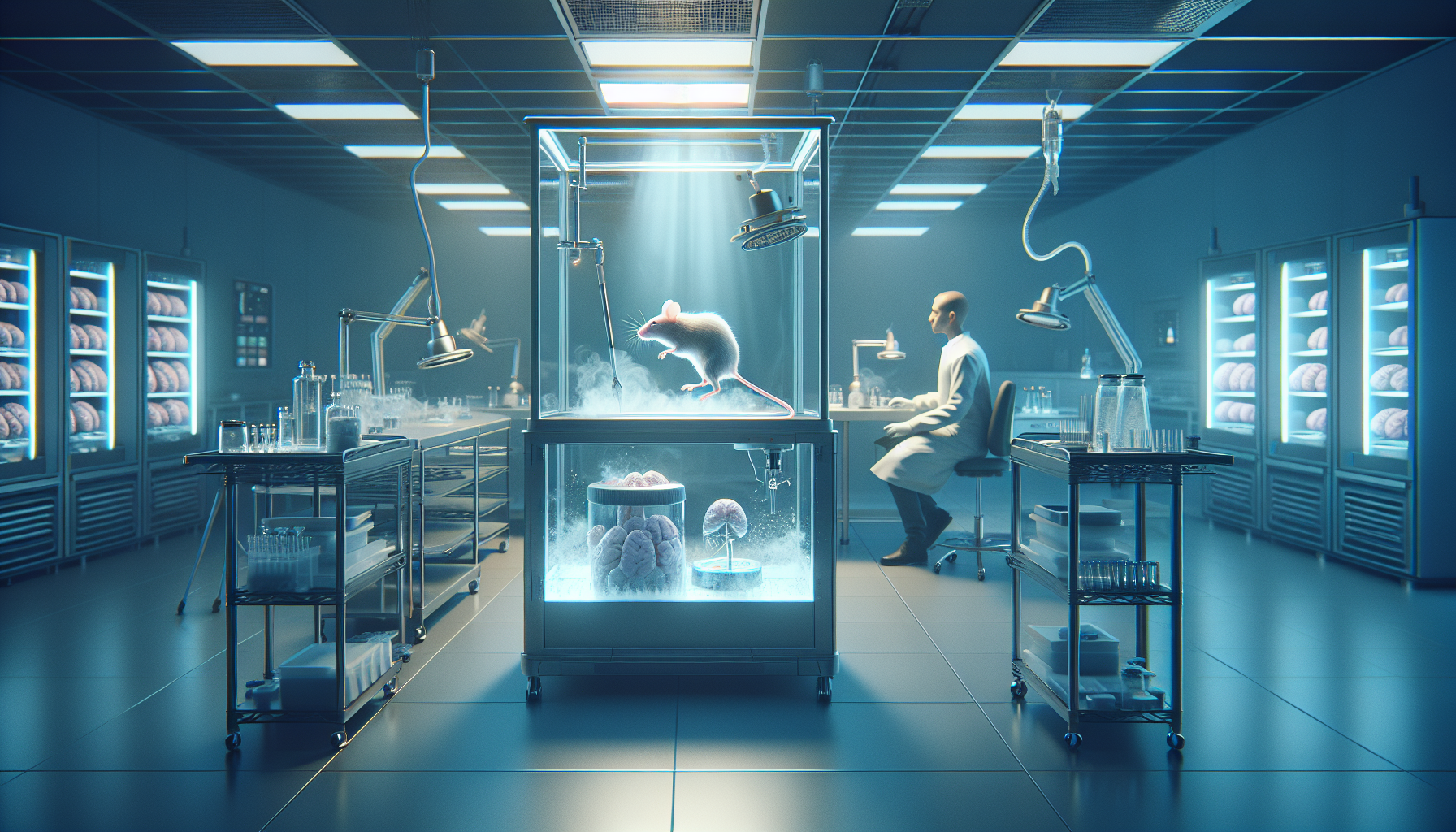
For decades, the idea of freezing a brain and bringing it back intact has lived in the uncomfortable territory between science fiction and serious research. A new study has nudged it, carefully, toward the latter. Researchers have successfully vitrified mouse brain slices and a complete mouse brain, then rewarmed them to find that much of the neuronal function had survived the process. It is not resurrection. It is not immortality. But it is something genuinely significant: proof that the architecture of a brain, its synaptic connections and cellular structures, can endure a journey through extreme cold and return largely functional.
The technique at the heart of this is vitrification, which is distinct from conventional freezing in a way that matters enormously. Ordinary freezing kills cells because water expands as it crystallises, puncturing membranes and shredding the delicate scaffolding of tissue. Vitrification sidesteps this by cooling biological material so rapidly, and with the help of cryoprotectant chemicals, that water molecules never have time to form crystals. Instead, the tissue enters a glass-like amorphous state, suspended rather than destroyed. The challenge has always been applying this to something as structurally complex as brain tissue, where the density of connections and the sensitivity of neurons make any chemical or thermal stress potentially catastrophic.
What makes this study notable is not just that the researchers vitrified brain slices, which has been attempted before with mixed results, but that they extended the process to a whole brain and still observed preserved neuronal function upon rewarming. The gap between a thin slice and a complete organ is not merely a matter of scale. It involves fundamentally different heat transfer dynamics, uneven penetration of cryoprotectants, and a vastly greater surface area where ice formation can initiate. Getting a whole brain through that process with meaningful functional preservation is a meaningful technical leap.
Cryopreservation research has a long and uneven history. Sperm and embryos have been routinely vitrified and thawed for decades in reproductive medicine, and simple organisms like the roundworm C. elegans have been frozen and revived with behavioural memory apparently intact. But mammalian brains are orders of magnitude more complex, and the field has been haunted by the difficulty of demonstrating that preserved tissue is not merely structurally intact but functionally alive in any meaningful sense. Previous work, including research on rabbit hippocampal slices and pig brains maintained in a perfusion system after death, suggested that preservation was possible but stopped short of demonstrating the kind of neuronal activity this new study reports.
The incentive structure driving this research is layered. At the most immediate level, there are clinical applications in transplant medicine, where the ability to store donor organs for longer periods without degradation could save thousands of lives annually. Brain tissue banking for neurological research is another obvious beneficiary. But the longer shadow here is the cryonics industry, a small but persistent field in which people pay to have their bodies or brains preserved after legal death in the hope that future technology might revive them. That industry has operated largely on faith and theoretical possibility. Studies like this one, even at the mouse scale, provide the first credible empirical scaffolding for what has until now been closer to a belief system than a science.
The distance between a preserved mouse brain and a preserved human brain is vast, both biologically and ethically. Human brains are roughly 3,000 times larger by volume, and the cryoprotectant penetration problem scales non-linearly. The rewarming phase, which must be rapid and uniform to prevent ice formation as temperatures rise, becomes exponentially harder to control at larger sizes. Researchers will need to solve problems of thermal gradients, toxicity from cryoprotectant chemicals at the concentrations required for deep tissue penetration, and the question of what functional preservation actually means at the level of memory and identity rather than just cellular activity.
But the cascading consequence worth watching is not the technical roadmap. It is the regulatory and philosophical one. If brain preservation becomes reliably demonstrable in mammals, pressure will mount on medical and legal systems to reconsider what death means, when it is irreversible, and who has the right to attempt to reverse it. Hospitals, insurers, bioethics boards, and courts have largely been able to ignore cryonics because it lacked scientific credibility. That insulation is beginning to erode.
The mouse brain sitting preserved in a laboratory is a small thing. The questions it is quietly beginning to force into the open are not.

Discussion (0)
Be the first to comment.
Leave a comment