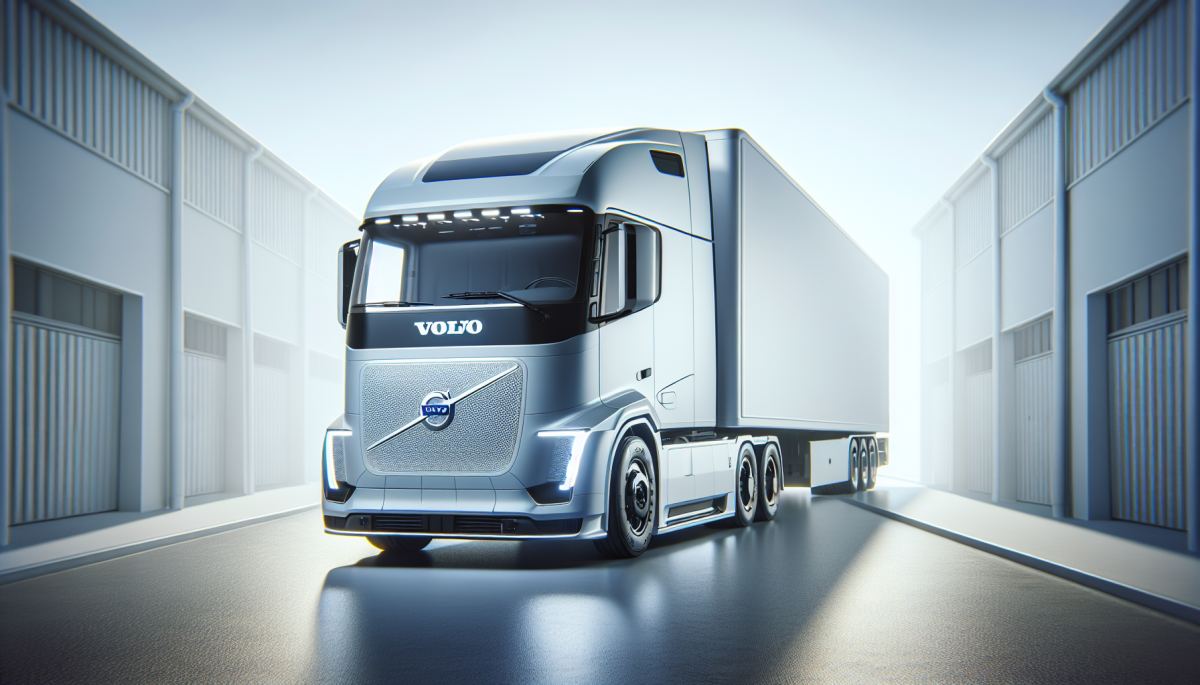
Range anxiety has always been the quiet killer of electric trucking ambitions. Fleet operators running long-haul routes don't have the luxury of a two-hour charge window, and the economics of freight depend on wheels turning, not sitting at a charging station. So when Volvo Trucks announced that its flagship electric truck now exceeds 400 miles of range, the number landed with real weight in an industry that has been watching EV promises fall short of operational reality for years.
The engineering breakthrough behind the figure is worth understanding. Volvo achieved the range improvement not by simply stuffing in a larger battery pack, but by redesigning the rear electric axle into a more compact configuration. That spatial efficiency freed up room for additional battery capacity without fundamentally altering the truck's footprint or payload geometry. It's a reminder that in heavy vehicle electrification, the constraint is rarely chemistry alone. It's packaging. The ability to rearrange drivetrain components to liberate space is, in many ways, as consequential as improvements in energy density.
For context, the U.S. Class 8 trucking market moves roughly 70 percent of all domestic freight by value, according to the American Trucking Associations. The average long-haul route can stretch well beyond 500 miles in a single driver shift, which means even 400 miles doesn't fully close the gap with diesel. But it narrows it considerably, and in the world of fleet procurement, narrowing the gap is often enough to shift purchasing decisions, particularly when fuel cost differentials and state incentive programs are factored in.
California's Advanced Clean Trucks regulation, which requires manufacturers to sell increasing percentages of zero-emission trucks, has created a regulatory floor that is pulling investment into exactly this kind of development. Volvo, which already operates one of the more mature electric truck lineups among major OEMs, is positioning itself ahead of compliance curves that will tighten through the late 2020s. The 400-mile threshold is partly a technical achievement and partly a market signal: Volvo is telling fleet operators that the operational compromises of electric long-haul are shrinking faster than expected.
The charging infrastructure question, however, remains the system's most stubborn bottleneck. A truck with 400 miles of range still needs megawatt-level charging to turn around quickly enough for commercial viability. The Megawatt Charging System standard, developed through a coalition including Volvo, is still being deployed at scale, and the geographic distribution of high-power truck charging remains thin outside of major freight corridors. Range improvements in the vehicle are outpacing the buildout of the network that makes those improvements operationally useful.
The more interesting systemic consequence may play out not in the trucking industry itself, but in the electricity grid. As electric trucks with larger battery packs become more commercially viable, the aggregate charging demand from freight fleets will begin to register as a meaningful grid load, particularly at highway-adjacent charging depots. Unlike passenger EVs, which tend to charge overnight at low power levels, electric trucks will demand large bursts of energy at predictable but commercially driven times. Grid operators in freight-heavy states like Texas, Ohio, and Tennessee are not yet fully accounting for this in their long-range capacity planning.
There's also a competitive dynamic worth tracking. Daimler Truck's eCascadia and Kenworth's T680E are both competing in the same space, and Volvo's range announcement will accelerate the engineering arms race. When one manufacturer demonstrates that compact axle design can unlock meaningful range gains, competitors face pressure to match or exceed it. That kind of leapfrog competition tends to compress development timelines in ways that surprise even optimistic forecasters.
The 400-mile range figure will likely look modest within three years. But the more durable story is the design philosophy it represents: that electrifying freight is increasingly a problem of systems integration rather than raw battery capacity. The trucks that win the next decade of freight electrification will probably be the ones whose engineers thought hardest about space, not just kilowatt-hours.
Discussion (0)
Be the first to comment.
Leave a comment