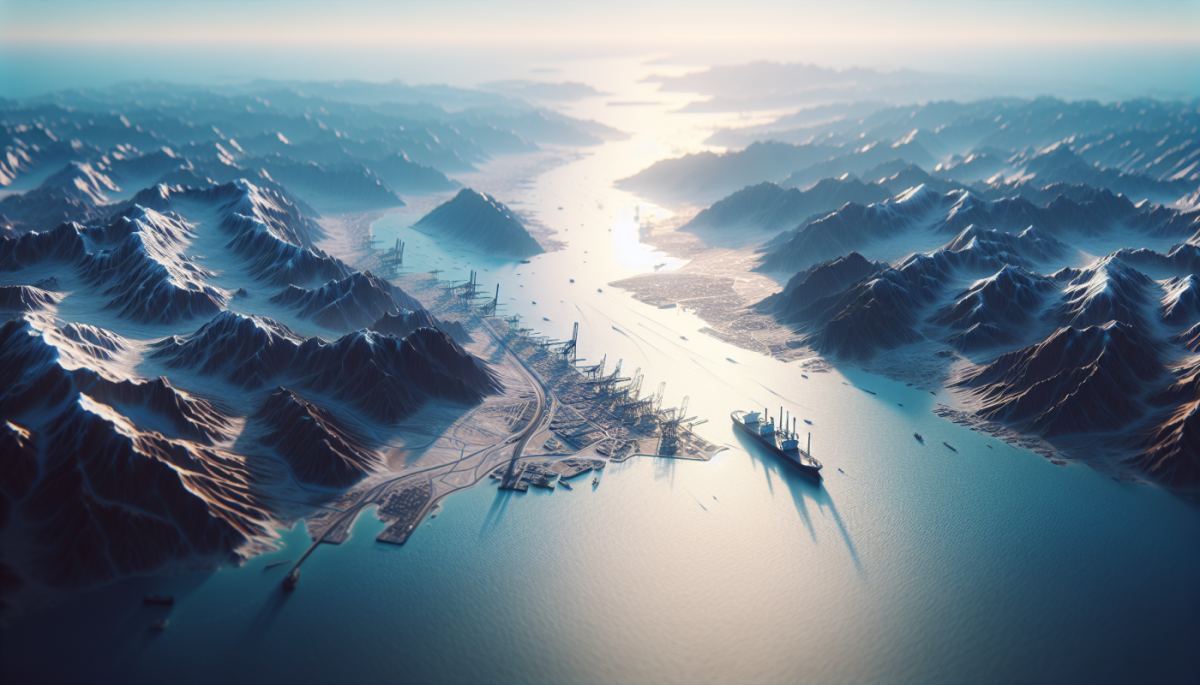
The guns may eventually fall silent, but the lesson Iran has just taught the world will not fade quietly. Whatever ceasefire or diplomatic arrangement eventually emerges from the current conflict, one strategic reality has been burned into the calculations of every government, every oil trader, and every naval planner on earth: the Strait of Hormuz is not merely a waterway. It is a trigger.
Roughly 20 percent of the world's oil supply passes through a channel barely 21 miles wide at its narrowest point. Every day, tankers carrying somewhere between 17 and 21 million barrels thread through that corridor between Iran and Oman, supplying energy to Asia, Europe, and beyond. For decades, Western strategists treated the strait as a vulnerability to be managed, a risk to be hedged. What the current crisis has demonstrated is that Iran has spent those same decades treating it as an asset to be cultivated.
The mechanics of Iranian power at Hormuz are not accidental. They are the product of sustained, deliberate investment in asymmetric capability: fast attack boats, shore-based anti-ship missiles, naval mines, and drone swarms that can complicate the movement of even the most sophisticated naval force. The United States Fifth Fleet is based in Bahrain for precisely this reason, a permanent, expensive reminder that keeping the strait open requires constant military presence. But presence is not the same as control, and the current conflict has made that distinction uncomfortably vivid.
When Iran signals, even implicitly, that it might move to restrict passage through Hormuz, the effect on global oil markets is immediate and disproportionate. Prices spike not because the strait is actually closed, but because the possibility that it could be closed is now credible in a way that reshapes risk premiums across the entire energy system. That is the nature of chokepoint leverage: you do not have to act to extract value from the threat. The mere existence of the capability, demonstrated and believed, does the work.
This is what makes Hormuz structurally different from most geopolitical flashpoints. Most territorial disputes or military confrontations affect the countries directly involved and ripple outward in diminishing waves. A serious disruption at Hormuz runs in the opposite direction, amplifying as it travels. Japan, South Korea, India, and China are all deeply exposed. European energy markets, still fragile after the shocks of the past few years, would feel the pressure almost immediately. The cascading effect would move through inflation figures, central bank decisions, and household energy bills in countries that have no direct stake in whatever started the conflict in the first place.
The deeper consequence of this moment is not the immediate price spike or the naval posturing. It is what Iran's adversaries and rivals have now learned about the returns on chokepoint investment. If controlling a 21-mile strait can give a mid-sized regional power genuine leverage over the global economy, the strategic lesson is not lost on others. The South China Sea, the Bab el-Mandeb, the Turkish Straits: every maritime chokepoint in the world just became slightly more contested in the minds of governments doing long-range strategic planning.
There is also a subtler feedback loop at work inside Iran itself. Every time the threat of Hormuz closure produces a visible international reaction, whether a diplomatic concession, a market movement, or a flurry of emergency consultations among major powers, it validates the investment in that capability. It tells the Iranian security establishment that the strategy works, that asymmetric chokepoint leverage is a more reliable instrument of national power than conventional military competition with the United States could ever be. That validation makes future de-escalation harder, not easier, because it strengthens the institutional hand of those within Iran who built and champion the strategy.
The world has spent considerable energy debating how to contain Iran's nuclear ambitions, and that debate is legitimate and urgent. But the Hormuz question is in some ways more structurally durable. Nuclear weapons are subject to treaties, inspections, and the logic of mutual deterrence. A coastline is not. Geography does not negotiate, and Iran's position at the mouth of the Gulf is a permanent fact that no diplomatic agreement can relocate.
The real challenge for the international community in whatever comes after this conflict is not simply restoring stability. It is grappling honestly with the reality that the global energy system has been designed, over decades of path-dependent infrastructure investment, to run through one of the most geopolitically volatile corridors on earth. Until that changes, every peace will carry Hormuz inside it, waiting.
Discussion (0)
Be the first to comment.
Leave a comment