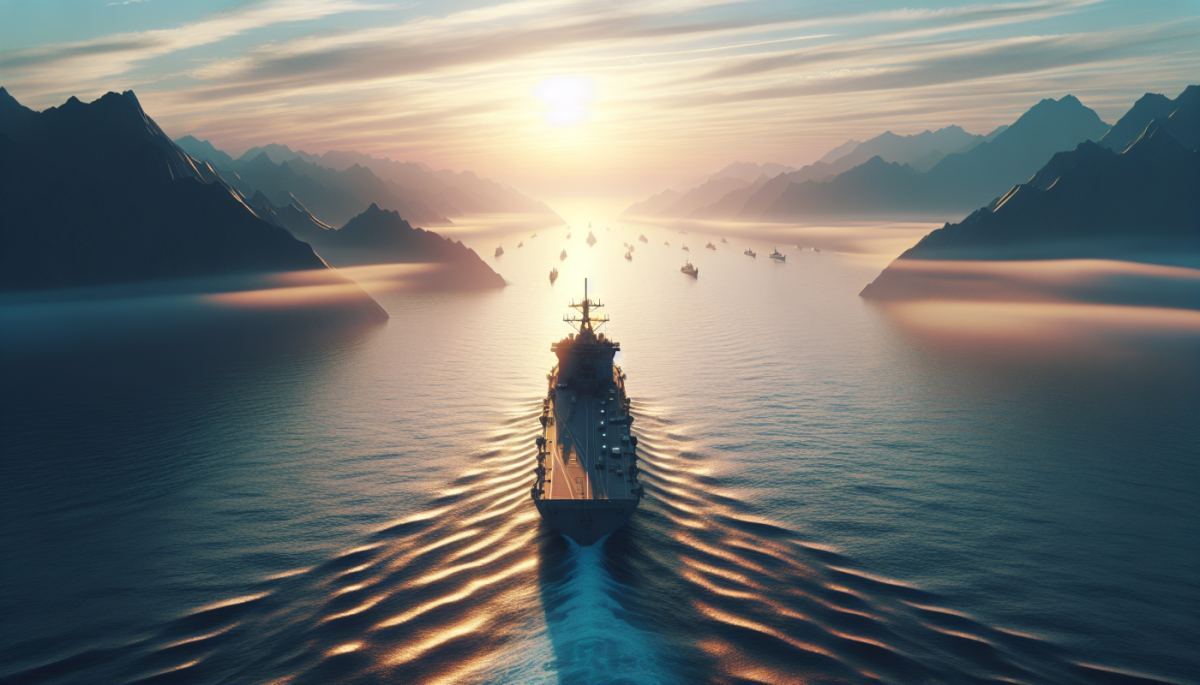
The head of the International Maritime Organization has said something that many in the shipping industry already know but rarely say aloud: putting naval escorts alongside commercial vessels in the Strait of Hormuz is not a long-term answer. Arsenio Dominguez, the IMO's Secretary-General, has made clear that military protection for ships passing through one of the world's most consequential chokepoints is not a sustainable solution. It is a telling admission, and one that carries implications far beyond the narrow channel of water that separates Iran from the Arabian Peninsula.
The Strait of Hormuz is not merely a geographic feature. Roughly 20 percent of the world's oil and a significant share of liquefied natural gas passes through its 21-mile-wide navigable corridor. When tension rises there, it does not stay there. Insurance premiums spike. Shipping companies reroute. Energy markets twitch. The strait functions less like a passage and more like a pressure valve for the global economy, and the question of who controls access to it has never been purely military.
Naval escorts are expensive, logistically complex, and politically loaded. They require sustained commitment from states that have competing priorities, and they do nothing to address the underlying disputes that make the strait dangerous in the first place. History offers a useful reference point: during the Tanker War of the 1980s, the United States reflagged Kuwaiti vessels and provided military escorts under Operation Earnest Will. It reduced some immediate risk, but the broader conflict continued, and the costs of maintaining that posture were enormous. The situation eventually resolved not because of naval presence but because of diplomatic and economic exhaustion on multiple sides.
Dominguez's position reflects a growing recognition within international maritime governance that the tools available to bodies like the IMO are fundamentally civilian in nature. The IMO can set safety standards, facilitate communication between flag states, and advocate for freedom of navigation as a legal principle. What it cannot do is project force. When the Secretary-General says military escorts are not sustainable, he is also implicitly acknowledging the limits of his own institution's reach, and perhaps signaling that the diplomatic track needs to carry more weight.
The shipping industry, for its part, has been absorbing the costs of Hormuz instability in ways that rarely make headlines. War risk insurance surcharges have climbed sharply during periods of heightened tension. Crew welfare has become a more acute concern as seafarers face the psychological burden of transiting contested waters. Some operators have quietly begun factoring longer Cape of Good Hope routes into their planning, adding days and fuel costs to journeys that would otherwise take hours through the strait. These are not dramatic events, but they compound.
The more consequential risk may not be a single dramatic incident but a slow normalization of instability. If the industry and the international community come to accept naval escorts as the default operating condition in the Strait of Hormuz, they inadvertently signal that the strait's legal status as an international waterway is negotiable under pressure. That precedent does not stay confined to the Persian Gulf. Other chokepoints, from the South China Sea to the Taiwan Strait to the Bab el-Mandeb, are watching. The logic that military presence is required to guarantee passage in one place can be imported elsewhere by other actors with other grievances.
This is the systems-level consequence that Dominguez's statement gestures toward without fully articulating. The normalization of armed escorts as a condition of safe passage erodes the foundational principle that the high seas and international straits belong to no single state. Once that erosion begins, it tends to accelerate. Coastal states with strategic chokepoints gain leverage. The cost of global trade rises not through any single shock but through the steady accumulation of friction.
The IMO chief's skepticism about military solutions is, in this light, less a policy prescription than a warning about trajectory. The question now is whether the diplomatic and legal architecture of international maritime law can generate enough momentum to make that warning mean something before the escorts become permanent fixtures and the precedent becomes irreversible.
Discussion (0)
Be the first to comment.
Leave a comment