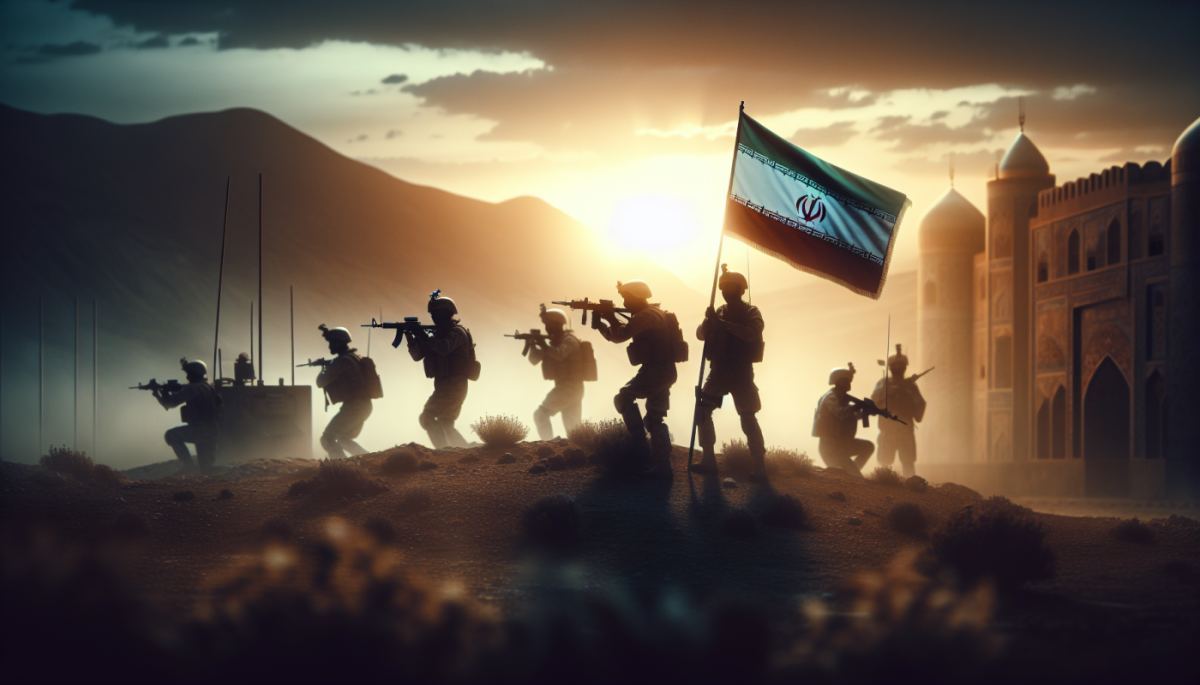
The scorecard, read quickly, looks devastating for Tehran. Its most capable proxy, Hezbollah, has been decapitated and degraded. Hamas, the movement Iran armed and bankrolled for years, has watched Gaza reduced to rubble. Syrian president Bashar al-Assad, a critical node in the so-called Axis of Resistance, has fallen. Iranian air defenses have been exposed as porous, struck twice by Israeli forces with near impunity. On the surface, this looks like a regional power in retreat.
But surface readings of Middle Eastern power struggles have a long history of misleading people who should know better.
What Iran retains, even after absorbing these blows, is something harder to destroy than weapons caches or proxy militias: geography, time, and a tolerance for pain that its adversaries structurally cannot match. Iran sits at the center of a vast arc stretching from the Persian Gulf to the Mediterranean. It shares borders or maritime proximity with Iraq, the Gulf states, Afghanistan, and Pakistan. Its ballistic missile arsenal, estimated at one of the largest in the region, remains largely intact. And crucially, the Islamic Republic has spent four decades conditioning its population and its political culture to absorb punishment and frame suffering as ideological proof of righteousness.
This asymmetry of pain tolerance is not a soft variable. It is a strategic asset. Israel is a democracy with a free press, a traumatized civilian population, and a government facing intense domestic pressure to deliver security. The United States is a superpower with a short electoral attention span and a public that has grown weary of open-ended Middle Eastern entanglements. Iran, by contrast, is an authoritarian theocracy that has survived a brutal eight-year war with Iraq, decades of crippling sanctions, and repeated internal uprisings. Its leadership calculates in decades, not news cycles.
The proxies that were degraded were also, in a sense, expendable. Hezbollah's military wing suffered serious losses, but the organization remains politically embedded in Lebanon in ways that bombs cannot easily dislodge. Hamas, whatever its military condition, has become a symbol whose power now operates independently of its operational capacity. Iran did not build these networks because it expected them to win conventional wars. It built them because they impose costs, drain attention, and keep adversaries permanently off-balance.
Here is where the systems-level consequences become genuinely unsettling. Every time Israel or the United States strikes Iran or its affiliates and declares a victory, they risk triggering a feedback loop that actually strengthens Tehran's long-term position. Military strikes on Iranian soil have, historically, consolidated nationalist sentiment around the regime even among Iranians who despise it. The 2020 assassination of Qasem Soleimani produced enormous crowds of mourners in a country that had been rocked by anti-government protests just weeks earlier. Pain, applied from outside, has a way of converting dissent into solidarity.
There is also the nuclear dimension, which looms over every calculation. Iran has not yet built a weapon, but it has enriched uranium to 60 percent purity, a threshold that leaves it a relatively short technical step from weapons-grade material. Each military humiliation Iran absorbs increases the internal pressure on its leadership to cross that line, not out of aggression, but out of a cold strategic logic: nuclear deterrence is the one guarantee that the kind of strikes Israel has conducted would become unthinkable. The very success of conventional operations against Iran may be accelerating the timeline toward the scenario everyone claims to want to prevent.
Meanwhile, the regional order that the United States spent thirty years constructing is under quiet but relentless pressure. The Abraham Accords, celebrated as a diplomatic breakthrough, have not produced the broad Arab-Israeli normalization their architects envisioned. Saudi Arabia has paused its own normalization talks. Arab publics, whatever their governments privately prefer, have watched Gaza with a fury that no amount of back-channel diplomacy can fully contain.
Iran does not need to win in any conventional sense. It needs its adversaries to exhaust themselves, overextend, and eventually conclude that the cost of sustained confrontation outweighs the benefit. That is a strategy with a long and uncomfortable track record of working.
The question worth watching is not whether Iran can rebuild what it has lost. It almost certainly can, given time and resources. The more consequential question is whether the coalition arrayed against it has the patience, the cohesion, and the strategic clarity to deny it that time. History suggests that is the harder thing to sustain.
Discussion (0)
Be the first to comment.
Leave a comment