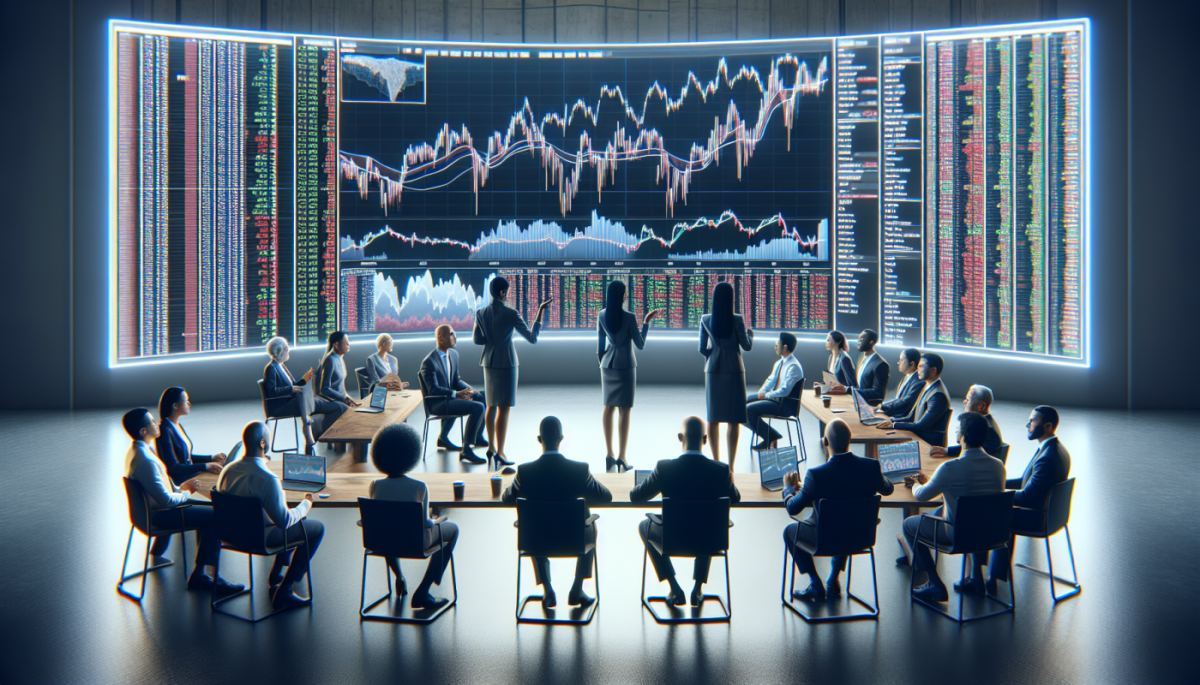
There is something quietly extraordinary happening in financial markets right now. Investors, by and large, agree that asset prices are disconnected from reality. They just each seem to believe that everyone else is the one who got it wrong.
This is not ordinary bearishness or routine skepticism. It is a more unsettling condition: a market-wide suspicion that valuations are stretched, risks are underpriced, and the whole edifice is leaning, combined with a near-universal reluctance to act on that suspicion. Traders keep buying. Fund managers keep allocating. The indices keep climbing. And yet, in surveys, in earnings calls, in private conversations, the same refrain surfaces again and again: something is off.
Economists have a name for the gap between what people believe and what they do. It sits at the intersection of behavioral finance and game theory, and it has a long, uncomfortable history in markets. John Maynard Keynes described it in 1936 as a "beauty contest" problem: investors are not trying to pick the most attractive asset, they are trying to guess what everyone else will find attractive. The result is that private conviction becomes almost irrelevant. What matters is the crowd's next move, and so everyone watches the crowd instead of the fundamentals.
What makes the current moment unusual is the scale of the dissonance. Sentiment surveys from institutions like the American Association of Individual Investors have repeatedly shown elevated bearish sentiment even as markets push higher. The Bank of America's Global Fund Manager Survey, one of the most closely watched barometers of institutional mood, has flagged persistent concerns about overvaluation among professional investors for several consecutive quarters. Yet cash allocations have not risen dramatically, and equity exposure has remained stubbornly high.
The mechanism driving this is not irrationality in the simple sense. It is something more structurally interesting: career risk. A fund manager who steps aside from a rising market and turns out to be wrong faces consequences that are immediate and personal. Underperformance relative to a benchmark is a firing offense in much of the industry. The cost of being wrong while everyone else is right vastly exceeds the cost of being wrong together. So the rational individual choice, even for someone who privately believes the market is overextended, is often to stay in.
This is a textbook collective action problem, and it has a feedback loop baked into it. The more investors stay in despite their doubts, the more prices rise, which appears to validate the optimists and discredits the skeptics, which makes it even harder for the next doubter to act on their doubts. Conviction erodes. The market becomes its own most persuasive argument.
History suggests that this kind of cognitive dissonance does not resolve gradually. It tends to resolve suddenly. The 2000 dot-com collapse, the 2008 financial crisis, and the sharp corrections of early 2020 all shared a common feature: they arrived after extended periods in which a significant portion of market participants privately acknowledged that something was wrong but publicly continued to act as though it were not. The trigger in each case was less about new information than about a shift in what economists call "common knowledge," the moment when everyone knows that everyone else knows.
That shift can be triggered by almost anything: a surprising earnings miss, a central bank statement, a geopolitical shock. The specific catalyst matters less than the underlying pressure that has been building. Markets under cognitive dissonance are not stable systems. They are compressed springs.
The second-order consequence worth watching here is what happens to the institutions that are supposed to provide early warning. Credit rating agencies, risk departments, and financial regulators all operate within the same incentive structures that keep individual investors paralyzed. If the entire system shares the same blind spot, the corrective mechanisms that might otherwise dampen a downturn are themselves compromised. Oversight becomes performative. Risk models, calibrated to recent history, underestimate tail events. The safety net is made of the same material as the thing it is supposed to catch.
What is most striking about the current moment is not that investors are wrong. It is that so many of them suspect they might be, and are betting on it anyway. That is not a market expressing confidence. That is a market holding its breath.
Discussion (0)
Be the first to comment.
Leave a comment