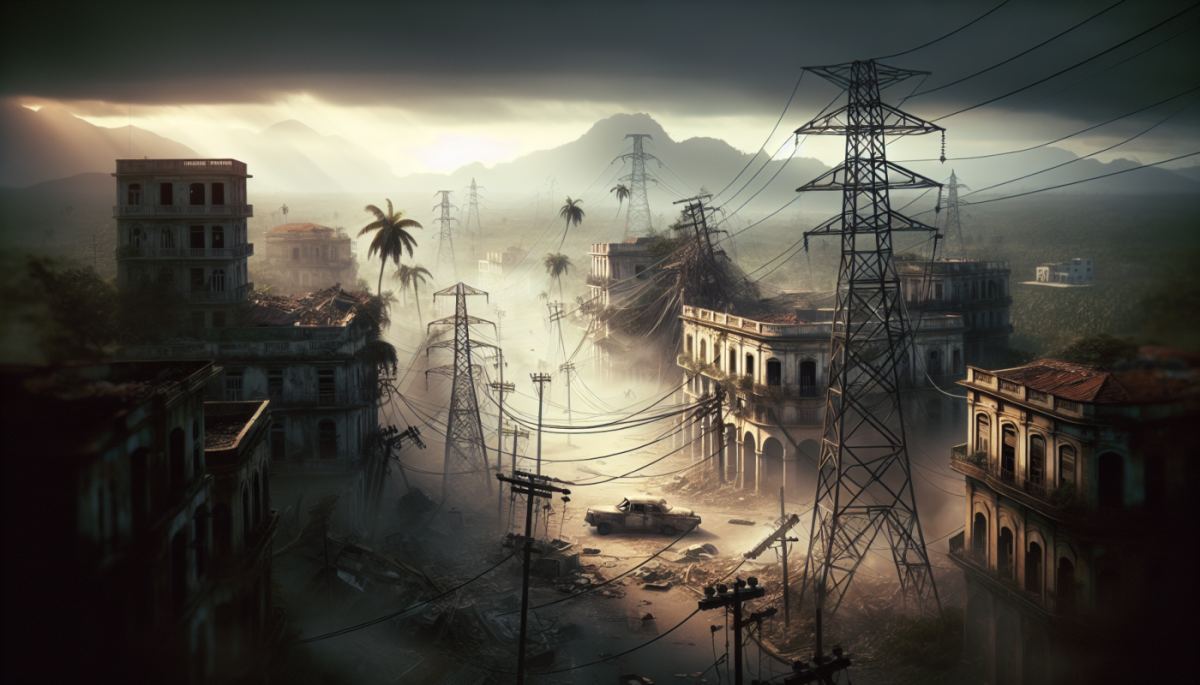
The lights went out across Cuba all at once. Not neighborhood by neighborhood, not city by city, but everywhere, simultaneously, leaving all 11 million Cubans without power in what officials are calling a total "disconnection" of the national energy grid. It is the largest blackout the island has experienced since the United States tightened its energy blockade earlier this year, and it arrives at a moment when the Cuban state's capacity to absorb shocks of any kind has been stretched to something close to its limit.
To understand why this happened, you have to look past the immediate failure and into the architecture of fragility that made it possible. Cuba's electricity infrastructure was already operating well below safe thresholds before the grid went dark. Aging Soviet-era generation equipment, chronic fuel shortages, and years of deferred maintenance had turned the national grid into something closer to a controlled emergency than a functioning utility. Rolling blackouts of eight, ten, even sixteen hours a day had become normalized across the island over the past two years. The total collapse, in that context, was not an anomaly. It was the logical endpoint of a system being asked to do far more than it was ever designed to do, with far fewer resources than it requires.
The tightening of U.S. energy restrictions earlier this year removed one of the last pressure-release valves the Cuban government had been relying on. With access to fuel imports further constrained, the state utility was left managing a generation deficit it could not close. Thermoelectric plants that were already running intermittently began failing more frequently. When one major plant trips offline in a grid this fragile, the cascading effect on frequency and voltage can pull other stations down with it in a matter of seconds. That is almost certainly what happened here. Engineers call it a cascade failure. For the 11 million people sitting in the dark, it is something more immediate than a technical term.
Blackouts at this scale are never just an inconvenience. They are a public health event. Hospitals running on backup generators face fuel constraints of their own. Refrigerated medicines, including insulin, begin to degrade within hours. Water pumping systems go offline, which in a tropical climate creates sanitation risks that compound quickly. Food stored in homes and small businesses spoils. For a population already navigating severe food shortages, that loss is not recoverable.
The social pressure this creates is also not trivial. Cuba has seen significant protest activity in recent years, most notably the July 2021 uprisings that spread across dozens of municipalities. The government managed that moment through a combination of internet shutdowns, arrests, and eventually some concessions on economic policy. A nationwide blackout removes the digital tools the state uses to monitor and manage dissent, but it also removes the tools ordinary Cubans use to organize and communicate. The darkness cuts both ways.
What makes this moment particularly consequential is the feedback loop it creates between energy failure and economic failure. Without reliable electricity, what remains of Cuba's productive economy, its small private businesses, its agricultural processing, its tourism infrastructure, cannot function. Every hour of blackout is an hour of lost output in an economy that has already contracted sharply. That contraction reduces the government's revenue, which reduces its ability to import fuel, which makes the next blackout more likely. The system is not just failing. It is failing in a way that makes recovery progressively harder.
The Cuban government will restore power, at least partially. It has done so before and will frame the restoration as evidence of resilience. But the structural conditions that produced this collapse will not have changed. The grid will return to its previous state of managed deterioration, and the next total disconnection will require a smaller triggering event than this one did.
The more interesting question is what this moment does to the calculus of the roughly 500,000 Cubans who have emigrated in the past three years alone, and to those still weighing that decision. Infrastructure collapse of this magnitude is not just a hardship. It is a signal about the state's capacity to provide the basic conditions of modern life. When a government cannot reliably keep the lights on, it loses something harder to restore than electricity: the ambient sense among its citizens that staying is a viable choice.
The grid may come back. The people who left because of nights like this one will not.
Discussion (0)
Be the first to comment.
Leave a comment