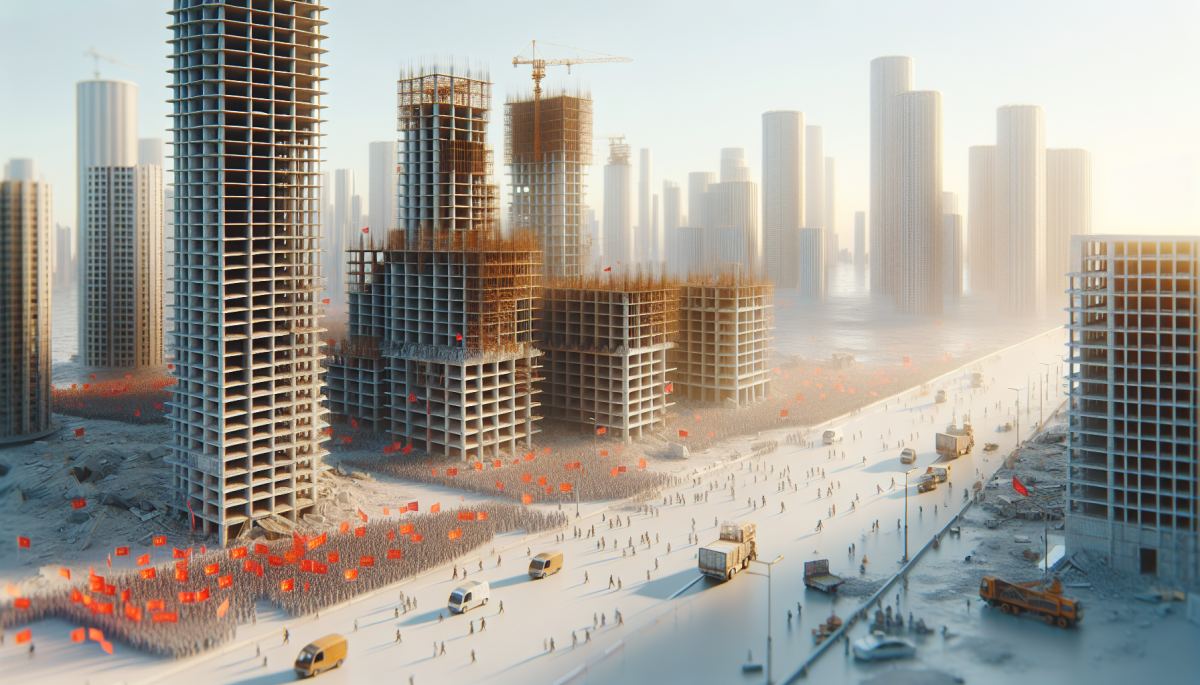
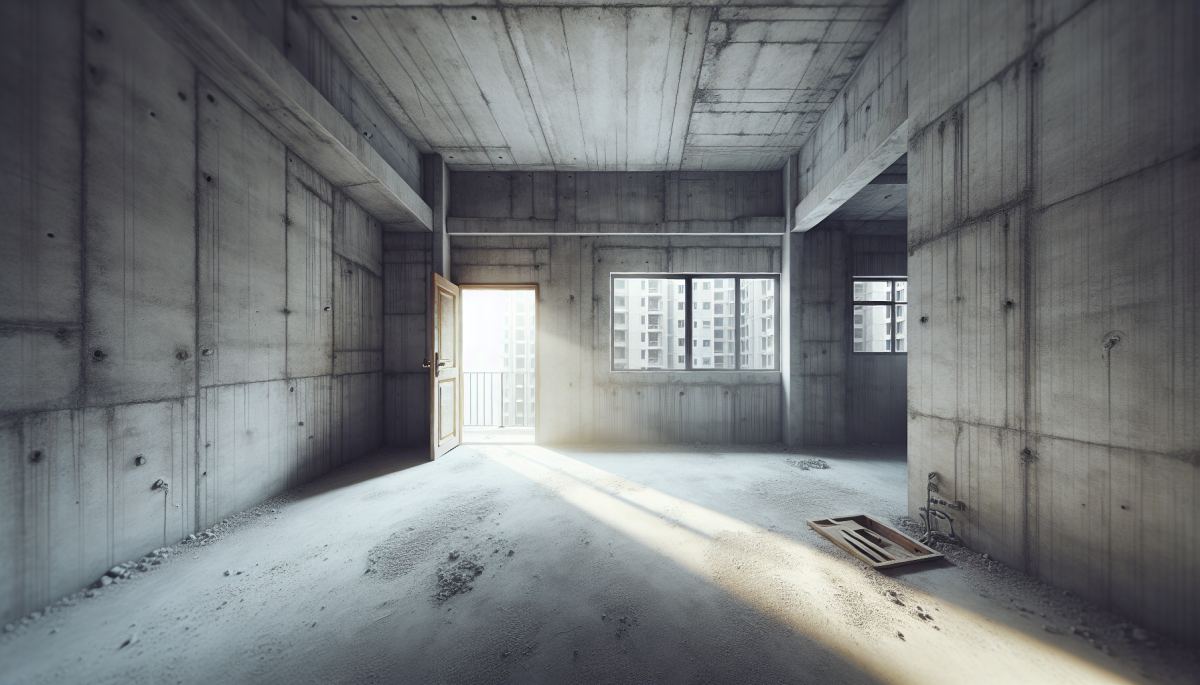
When Chinese homebuyers hand over their life savings for a new apartment, they are not simply purchasing square footage. They are buying into a social contract, one that promises stability, upward mobility, and a secure future. That contract is now visibly cracking, sometimes quite literally, as buyers across the country document warped walls, leaking roofs, substandard concrete, and doors that won't close in newly delivered units. The fury this has generated is not merely about bad construction. It is about a system that has failed people at every level, and the feedback loops that failure is now setting in motion.
China's property sector accounts for roughly 25 to 30 percent of GDP when upstream and downstream industries are included, making it one of the most consequential economic engines in the world. For decades, developers competed fiercely to acquire land, presell units, and use buyer deposits to fund construction, a model that prioritized speed and volume over quality. The result was a vast pipeline of apartments built under intense cost pressure, where corners were quietly cut at every stage. Buyers, many of whom purchased units years before completion, had little legal recourse and even less leverage. Regulators, often closely tied to local governments that depended on land sales for revenue, had limited incentive to enforce standards aggressively.
The crisis that began with Evergrande's collapse in 2021 did not create these quality problems, but it made them impossible to ignore. As developers ran out of cash, construction stalled or was handed to cheaper subcontractors scrambling to finish projects on skeleton budgets. Buyers who had already paid in full began receiving keys to apartments that looked nothing like the showroom models they had toured. Social media platforms, particularly Weibo and Douyin, became clearinghouses for grievance, with homeowners posting side-by-side comparisons of promised finishes and delivered reality. The phrase "lanjie lou," meaning rotten-tail buildings, entered everyday vocabulary.
The structural incentives here are worth examining carefully. China's presale model, in which buyers pay upfront for units that don't yet exist, transfers enormous financial risk onto consumers while insulating developers from accountability until long after the money has changed hands. Local governments, which derive a significant share of their fiscal revenue from land auction proceeds, have historically been reluctant to crack down on developers too harshly, since doing so risks slowing the very activity that funds public services. This created a regulatory environment where quality standards existed on paper but enforcement was inconsistent at best.
Beijing has acknowledged the problem. Regulators have introduced escrow requirements for presale funds in some cities, attempting to ensure that buyer deposits are actually used for construction rather than siphoned off to service developer debt. Some municipalities have piloted "completed home" sales models, where buyers only pay upon delivery of a finished unit. But these reforms are uneven, slowly implemented, and face fierce resistance from developers and local governments alike, both of whom benefit from the existing cash-flow structure.
The deeper issue is one of trust, and trust, once lost in a market this large, is extraordinarily difficult to rebuild. Surveys of Chinese consumer sentiment have shown persistent reluctance to re-enter the property market even as prices have softened and government stimulus has attempted to revive demand. When people believe that what they buy may not be what they receive, no interest rate cut or down payment subsidy fully compensates for that uncertainty.
The cascading effects extend well beyond individual homeowners. China's construction materials industry, its furniture and appliance sectors, and the vast network of migrant workers who depend on active building sites are all exposed to a prolonged demand slump driven partly by this erosion of buyer confidence. More subtly, the anger over building quality is feeding a broader skepticism about institutional reliability that could reshape how Chinese households allocate savings for a generation. If property is no longer the default store of value it once was, and if trust in developers has collapsed, where does that capital flow? Into gold, overseas assets, or simply into bank deposits earning minimal returns, none of which generates the domestic consumption that Chinese policymakers desperately need to rebalance the economy.
The homebuyer rage visible on Chinese social media today is not just a consumer complaint movement. It is a signal that the social compact underpinning three decades of property-driven growth has been fundamentally damaged. Whether China's regulators can rebuild that compact through genuine enforcement reform, rather than incremental policy patches, may determine the pace of the country's economic recovery far more than any headline stimulus figure suggests.
Discussion (0)
Be the first to comment.
Leave a comment