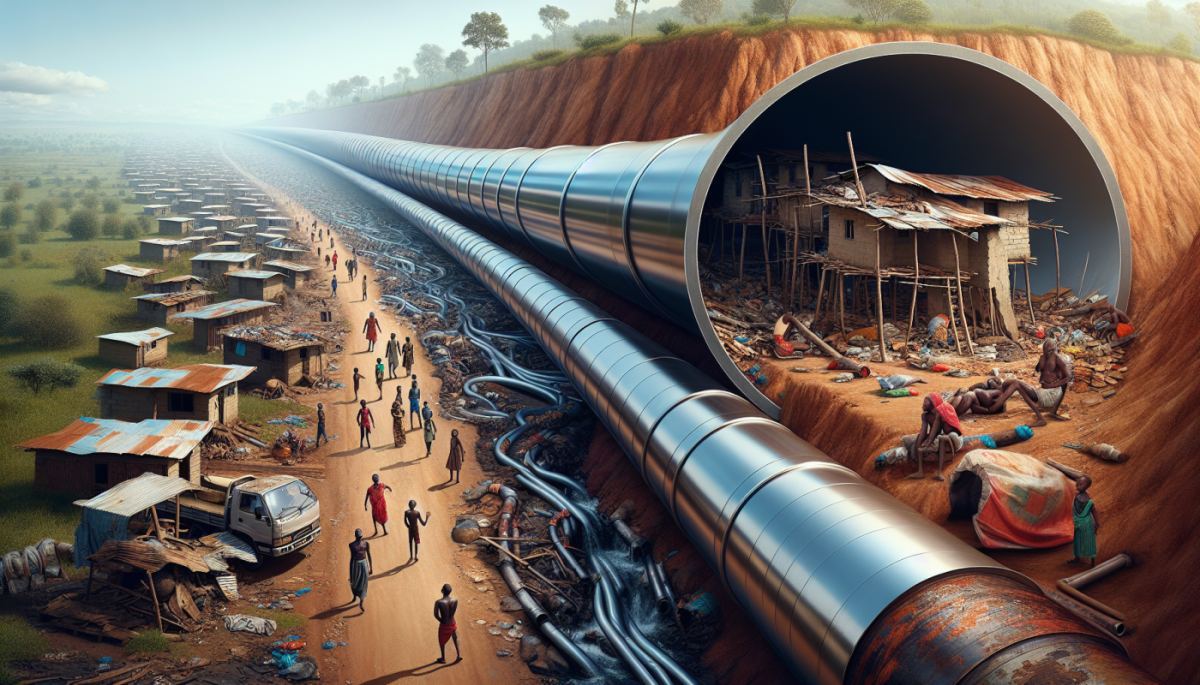
When TotalEnergies and the Tanzania-Uganda pipeline consortium promised that the East African Crude Oil Pipeline would bring prosperity to the region, the communities living along its 1,443-kilometre route had reason to be cautiously hopeful. Compensation frameworks were drawn up, resettlement plans were announced, and the language of "benefit sharing" filled the project documents. What has followed, according to reporting by Climate Home News, is something far more familiar to anyone who has studied extractive industry projects across the Global South: a gap between what was promised and what was delivered that is wide enough to swallow livelihoods whole.
The people most directly affected, those who lost farmland, grazing rights, or access to water sources along the pipeline corridor in Uganda, do not believe the compensation programmes left them better off. That is not a minor administrative complaint. It is a structural indictment of how large infrastructure projects continue to treat affected communities as line items to be managed rather than stakeholders whose long-term wellbeing is a genuine measure of project success.
The mechanics of pipeline compensation in low-income countries tend to follow a predictable and troubling pattern. Land is valued at rates that reflect formal market prices, which in rural Uganda are often a fraction of what that land actually produces over a lifetime of farming or herding. One-time cash payments are made to households that have no prior experience managing lump sums and limited access to financial services or investment opportunities. The payment arrives, the pipeline construction proceeds, and within months or years the money is gone while the land remains inaccessible or degraded.
What rarely gets counted in these frameworks is what economists call the "replacement cost" of land: not just its market value, but the full productive value of the crops it would have yielded, the livestock it would have supported, the water it filtered, and the social and cultural meaning it held for families who had farmed it across generations. When compensation is calculated on market value rather than replacement cost, communities are structurally guaranteed to end up poorer. The arithmetic is not complicated. The political will to change it, however, has proven elusive across decades of similar projects from Nigeria to Myanmar.
The East African Crude Oil Pipeline has attracted sustained criticism from environmental and human rights groups precisely because it locks in fossil fuel infrastructure at a moment when the global energy transition is accelerating. But the compensation failures documented along its route represent a separate and equally urgent problem: the pipeline's social licence was built on promises that, by the accounts of the people who matter most, were not kept.
The immediate harm to displaced Ugandan families is serious enough on its own terms. But the second-order consequences of inadequate compensation deserve equal attention, because they tend to compound over time in ways that are difficult and expensive to reverse.
Communities that feel cheated by infrastructure projects do not simply absorb the loss and move on. They organise, they resist future projects, and they carry a justified institutional distrust that makes the next round of negotiations harder for everyone. In regions where governments are hoping to attract further investment in energy, agriculture, or transport infrastructure, a track record of broken compensation promises functions as a tax on future development. Investors face higher political risk premiums. Communities demand more upfront, having learned from experience. The cost of the original failure gets distributed across projects that have not yet been built.
There is also a feedback loop operating at the level of climate politics. Uganda and Tanzania have defended the pipeline partly on the grounds that African nations have a right to monetise their natural resources to fund development, the same path that wealthy nations took during their own industrialisation. That argument has genuine moral weight. But it is significantly weakened when the development benefits of the pipeline demonstrably fail to reach the Ugandan farmers and herders who bore its most direct costs. If the pipeline cannot be shown to have made its nearest neighbours better off, the development justification starts to look like a rationale that serves governments and corporations rather than the people invoked to defend it.
The communities along the pipeline corridor are, in a very real sense, the proof of concept for the entire argument. If they are worse off, the argument fails on its own terms.
As the first oil is eventually pumped through the pipeline and revenues begin flowing to Kampala, the question of whether any meaningful portion finds its way back to the people who gave up their land to make it possible will be one of the more consequential tests of whether resource extraction in East Africa has genuinely changed, or whether it has simply found new language for the same old arrangement.
Discussion (0)
Be the first to comment.
Leave a comment