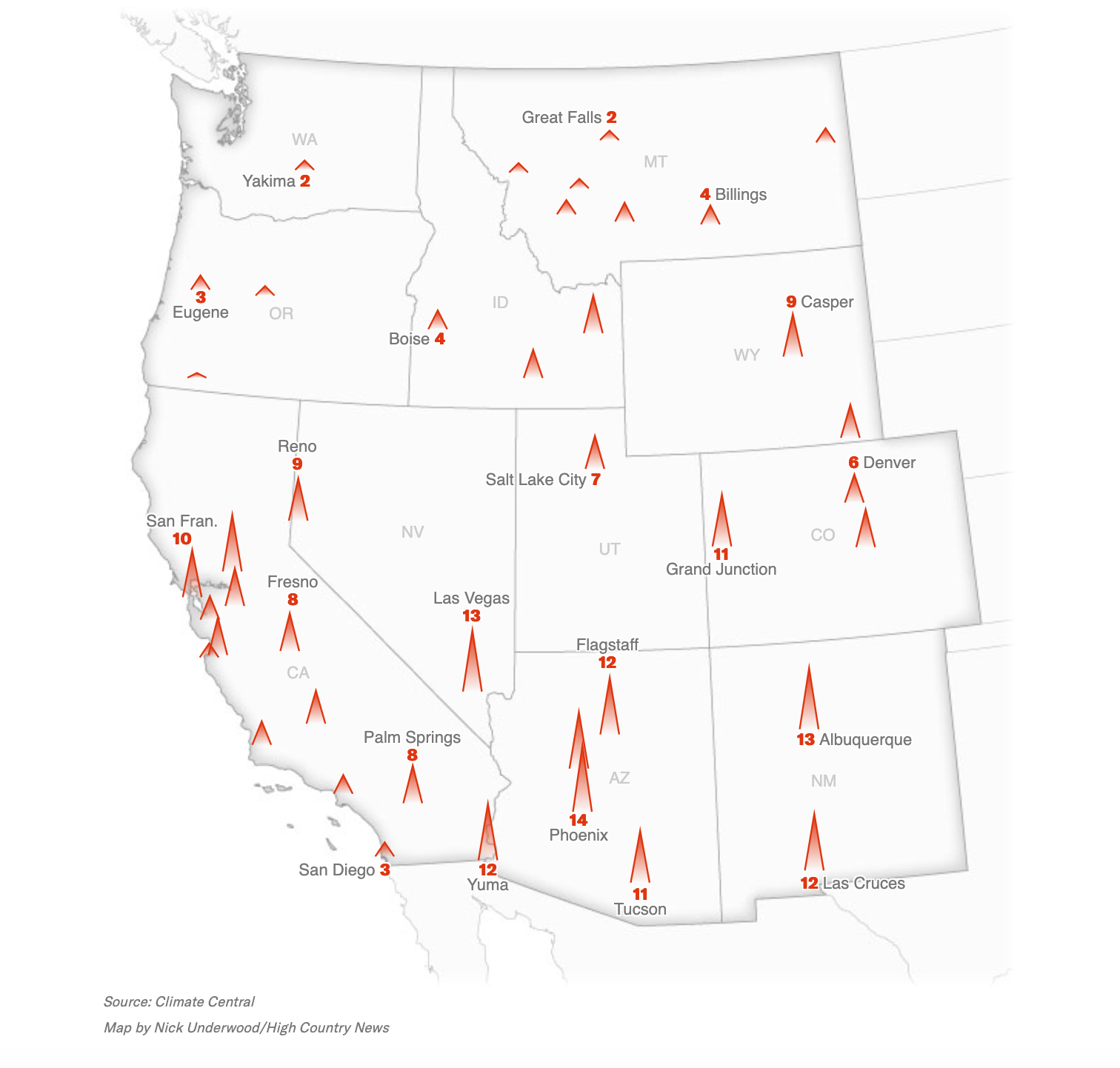
The winter was already struggling. Snowpack running thin, reservoirs not recovering the way they should, the kind of quiet desperation that land managers and hydrologists recognize but rarely say out loud. Then the heat arrived, and it didn't just close out a bad season. It shattered records and accelerated a cascade of ecological consequences that researchers are still scrambling to fully understand.
Across the American West, the combination of an underperforming winter and record-breaking spring and summer heat has created conditions that go well beyond a single bad year. What's unfolding is a compounding crisis, where each stressor weakens the system's ability to absorb the next one. Snowpack that melts too early doesn't just reduce summer water supplies. It shifts the entire phenological calendar, the timing of when plants bloom, when insects emerge, when migratory birds arrive, and when fish spawn. When those timings fall out of sync with each other, the consequences ripple outward in ways that are genuinely difficult to predict.
Ecologists have a term for this: phenological mismatch. It describes what happens when species that evolved together over millennia suddenly find themselves operating on different schedules. A wildflower that blooms two weeks early may miss its primary pollinator. A songbird that arrives on its ancestral schedule may find the insect hatch it depends on already finished. These mismatches don't kill ecosystems overnight, but they erode the redundancy and resilience that allow natural systems to absorb shocks.
The record heat compounds this by pushing temperatures beyond thresholds that many species simply haven't encountered before, at least not in the recent evolutionary past. Cold-water fish like trout and salmon are acutely vulnerable. Stream temperatures that exceed roughly 68 degrees Fahrenheit begin to cause physiological stress in many salmonid species, and prolonged exposure above that threshold can be lethal. In a year where snowmelt runs early and summer heat arrives hard, the window of thermally safe habitat shrinks dramatically, sometimes disappearing entirely in lower-elevation streams.
Forests face a different but equally serious reckoning. Drought stress weakens trees' ability to produce the resin that defends against bark beetle attacks. Warmer winters allow beetle populations to survive and reproduce at elevations and latitudes that once served as natural barriers. The result is a feedback loop: heat and drought stress trees, stressed trees fall to beetles, dead trees fuel larger and hotter wildfires, and those fires release stored carbon that contributes to further warming. Scientists tracking this loop in the Sierra Nevada and the Rocky Mountains have described it as a self-reinforcing cycle that is genuinely difficult to interrupt once it gains momentum.
What makes this moment particularly consequential is the question of ecological memory. Ecosystems are not static. They carry forward the effects of past disturbances, and a system that has absorbed several consecutive years of heat, drought, and fire is not the same system it was a decade ago. Its seed banks are depleted. Its soil microbiomes are altered. Its predator-prey relationships have shifted. When the next extreme event arrives, and in the current climate trajectory it will, it lands on a landscape that is already compromised.
The second-order effect that deserves more attention is what this means for human communities that depend on these ecosystems, not just for recreation or aesthetics, but for water, for flood control, for the natural filtration that keeps municipal supplies clean. Forests that burn severely and repeatedly stop functioning as watersheds. The soil becomes hydrophobic, repelling water rather than absorbing it, which means that when rain does fall, it runs off fast and dirty, carrying sediment into reservoirs and treatment systems that weren't designed to handle that load.
Water managers in cities like Denver, Salt Lake City, and Los Angeles are already grappling with the upstream consequences of degraded forest watersheds. The infrastructure costs of treating sediment-laden water, of building additional storage to compensate for lost snowpack retention, run into the billions. Those costs will ultimately land somewhere, on ratepayers, on municipal budgets, on federal disaster accounts.
The West has always been a place defined by its relationship with scarcity and extremes. But the record heat closing out an already punishing winter is not simply another chapter in that long story. It may be the moment when the pace of change outstrips the adaptive capacity of both ecosystems and the human systems built around them. The real question now is not whether the West can return to some prior equilibrium, but whether it can build new ones fast enough to matter.
References
- Parmesan, C. (2006) — Ecological and Evolutionary Responses to Recent Climate Change
- Westerling, A.L. et al. (2006) — Warming and Earlier Spring Increase Western U.S. Forest Wildfire Activity
- Pörtner, H.O. et al. (2022) — IPCC Sixth Assessment Report: Impacts, Adaptation and Vulnerability
- Isaak, D.J. et al. (2012) — Climate Change Effects on Stream and River Temperatures Across the Northwest U.S.
- Bladon, K.D. et al. (2014) — Wildfire and the Future of Water Supply
Discussion (0)
Be the first to comment.
Leave a comment