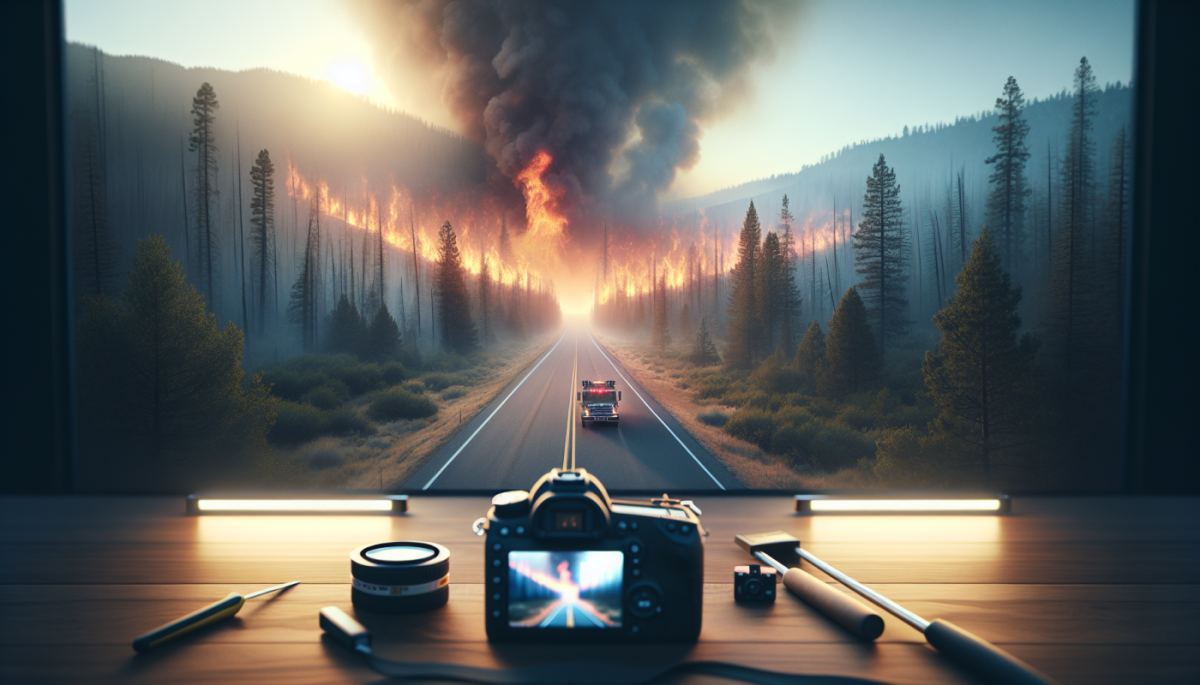
The federal government's argument for opening up America's roadless forests has always rested on a simple, intuitive logic: you cannot fight a fire you cannot reach. When the Trump administration moved to rescind the Roadless Area Conservation Rule, a Clinton-era protection covering roughly 58.5 million acres of national forest land, the U.S. Department of Agriculture framed the rollback as a matter of fire management urgency. Roads mean access. Access means suppression. The reasoning sounds almost self-evident, until you look at what the science actually says.
A growing body of research suggests the relationship between roads and wildfire runs in precisely the opposite direction from what officials have claimed. Rather than serving primarily as firebreaks or suppression corridors, roads into forested land are among the most reliable predictors of where human-caused ignitions will occur. Studies have consistently found that the overwhelming majority of wildfires in the United States, somewhere between 84 and 90 percent depending on the dataset, are started by people, and people follow roads. Campfires left burning, equipment sparks, cigarettes tossed from car windows: these are the ignition sources that roads deliver deep into landscapes that would otherwise remain buffered from human contact.

This is the central tension now sitting at the heart of the USDA's forthcoming draft environmental impact statement for the rescission. The agency must weigh its stated fire management rationale against evidence that the infrastructure it wants to build could increase the very risk it claims to be reducing.
The systems-level problem here is not just that roads bring fire. It is that roads bring fire into places where fire, once started, is hardest to control. Roadless areas tend to be the most remote, the most ecologically intact, and often the most densely vegetated portions of national forests. They are also, by definition, the areas where suppression resources take longest to arrive. Opening those areas to road construction does not simply add a suppression asset; it simultaneously adds an ignition risk in a high-consequence location. The net effect on fire probability is almost certainly negative.
There is also a longer feedback loop worth tracing. Road construction in forested terrain accelerates erosion, fragments habitat, and introduces invasive species along disturbed corridors. Invasive grasses in particular, which spread readily along roadsides, are highly flammable and can dramatically alter fire behavior by creating continuous fuel beds where discontinuous native vegetation once provided natural breaks. Research in the intermountain West has documented this dynamic extensively, showing that cheatgrass invasion, often road-facilitated, has fundamentally changed fire return intervals across millions of acres.
Timber harvesting, the other activity the rescission would expand, adds its own layer of complexity. Selective logging leaves behind slash, the branches and treetops stripped during harvest operations, which can create dense, dry fuel loads near the ground. Depending on how harvests are conducted and whether slash is treated afterward, logging can temporarily increase rather than decrease fire risk in the years immediately following operations.
None of this means that forest access is irrelevant to fire management. There are legitimate scenarios, particularly in areas already fragmented by existing roads, where improved access genuinely aids suppression. The problem is that the administration's argument has been applied as a blanket justification for a sweeping policy change affecting tens of millions of acres, many of which bear little resemblance to the fire-prone, access-limited landscapes where the access argument has its strongest footing.
The political economy driving the rescission is not difficult to read. The timber industry has long viewed the Roadless Rule as an obstacle to harvesting economically valuable stands in backcountry forests. Wildfire anxiety, which is entirely legitimate given the scale of recent fire seasons across the American West, provides a more publicly palatable frame for reopening that debate. When the USDA releases its draft environmental impact statement, the quality of its fire risk analysis will reveal whether the agency is genuinely grappling with the science or using fire as rhetorical cover for a predetermined outcome.
The second-order consequence most worth watching is what happens to fire insurance markets and rural property values in communities adjacent to newly roaded forests. If road expansion increases ignition frequency in high-risk terrain, the costs will not be borne by the timber interests that benefit from access. They will be distributed across federal suppression budgets, state emergency agencies, and the homeowners who find themselves in the path of fires that started somewhere a road was not supposed to go.
The draft EIS, when it arrives, will be a document worth reading very carefully, not for what it claims, but for what it chooses not to measure.
References
- Balch et al. (2017) — Human-started wildfires expand the fire niche across the United States
- Gookin et al. (2020) — Roads and Wildfire Risk in the Western United States
- Brooks et al. (2004) — Effects of Invasive Alien Plants on Fire Regimes
- U.S. Forest Service (2001) — Roadless Area Conservation Rule
Discussion (0)
Be the first to comment.
Leave a comment