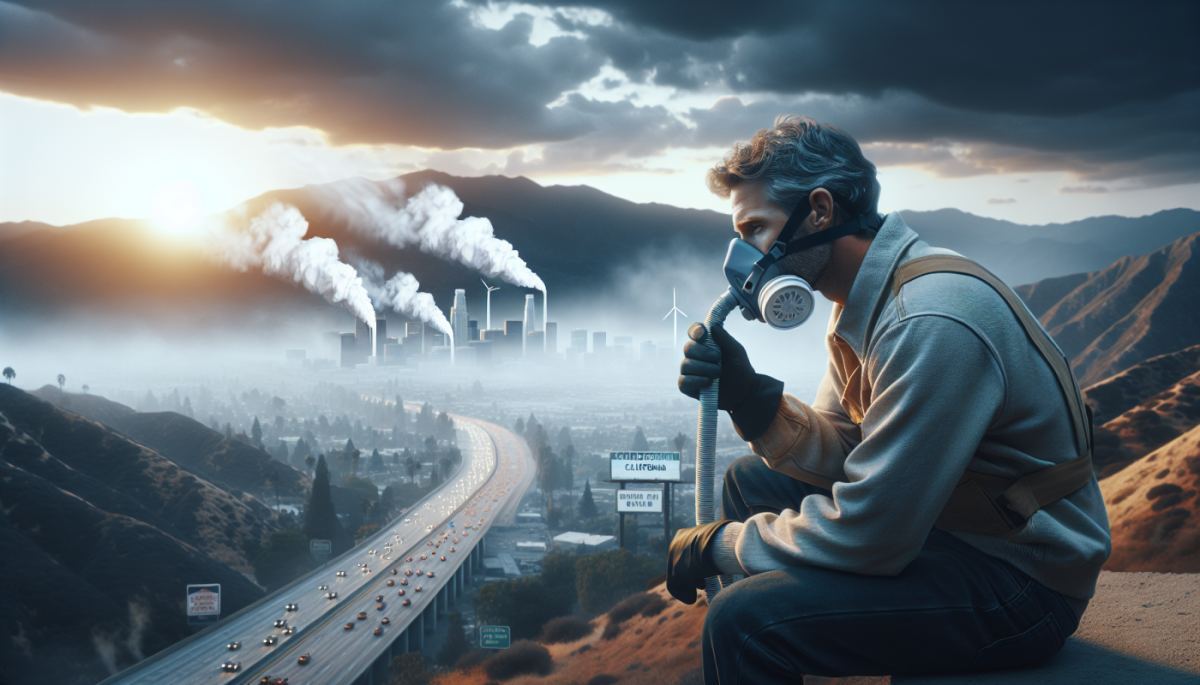
When the Trump administration revoked California's authority to set its own vehicle emissions standards earlier this year, it did not just strip a regulatory tool from the state's hands. It removed the cornerstone of an air quality architecture that dozens of other states had quietly built their own policies around. California's response, now taking shape in Sacramento, is to reach for something far less glamorous but potentially just as consequential: indirect source rules, a regulatory mechanism so obscure that most people outside environmental law circles have never heard of it.
The logic behind indirect source rules is elegant in its simplicity. Rather than regulating the trucks, ships, and trains directly, the state would hold the facilities that attract them accountable. Warehouses, ports, railyards, and distribution centers would face requirements to reduce the pollution generated by the vehicles flowing in and out of their gates. It is a form of liability transfer, shifting the burden from the exhaust pipe to the economic engine behind it. California's Air Resources Board has had this authority sitting in statute for years, but the political will to use it aggressively has never quite materialized until now.
The timing is not accidental. Communities in the Inland Empire, the San Joaquin Valley, and along the Port of Los Angeles corridor have some of the worst air quality in the United States. These are not abstract statistics. Diesel particulate matter and nitrogen oxides from freight movement contribute directly to elevated rates of asthma, cardiovascular disease, and premature death in neighborhoods that sit downwind of the logistics economy. Residents in places like Fontana and Wilmington have been raising these concerns for decades, and the regulatory system has moved slowly in response.

What makes the freight sector so difficult to regulate is that it operates as a tightly coupled system. A warehouse locates near a freeway to reduce shipping costs. That decision attracts more trucks. More trucks attract more warehouses. The cycle compounds, and the pollution burden concentrates geographically in communities that rarely have the political leverage to push back. Indirect source rules attempt to interrupt this loop by internalizing costs that the logistics industry has historically externalized onto surrounding neighborhoods and public health budgets.
The second-order effects of this approach could be significant. If California succeeds in making large freight facilities financially responsible for the emissions they generate, it changes the calculus for where and how those facilities are built. Developers might invest more heavily in electrification infrastructure, on-site charging for drayage trucks, or shore power for ships at berth, not because regulators mandated those specific technologies, but because the cost of not doing so becomes real and measurable. That kind of technology-neutral pressure has historically been more durable than prescriptive mandates, because it allows the market to find the most efficient path to compliance.
There is also a federalism dimension worth watching. California's vehicle emissions waiver, the one Trump revoked, was powerful precisely because other states could adopt California's standards under the Clean Air Act. Indirect source rules do not carry that same portability. They are a state-level tool, grounded in California's unique legal authority over stationary and quasi-stationary sources. That means the model, if it works, would need to be replicated state by state, a slower and more fragmented process than the waiver system allowed.
The freight and logistics industry has not been quiet about its concerns. Trade groups argue that holding facility operators responsible for the behavior of independent truckers and carriers creates an unfair and unworkable compliance burden. There is a genuine legal and practical tension here. A warehouse operator does not own the trucks that service it. Requiring that operator to somehow guarantee the emissions profile of hundreds of independent contractors raises real questions about enforceability and due process.
But environmental attorneys and public health advocates counter that this framing misunderstands how economic power actually flows in the logistics sector. Large shippers and facility operators have enormous leverage over the carriers they hire. Contract terms, preferred vendor lists, and access to loading docks are all levers that could be used to incentivize cleaner equipment. The industry's claim of helplessness, they argue, does not survive scrutiny.
What California is really testing is whether environmental regulation can keep pace with a supply chain economy that has been deliberately structured to diffuse accountability. If indirect source rules prove enforceable and survive legal challenge, they could become a template not just for air quality, but for a broader rethinking of how regulators assign responsibility in systems designed to make responsibility hard to find.
Discussion (0)
Be the first to comment.
Leave a comment