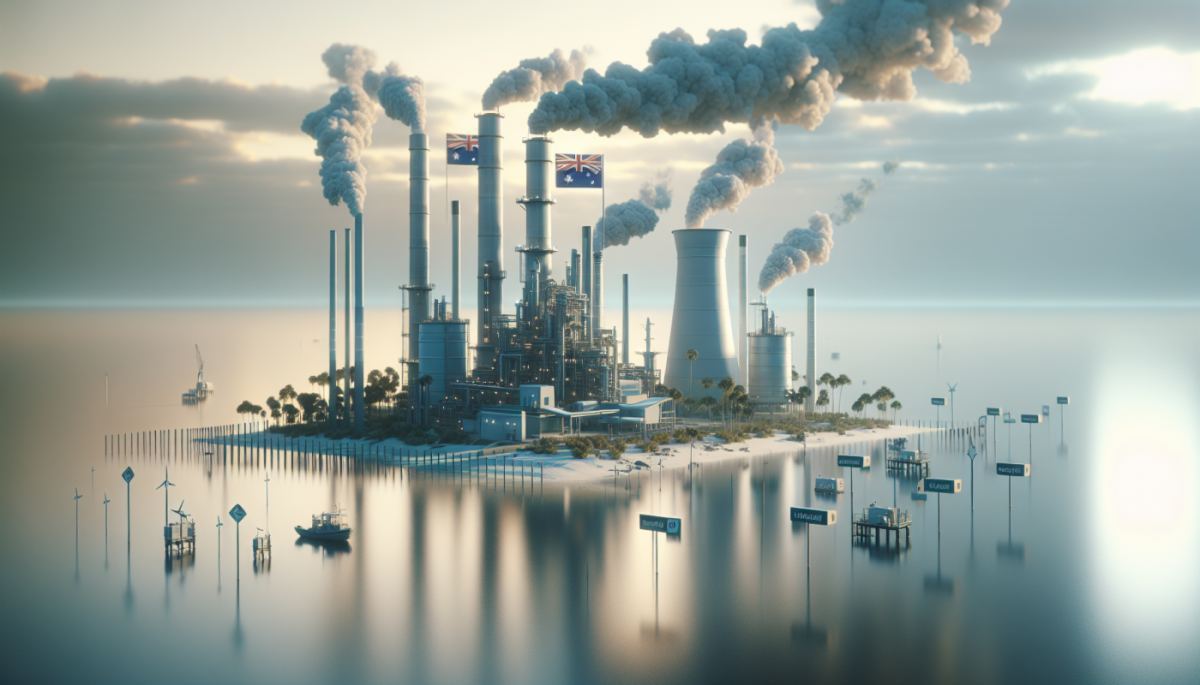
Australia exports more liquefied natural gas than almost any country on earth, yet it remains dangerously dependent on imported liquid fuels to keep its economy moving. That paradox has never looked more glaring than it does right now, as conflict in the Middle East rattles global energy markets and exposes just how thin the country's strategic fuel reserves actually are. The conversation about renewables and electric vehicles is often framed as an environmental one. Increasingly, it needs to be understood as a matter of national survival.
For years, Australia has maintained fuel stockholding levels that fall well below the International Energy Agency's 90-day emergency reserve benchmark. At various points, the country has held fewer than 30 days of liquid fuel supply, a vulnerability that defense analysts and energy economists have flagged repeatedly without much political urgency following. The Albanese government did receive a classified report from the Office of National Intelligence examining how the climate crisis is likely to amplify national security threats, but that document has never been made public. Three years on, Australians are still in the dark about what their own intelligence community concluded. That opacity is itself a signal worth reading.
Australia's fuel supply chain runs through some of the world's most contested geography. A significant share of the refined petroleum products the country consumes passes through chokepoints in the Middle East and Southeast Asia, including the Strait of Hormuz and the Strait of Malacca. When tensions in those regions spike, so does the cost and uncertainty of supply. This is not a theoretical risk. It is a structural condition that Australian policymakers have chosen, through years of inaction, to simply absorb.
The domestic refining situation makes things worse. Australia has watched its refining capacity collapse over the past two decades, with the closure of major facilities leaving the country almost entirely reliant on imported refined fuels rather than crude it processes itself. The two remaining refineries, Ampol's Lytton plant in Queensland and Viva Energy's Geelong facility, represent a thin and fragile thread. Any disruption to shipping lanes, any sustained regional conflict, or any coordinated supply shock could leave Australian hospitals, farms, logistics networks, and defense assets scrambling for fuel within weeks.
This is the context in which the push toward renewable energy and electric vehicles should be understood. An EV charged on Australian-generated solar or wind power is not just a lower-emissions vehicle. It is a vehicle that runs on a domestic energy source that cannot be blockaded, sanctioned, or priced out of reach by a foreign government or a distant conflict. The energy security argument for electrification is, in many respects, stronger than the climate argument, at least in terms of its ability to cut through to voters and policymakers who remain skeptical of emissions targets.
The systems-level consequence that rarely gets discussed is what prolonged delay does to Australia's strategic options over time. Every year that the country's vehicle fleet remains predominantly petrol and diesel-powered is another year of deepening lock-in. Fuel infrastructure, vehicle supply chains, consumer habits, and urban planning all calcify around the assumption of liquid fuel availability. The longer that lock-in persists, the more expensive and disruptive the eventual transition becomes, and the narrower the window for managing it on Australia's own terms rather than in response to a crisis.
There is also a compounding effect on defense capability. The Australian Defence Force is itself a massive consumer of liquid fuels, and its operational planning is built around assumptions of supply continuity that may not hold in a high-intensity regional conflict. If civilian fuel stocks are already stretched, military logistics become a direct competition with the broader economy. Countries that have invested seriously in electrifying civilian transport and diversifying their energy base have, whether intentionally or not, also reduced the pressure on military fuel supply chains during emergencies.
The classified ONI report sits at the center of this problem. A democracy that cannot have an informed public conversation about the intersection of climate risk and national security is a democracy making strategic decisions with one hand tied behind its back. The argument for declassifying at least a summary of that report's findings is not just about transparency. It is about giving Australians the information they need to understand why the energy transition is not a luxury or an ideological project, but a practical hedge against a world that is becoming less stable, not more.
The Middle East will not be the last conflict to test the assumptions baked into Australia's energy infrastructure. The question is whether the country uses this moment to accelerate a transition it was already overdue to make, or waits until the next disruption makes the choice for it.
Discussion (0)
Be the first to comment.
Leave a comment