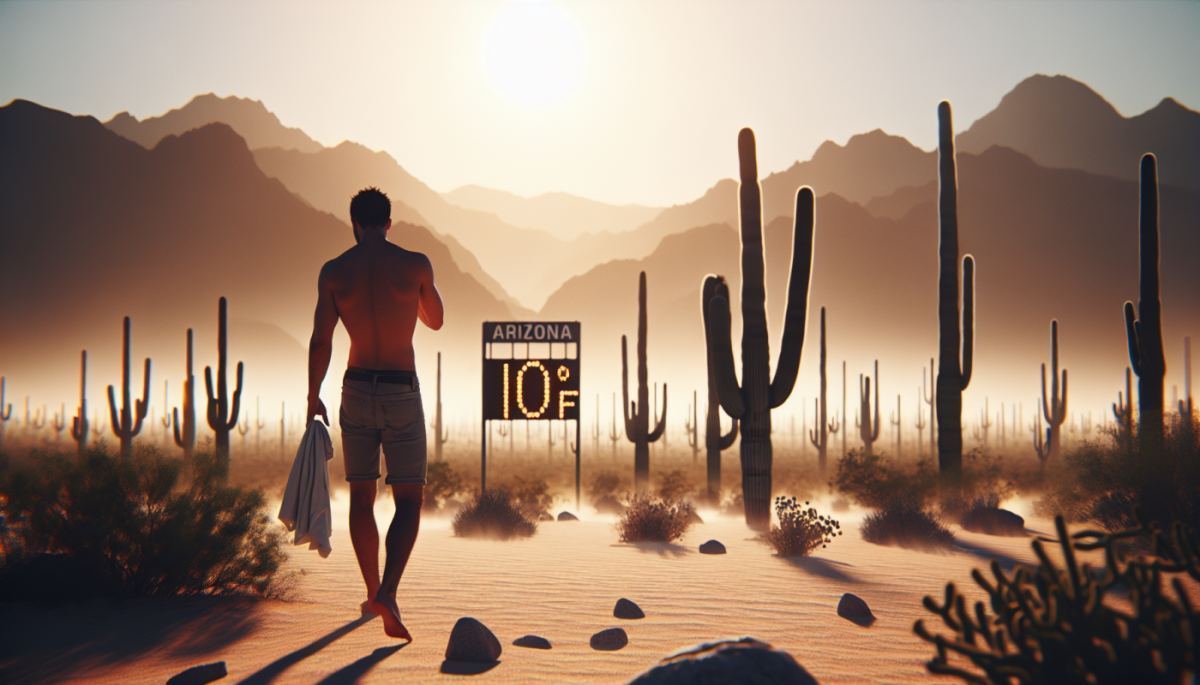
Martinez Lake, a small community roughly 145 miles west of Phoenix, did something on a Thursday in late March that no place in the United States had ever done before: it hit 110 degrees Fahrenheit, or 43.3 degrees Celsius, in a month that meteorologists still technically classify as late winter. The record, confirmed by weather observers tracking the southwestern heatwave, is not just a number. It is a signal that the desert Southwest is operating under a fundamentally different atmospheric regime than the one that shaped the climate baselines we still use to define "normal."
For context, 110°F is a temperature that Phoenix, one of the hottest cities on Earth, typically does not reach until late May or June. Seeing that threshold crossed in March, in a community that sits along the lower Colorado River near the California border, compresses the seasonal calendar in ways that carry consequences far beyond the discomfort of residents. The heat arrived as part of a broader southwestern baking event, with high pressure systems anchoring themselves over the region and producing the kind of sustained warmth that used to be reserved for the deep heart of summer.
The danger in treating a broken record as a curiosity is that it obscures a pattern. The American Southwest has been warming at roughly twice the global average rate, a trend documented extensively by climate scientists tracking the region's aridification. The Colorado River basin, which Martinez Lake sits adjacent to, has already lost a significant portion of its flow over the past two decades, driven in large part by heat-driven evaporation and reduced snowpack in the Rockies. A March that behaves like June accelerates that process. Snowmelt that should trickle into reservoirs over weeks instead rushes and evaporates. Soil moisture deficits deepen before the summer monsoon season even begins.
There is also an energy grid dimension that rarely gets discussed when these records are announced. Utilities in Arizona and neighboring states plan their peak demand forecasts around historical temperature curves. When March starts pulling electricity demand that belongs to July, grid operators face a planning gap. Air conditioning loads spike before utilities have fully transitioned from winter operating protocols, and before some seasonal generation capacity is fully online. The February 2021 Texas grid failure demonstrated, catastrophically, what happens when weather events arrive outside the window that infrastructure was designed to handle. Arizona is not Texas, and its grid architecture differs, but the underlying vulnerability, systems built for a climate that no longer exists, is shared.
Perhaps the most underappreciated second-order consequence of a record like this one is what it does to the urban heat island effect in the weeks that follow. When desert soils dry out earlier in the year due to anomalous heat, they lose their capacity to absorb and slowly release moisture. That drier surface then radiates heat more aggressively, reinforcing the high pressure systems that caused the warmth in the first place. It is a feedback loop: early heat dries the land, dried land amplifies subsequent heat, amplified heat extends the anomaly further into the season.
For communities like Martinez Lake, which sits in one of the most economically marginal and geographically isolated stretches of the lower Colorado River corridor, the human stakes are immediate. Outdoor workers, many of them in agriculture or along the river's recreational economy, face physiological limits that a thermometer reading of 110°F in March simply does not give them time to adapt to. The body's heat acclimatization process takes roughly 10 to 14 days of graduated exposure. A sudden March spike offers none of that runway.
Meteorologists will note, correctly, that a single record does not rewrite climate science. But the accumulation of such records, each one described as unprecedented at the time of its breaking, is itself the story. The Southwest is not experiencing a bad stretch of weather. It is experiencing the early operational phase of a hotter baseline, one where the question is no longer whether March can reach 110°F, but how soon that temperature stops being considered remarkable at all.
References
- Overpeck et al. (2013) — The Southwest North America Study of Climate Change
- Williams et al. (2020) — Large contribution from anthropogenic warming to an emerging North American megadrought
- NOAA National Centers for Environmental Information (2024) — U.S. Climate Extremes Index
- Milly et al. (2008) — Stationarity Is Dead: Whither Water Management?
Discussion (0)
Be the first to comment.
Leave a comment