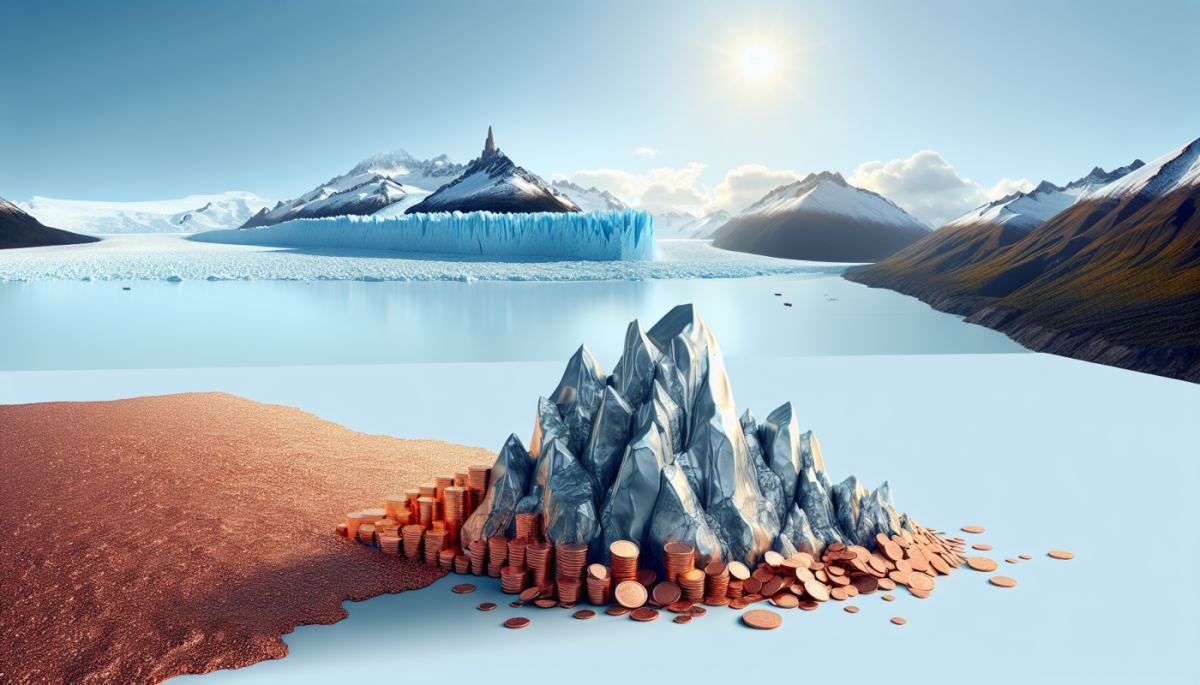
Argentina passed its Glacier Protection Law in 2010 after years of fierce lobbying from mining companies and environmental groups locked in open conflict over the country's high-altitude water reserves. The law was considered a landmark: it prohibited industrial activity, including mining and oil extraction, within glacier perimeters and the permafrost zones that feed them. For over a decade, it stood as one of the most protective pieces of environmental legislation in Latin America. Now President Javier Milei wants Congress to gut it.
The push is not incidental to Milei's broader economic project. It is central to it. Argentina sits atop some of the world's largest untapped copper deposits, concentrated in the Andean cordillera, the same mountain range where glaciers act as slow-moving freshwater reservoirs for millions of people living in arid western provinces like San Juan, Mendoza, and La Rioja. Copper prices have surged globally as the energy transition accelerates demand for wiring, electric motors, and grid infrastructure. For a government that inherited an economy with triple-digit inflation and a debt crisis, the arithmetic of a copper boom is hard to resist.
Milei's administration has framed the glacier law as an obstacle to investment, part of the regulatory thicket it blames for Argentina's chronic underperformance. The argument follows a familiar libertarian logic: that environmental restrictions imposed by the state distort markets and suppress growth that would otherwise lift living standards. But the glacier law was not written arbitrarily. It emerged from documented evidence that mining operations in the Andes were physically destroying ice formations and contaminating meltwater that downstream communities depend on for drinking, irrigation, and agriculture.
The stakes here are not abstract. Glaciers in the Argentine Andes function as natural water towers, storing precipitation during wet seasons and releasing it slowly through summer months when rivers would otherwise run low. In provinces like Mendoza, where viticulture and agriculture are economically significant, that glacial meltwater is not supplementary. It is foundational. The Intergovernmental Panel on Climate Change has repeatedly flagged Andean glaciers as among the most vulnerable to warming, with accelerated retreat already measurable across the region. Weakening legal protections at precisely the moment climate stress is intensifying is not a neutral policy choice. It is a compounding one.
Opponents of the reform, including environmental lawyers, provincial water authorities, and Indigenous communities whose territories overlap with the affected zones, argue that the economic case for relaxing the law is also weaker than it appears. Large-scale copper mining in glaciated terrain requires enormous volumes of water for processing ore, generates acid mine drainage that can persist for centuries, and leaves tailings infrastructure that has failed catastrophically in other Andean countries. The externalized costs, borne by ecosystems and downstream communities rather than mining companies, rarely appear in the investment prospectuses that governments wave at foreign capital.
There is a second-order consequence here that deserves more attention than it typically receives. If Argentina weakens its glacier law and accelerates copper extraction, it will be producing a metal that is genuinely essential to decarbonizing the global economy. Wind turbines, solar installations, and electric vehicles all require copper in significant quantities. The cruel irony is that the infrastructure of the green transition depends on mining practices that can accelerate the very glacial retreat that climate change is already driving. Argentina would be trading its water security for a role in someone else's energy transition, with the profits flowing primarily to foreign mining corporations and the risks absorbed locally.
This is not a hypothetical. It is a pattern that has played out across the Andes in Chile and Peru, where communities near copper operations have spent decades fighting for clean water access while national governments pointed to export revenues as proof of shared benefit. The distribution of gains and losses in extractive economies is rarely as symmetrical as the headline GDP figures suggest.
What makes Argentina's situation particularly worth watching is that the glacier law itself has become a test case for how far Milei's deregulatory agenda can reach into environmental governance. If Congress agrees to amend it, the signal sent to other industries, and to other countries watching from the region, will be significant. Environmental protections that took years to build can be dismantled in a single legislative session, and the ecosystems they were designed to protect do not recover on political timescales. The glaciers will keep retreating regardless of what Congress decides. The question is whether Argentina accelerates that process in exchange for a copper boom whose benefits may prove far more temporary than the damage.
Discussion (0)
Be the first to comment.
Leave a comment