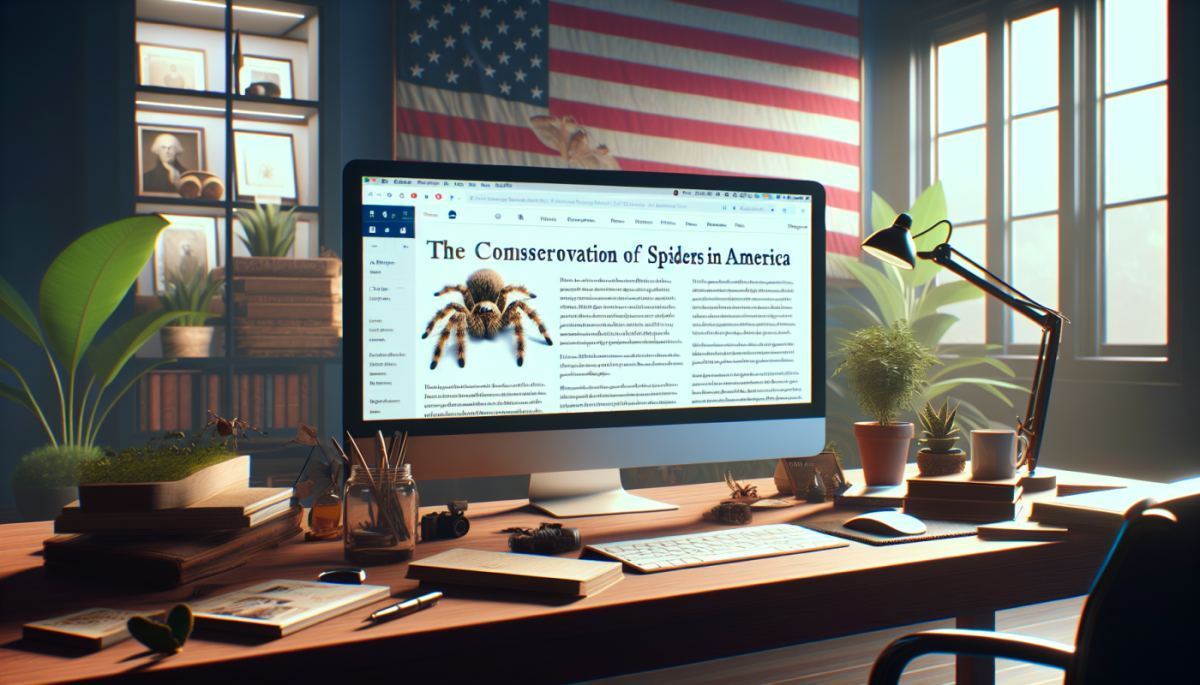
Most people, given the choice, would rather not think about spiders. That instinct is understandable and also, according to a growing body of research, genuinely dangerous. A new study has found that nearly 90% of North America's insect and arachnid species have no formal conservation status whatsoever, meaning scientists have no reliable way of knowing whether these populations are stable, declining, or quietly vanishing. For creatures that underpin nearly every terrestrial food web on the continent, that is a staggering blind spot.
The findings arrive at a moment when ecologists are already sounding alarms about what some are calling an "insect apocalypse." But while bees and butterflies have attracted conservation attention and public sympathy, arachnids, the class that includes spiders, scorpions, mites, and ticks, have been almost entirely left behind. The study reveals that most U.S. states do not protect a single arachnid species under state law. Not one. That is less a reflection of ecological reality than it is a reflection of cultural bias dressed up as policy.
Spiders alone consume an estimated 400 to 800 million tons of prey annually, a figure that dwarfs the meat consumption of the entire human population. They are, in the language of ecology, a keystone pressure: remove them, and the insects they suppress explode in number, reshaping plant communities, agricultural systems, and the broader food chains that depend on both. Arachnids also serve as prey themselves, feeding birds, reptiles, amphibians, and small mammals. Their webs trap and recycle nutrients. Their venom has yielded compounds being studied for pain management and neurological conditions. The economic and medical value embedded in these creatures is not hypothetical. It is already being extracted, just not acknowledged in the conservation frameworks that are supposed to protect them.
The core problem is one of data poverty compounded by institutional inertia. Conservation status assessments require baseline population data, long-term monitoring, and taxonomic expertise. Arachnology, the scientific study of spiders and their relatives, is one of the most underfunded fields in biology. There are fewer professional arachnologists in North America than there are employees at a mid-sized grocery chain. Without specialists, species go undescribed. Without descriptions, they cannot be assessed. Without assessments, they cannot be listed. Without listings, they receive no legal protection and no dedicated funding. The system, in other words, is structured to ignore what it cannot see.
This is where systems thinking reveals something that straightforward reporting tends to miss. The absence of conservation status is not simply a gap in the data. It is a self-reinforcing feedback loop. When a species has no status, it generates no regulatory pressure on developers, agricultural operators, or land managers. No pressure means no incentive to fund monitoring. No monitoring means no data. No data means no status. The loop closes, and the species continues declining in the dark.
That dynamic has already played out with insects more broadly. Research published in journals including Science and Biological Conservation has documented declines of 40% or more in insect biomass across multiple regions, often in areas where no one was formally watching. By the time the data existed to confirm the collapse, the window for early intervention had closed. With arachnids, the scientific community may be watching the same slow-motion crisis from an even greater distance.
There is also a second-order consequence worth naming directly. Arachnids are among the most sensitive bioindicators of habitat quality. Their presence, diversity, and abundance reflect the health of the soil, the moisture regime, the structural complexity of vegetation, and the absence or presence of pesticide contamination. Losing the ability to track them does not just mean losing the spiders. It means losing one of the most reliable early-warning systems the natural world has ever produced.
The researchers behind this study are calling for expanded monitoring programs, greater investment in taxonomic science, and state-level legislative reform that would extend protection to invertebrates beyond the handful of charismatic species that currently qualify. Those are reasonable asks. Whether they gain traction may depend less on the science than on whether policymakers can be convinced that the creatures most people instinctively recoil from are, in fact, holding the living world together. That is a harder sell than saving the polar bear, but it may be the more consequential one.
If the history of conservation biology teaches anything, it is that the species we choose not to look at are often the ones we can least afford to lose.
References
- Dirzo et al. (2014) — Defaunation in the Anthropocene
- Sanchez-Bayo & Wyckhuys (2019) — Worldwide decline of the entomofauna: A review of its drivers
- Cardoso et al. (2011) — Overcoming ignorance: towards a rational classification for the conservation of arachnids
- Nyffeler & Birkhofer (2017) — An estimated 400–800 million tons of prey are annually killed by the global spider community
Discussion (0)
Be the first to comment.
Leave a comment