
Something unexpected turned up in the American atmosphere recently, and it wasn't supposed to be there at all. Researchers monitoring air quality stumbled across medium-chain chlorinated paraffins, known as MCCPs, drifting through the air over the United States. It marked the first confirmed detection of these industrial chemicals in the atmosphere anywhere in the Western Hemisphere, and the likely culprit wasn't a factory smokestack or a chemical spill. It was fertilizer made from treated sewage sludge, spread quietly across farmland as a routine agricultural practice.
MCCPs are synthetic chlorinated compounds used widely in industrial applications, including as plasticizers, flame retardants, and metalworking fluids. They belong to a broader family of chlorinated paraffins that have drawn increasing regulatory scrutiny in Europe and Canada for their persistence in the environment, their tendency to bioaccumulate in living tissue, and their suspected toxicity to aquatic organisms and mammals. The European Chemicals Agency has flagged them as substances of very high concern. Yet in the United States, they remain largely unregulated, and their presence in biosolids, the treated solid material left over from wastewater processing, has received almost no systematic attention.
The discovery reframes a problem that was already quietly growing. Biosolids have been land-applied as fertilizer for decades, promoted as a sustainable way to recycle nutrients back into agricultural soil. Roughly half of all biosolids generated in the U.S. are applied to land each year, according to the Environmental Protection Agency. What flows into municipal wastewater systems, from households, hospitals, and industrial facilities alike, ends up concentrated in that sludge. PFAS contamination from biosolids has already triggered a slow-moving public health crisis in farming communities across the country. The MCCP finding suggests the contamination picture may be considerably more complex than even that alarming story implies.
What makes this detection particularly significant from a systems perspective is the pathway it reveals. Contamination from biosolids has typically been understood as a soil and groundwater problem, something that leaches downward or runs off into nearby waterways. The idea that these chemicals could volatilize, lifting off the land surface and entering the atmosphere, opens an entirely different vector. Air doesn't respect property lines or watershed boundaries. A chemical that becomes airborne near a treated field in one county can travel hundreds of miles before settling somewhere else entirely, potentially onto food crops, into water supplies, or into the lungs of people who live nowhere near the original application site.
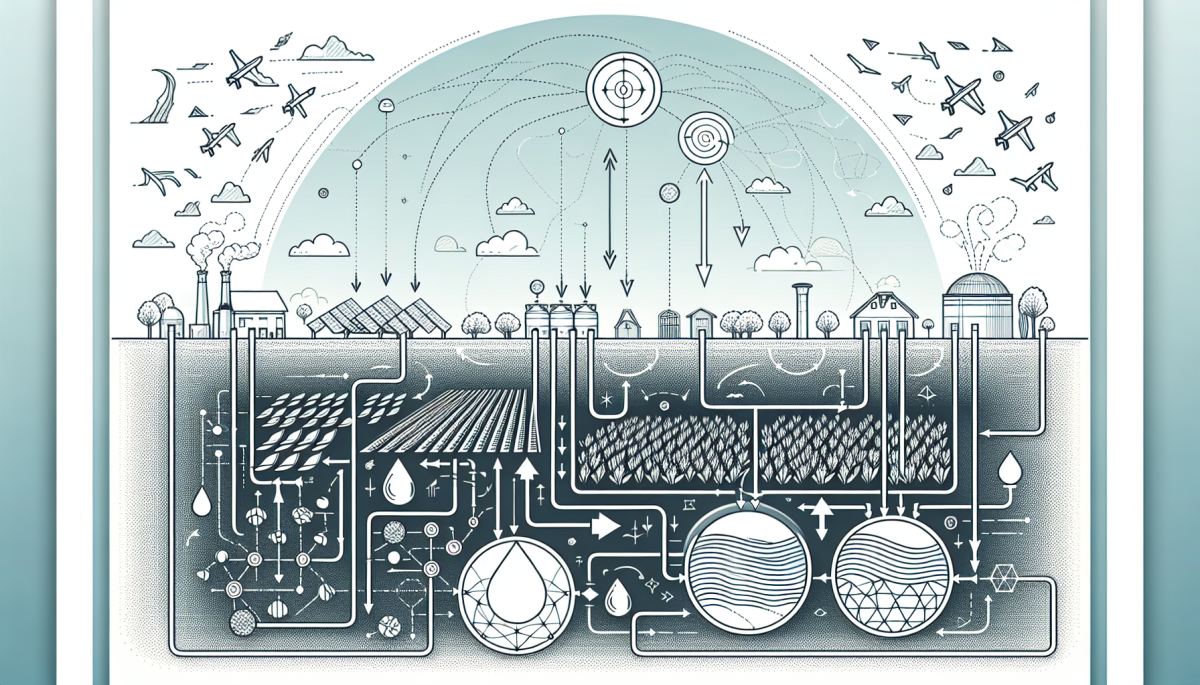
This is the kind of second-order consequence that tends to get missed when regulatory frameworks are built around single exposure pathways. The EPA's oversight of biosolids, last comprehensively updated in 1993, was designed around a world where the primary concern was pathogens and heavy metals. The explosion of synthetic chemical use in the decades since has loaded wastewater streams with compounds that the original framework simply wasn't designed to catch. Chlorinated paraffins, PFAS, pharmaceuticals, microplastics: the biosolids applied to American fields today carry a chemical fingerprint that bears almost no resemblance to what regulators were thinking about thirty years ago.
There is a feedback dynamic embedded in this story that deserves attention. The agricultural use of biosolids is actively encouraged by environmental policy because it reduces the volume of material that would otherwise go to landfills or incinerators, both of which carry their own environmental costs. Utilities and municipalities have strong financial incentives to land-apply sludge rather than pursue more expensive disposal alternatives. That incentive structure has remained largely intact even as the contamination evidence has accumulated, because the regulatory system has been slow to update its understanding of what's actually in the material being spread.
If atmospheric transport of MCCPs is confirmed as a genuine exposure pathway, the implications ripple outward quickly. It would mean that communities downwind of agricultural areas, not just those living on or near treated farms, have potential exposure. It would complicate efforts to trace contamination back to specific sources. And it would add pressure to an already strained debate about whether biosolids should continue to be classified as a beneficial use product at all, a classification that has shielded the practice from stricter scrutiny for decades.
The scientists who found MCCPs in American air were looking for something else entirely. That kind of accidental discovery has a way of pulling threads that unravel larger assumptions. The question now is whether regulators will follow where the data leads, or whether the gap between what is known and what is acted upon will continue to widen.
References
- EPA (2023) — Biosolids Laws and Regulations
- ECHA (2023) — Chlorinated Paraffins
- Hamid et al. (2020) — A Review on the Occurrence, Distribution, and Fate of Chlorinated Paraffins in the Environment
- EPA (1993) — Standards for the Use or Disposal of Sewage Sludge (40 CFR Part 503)
- Pelch et al. (2019) — PFAS Health Effects Database
Discussion (0)
Be the first to comment.
Leave a comment