The Great Salt Lake has long been defined by what it lacks: fresh water. Decades of agricultural diversion, urban growth, and climate-driven drought have shrunk it to roughly half its historic surface area, leaving behind a cracked, mineral-crusted lakebed that generates toxic dust storms capable of reaching Salt Lake City within hours. But a discovery published earlier this year is forcing scientists to reconsider the lake's hydrology from the ground up, literally.
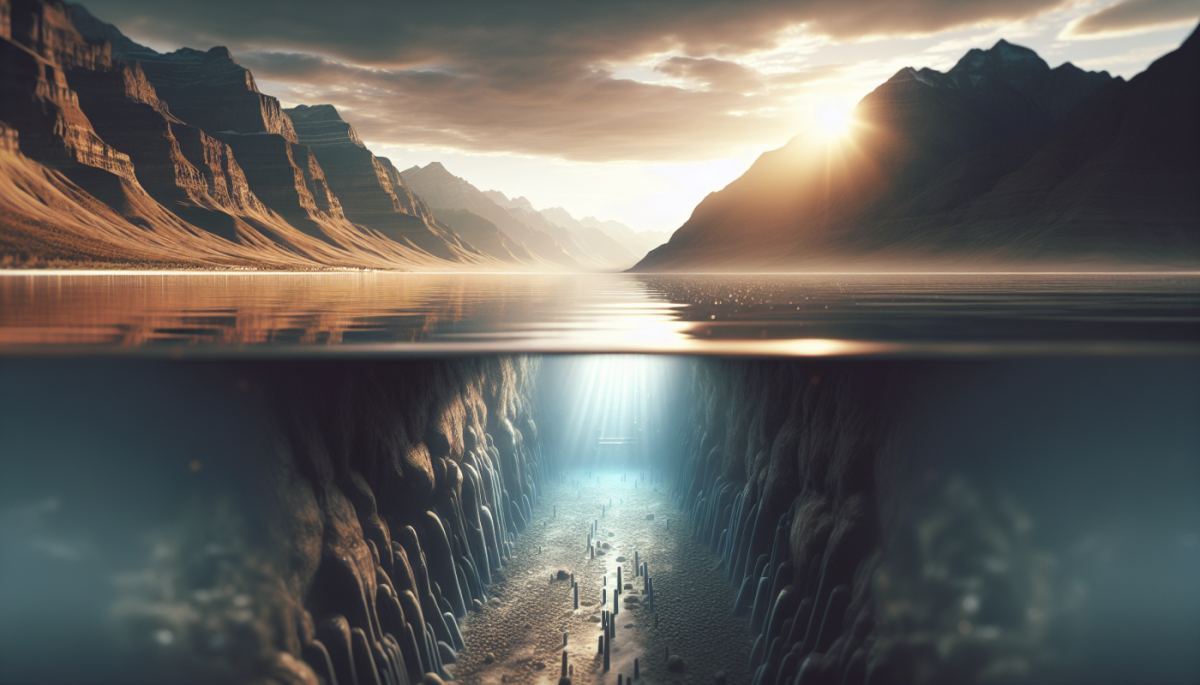
Using airborne electromagnetic surveys, a research team detected a vast freshwater reservoir hidden beneath the lake's hypersaline surface, extending to depths of up to four kilometers. The finding was not entirely accidental. Scientists had been puzzling over strange reed-covered mounds scattered across the lakebed, geological oddities that turned out to be formed by pressurized groundwater pushing upward through the sediment. Those mounds, easy to dismiss as curiosities, were in fact surface signatures of something enormous underneath.
The electromagnetic survey technology works by measuring how electrical currents move through subsurface materials. Fresh water and salt water conduct electricity very differently, which allowed researchers to map the boundary between the two with surprising precision. What they found was that freshwater extends far deeper and farther laterally than anyone had modeled or anticipated. The aquifer system is not a small, isolated pocket. It is a substantial, interconnected body of water sitting beneath one of the most stressed saline lakes in the Western Hemisphere.
The reed mounds are worth dwelling on, because they reveal something important about the system's dynamics. When groundwater is under enough pressure to push visibly through a lakebed and sustain plant life in an otherwise hostile saline environment, it signals that the aquifer is actively charged, not a static relic of wetter geological periods. This matters enormously for how scientists and water managers think about the lake's future.
The American West's water crisis is typically framed as a surface problem: shrinking rivers, depleted reservoirs, over-allocated irrigation rights. The Colorado River compact, negotiated in 1922 during an anomalously wet period, has become a symbol of how badly humans can miscalibrate long-term water planning. The Great Salt Lake's decline follows a similar logic. The Bear River, Weber River, and Jordan River collectively deliver the lake's freshwater inflows, and those flows have been systematically reduced over more than a century of upstream development. The lake has lost roughly 73 percent of its water volume as a result.
Against that backdrop, the discovery of a deep freshwater system raises an immediate and complicated question: could this water be used? Researchers are already investigating whether the underground reservoir might help suppress the hazardous dust that blows off the exposed lakebed. That dust contains arsenic, mercury, and fine particulate matter linked to respiratory illness, and it represents one of the most direct public health threats from the lake's decline. If pressurized groundwater could be managed to keep portions of the lakebed wet, it might reduce dust generation without requiring the politically fraught reallocation of surface water rights.
But here is where systems thinking becomes essential. Aquifers do not exist in isolation. They are recharged by surface water percolating downward over decades and centuries, and they are connected to the broader hydrological cycle in ways that are rarely fully mapped before extraction begins. The history of groundwater development in the American West is littered with cases where pumping one aquifer reduced flows in a connected river or dried up a neighboring well field years later. The Ogallala Aquifer, which underlies much of the Great Plains, is the most cited example: drawn down far faster than natural recharge rates, it is already effectively non-renewable in some sections.
If the freshwater system beneath the Great Salt Lake is being actively recharged by the same surface inflows that the lake itself depends on, then any significant extraction could create a feedback loop that accelerates the lake's decline rather than slowing it. Conversely, if the aquifer is largely fossil water, ancient precipitation locked in sediment over thousands of years, then it represents a one-time resource that would need to be managed with extraordinary care.
The researchers have not yet answered those recharge questions, and that uncertainty is the most important thing about this discovery. The find is genuinely exciting, a reminder that even heavily studied landscapes can hold structural surprises. But the history of the West suggests that the gap between discovering a water source and wisely managing it is where the real damage tends to happen. The reed mounds pushed their way to the surface for a reason. Whether humans respond to that signal with patience or urgency will likely determine whether this hidden reservoir becomes a lifeline or the next cautionary tale.
Discussion (0)
Be the first to comment.
Leave a comment