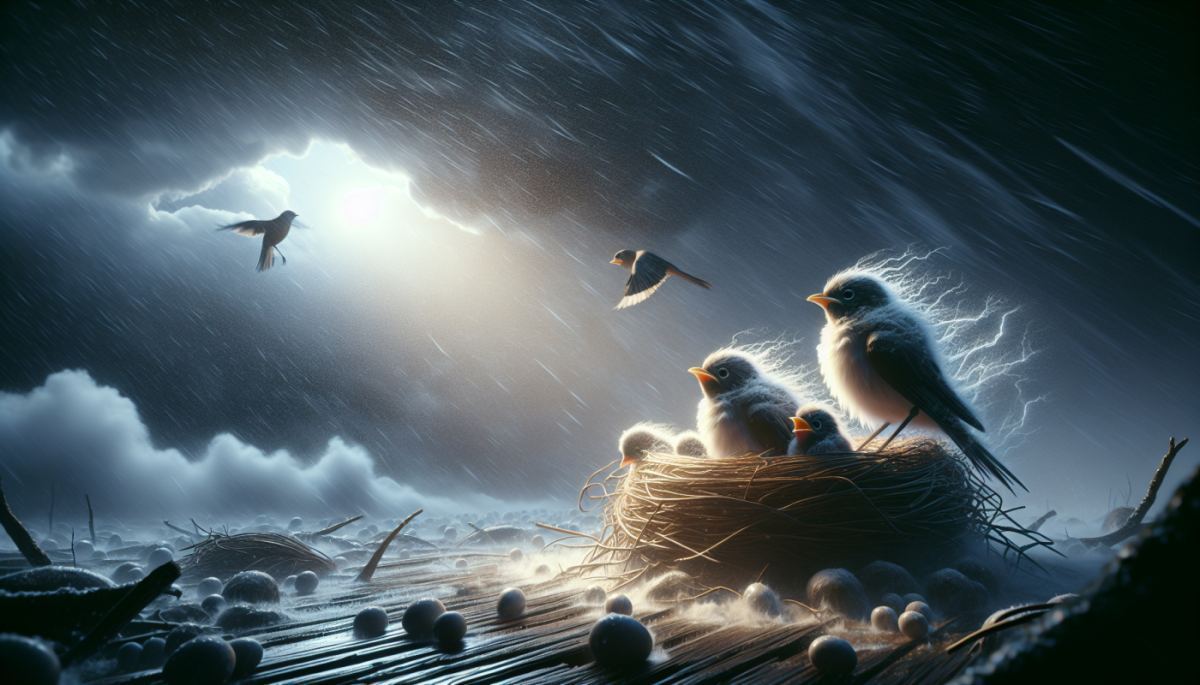
The great tit is not a glamorous bird. It does not migrate thousands of miles or inspire conservation fundraising campaigns. It builds its nest in a box, lays its eggs, and gets on with the business of survival in the woodlands of Europe. But for researchers at Oxford University's Wytham Woods, that quiet persistence has made the great tit one of the most scientifically valuable animals on the planet. A study drawing on more than 60 years of continuous monitoring and data from over 80,000 individual nestlings has now produced something rare in ecology: a long, clear window into how climate extremes are reshaping the earliest and most fragile stage of a bird's life.
The findings are precise in a way that broad climate projections rarely are. Cold snaps occurring shortly after hatching suppress nestling body mass, leaving chicks physically smaller at a stage when size is directly tied to survival odds. Heavy rainfall later in the developmental window compounds the problem, reducing the ability of parent birds to forage and deliver the insect protein that growing bodies depend on. These are not marginal effects. Lower body mass in the nest translates into measurably reduced survival rates, meaning the weather a chick experiences in its first weeks of life can determine whether it ever reaches adulthood.
What makes the study more than a straightforward climate alarm is the nuance embedded in the data. Moderate warm spells, it turns out, are not harmful. They are beneficial. Warmer temperatures during the right developmental window increase insect activity, which means more food arriving at the nest more frequently. Chicks in those conditions grow faster and heavier. The system is not simply one in which warming equals damage. It is one in which the timing, intensity, and sequence of weather events interact with the biology of the bird in ways that are deeply context-dependent.
Perhaps the most consequential finding involves breeding timing. Birds that nest earlier in the season appear meaningfully buffered against the worst weather shocks. This is not accidental. Early breeders tend to be older, more experienced birds with better territorial access to food. But it also reflects a deeper ecological alignment: earlier nesting historically meant that the peak of nestling development coincided with the peak of caterpillar abundance in the woodland canopy, the primary food source for great tit chicks. That synchrony has been under pressure for decades as spring warming causes caterpillar emergence to advance faster than bird breeding schedules can reliably track.
The birds that breed earliest are, in effect, the ones most likely to still be in rough alignment with their food supply. Those that breed later face a double disadvantage: they miss the caterpillar peak and they expose their chicks to a longer window of potential weather disruption as the season progresses into less predictable summer conditions. The result is a system where the penalties for mistimed breeding are compounding rather than linear.
The second-order consequence worth watching here extends well beyond the great tit itself. Woodland bird populations function as indicators of broader ecosystem health, and the pressures documented in this study are not unique to one species. Many cavity-nesting and insectivorous birds face structurally similar constraints: dependence on insect prey that is itself sensitive to temperature and rainfall, developmental windows that cannot be easily shifted, and a growing mismatch between the climate cues that trigger breeding and the ecological conditions that determine whether breeding succeeds.
If extreme weather events continue to increase in frequency and intensity, as climate projections consistently suggest they will, the compounding effect on early-life survival across multiple species could quietly reshape woodland bird communities over decades. Population declines driven by nestling mortality are slow and hard to detect in real time. By the time the signal is obvious in population counts, the underlying cause may already be deeply entrenched.
What 60 years of data from Wytham Woods ultimately offers is not just a record of what has happened to great tits. It is a demonstration of what sustained, unglamorous scientific attention makes visible. The birds that breed earliest are already, in some sense, running an adaptive experiment. Whether the rest of the population can follow fast enough is a question the next 60 years will answer.
References
- Sheldon et al. (2025) — Extreme weather events shape nestling body mass and survival in a long-term study of great tits
- Visser et al. (1998) — Warmer springs lead to mistimed reproduction in great tits
- Both et al. (2006) — Climate change and population declines in a long-distance migratory bird
- Perrins, C.M. (1965) — Population fluctuations and clutch-size in the great tit

Discussion (0)
Be the first to comment.
Leave a comment