
American manufacturers were already threading a needle before the missiles flew. Four consecutive months of growth — the longest such streak since 2021 — had given the industrial sector a cautious but genuine sense of momentum. Then rising oil prices and war-linked inflation arrived to complicate the picture, and what looked like a durable recovery suddenly started to feel more fragile.
The four-month expansion is not a trivial milestone. Manufacturing in the United States has spent much of the post-pandemic period lurching between contraction and stagnation, squeezed by elevated interest rates that dampened capital investment, a strong dollar that made American exports less competitive, and persistent uncertainty about trade policy. Four straight months of growth signals that some of those headwinds had, at least temporarily, eased enough for factory floors to pick up the pace. Hiring, new orders, and output all tend to move together during such stretches, meaning the gains likely rippled into supplier networks, freight, and the communities built around industrial employment.
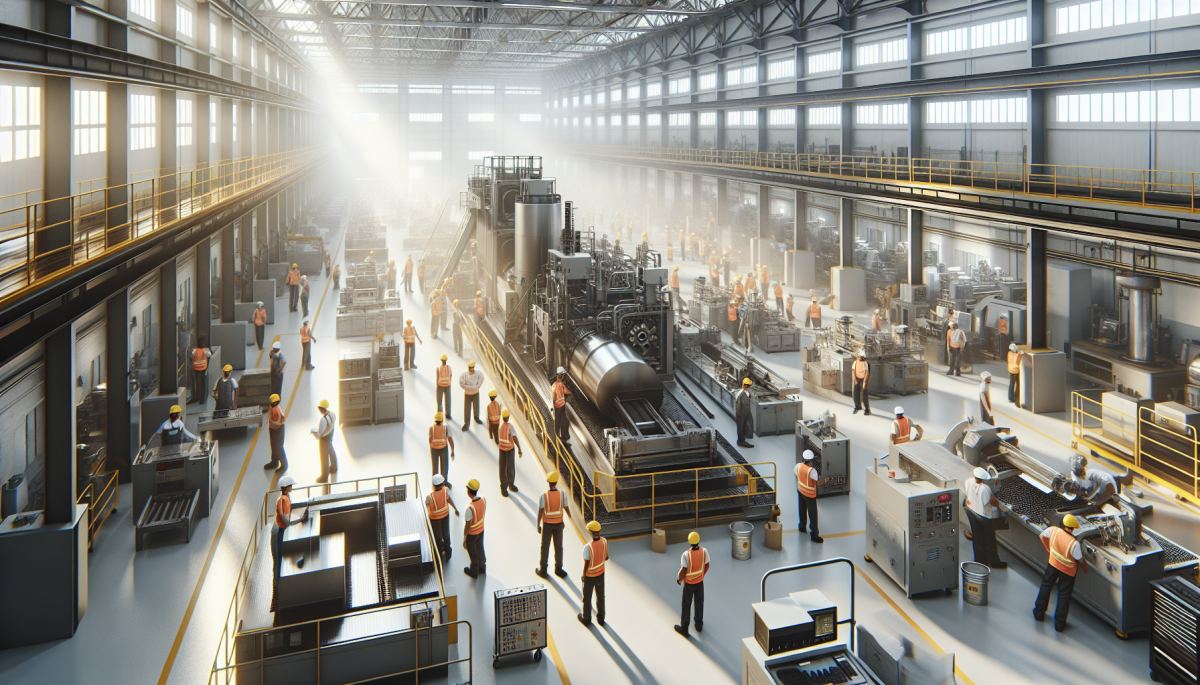
The Iran conflict introduces a feedback loop that manufacturers understand viscerally: energy costs are an input cost, and input costs are margin. Oil prices spiked on the news of hostilities, and while the precise magnitude of the increase matters enormously, even a sustained 10 to 15 percent rise in crude prices translates into higher transportation costs, more expensive petrochemical feedstocks, and upward pressure on plastics, resins, and synthetic materials that run through virtually every modern supply chain. For manufacturers who spent the last two years painstakingly rebuilding margins after the inflation surge of 2022, that is an unwelcome development.
The inflation dimension is equally important. If war-linked energy costs push headline inflation higher, the Federal Reserve faces renewed pressure to keep interest rates elevated or even consider further tightening. That dynamic would directly undercut one of the key conditions that allowed manufacturing to recover in the first place: the expectation that borrowing costs were finally coming down, making it cheaper to finance equipment, expand capacity, and take on longer-horizon contracts. A rate environment that stays restrictive longer than anticipated is, in effect, a tax on industrial ambition.
There is a version of this story where American manufacturers prove more resilient than the headlines suggest. Some domestic producers, particularly in defense-adjacent industries and energy equipment, may actually benefit from the conflict's economic wake. Reshoring trends that accelerated after the pandemic have left certain sectors less exposed to Middle Eastern supply disruptions than they would have been a decade ago. And four months of growth suggests that underlying demand conditions — consumer spending, infrastructure investment, and the ongoing buildout of semiconductor and clean-energy facilities — remain supportive enough to absorb some external shocks.
But resilience has limits, and the current situation tests several of them simultaneously. Manufacturers who locked in long-term contracts at pre-war input prices may find themselves absorbing losses rather than passing costs to customers. Smaller suppliers, who lack the hedging tools and balance sheet depth of large industrial firms, are particularly exposed. The history of oil-shock episodes — 1973, 1979, 1990, 2022 — suggests that the damage rarely arrives all at once; it accumulates through months of compressed margins, deferred investment, and eventually, layoffs.
The second-order effect worth watching most carefully is what happens to the reshoring narrative. The political and economic case for bringing manufacturing back to American soil has rested partly on the argument that domestic production insulates companies from geopolitical disruption. If a regional conflict in the Middle East can still transmit inflationary pressure powerful enough to stall a domestic manufacturing recovery, that argument becomes harder to sustain in its simpler forms. Policymakers who have staked industrial strategy on geographic diversification may need to reckon with the fact that energy markets remain deeply globalized regardless of where the factory sits.
Four months of growth is real, and it matters. But it is also a reminder that recoveries are not self-sealing systems — they are vulnerable to the same interconnected pressures that caused the contraction in the first place. The question now is whether the momentum built since January is durable enough to absorb a war premium, or whether April turns out to be the high-water mark of a recovery that arrived just before the tide changed.
Discussion (0)
Be the first to comment.
Leave a comment