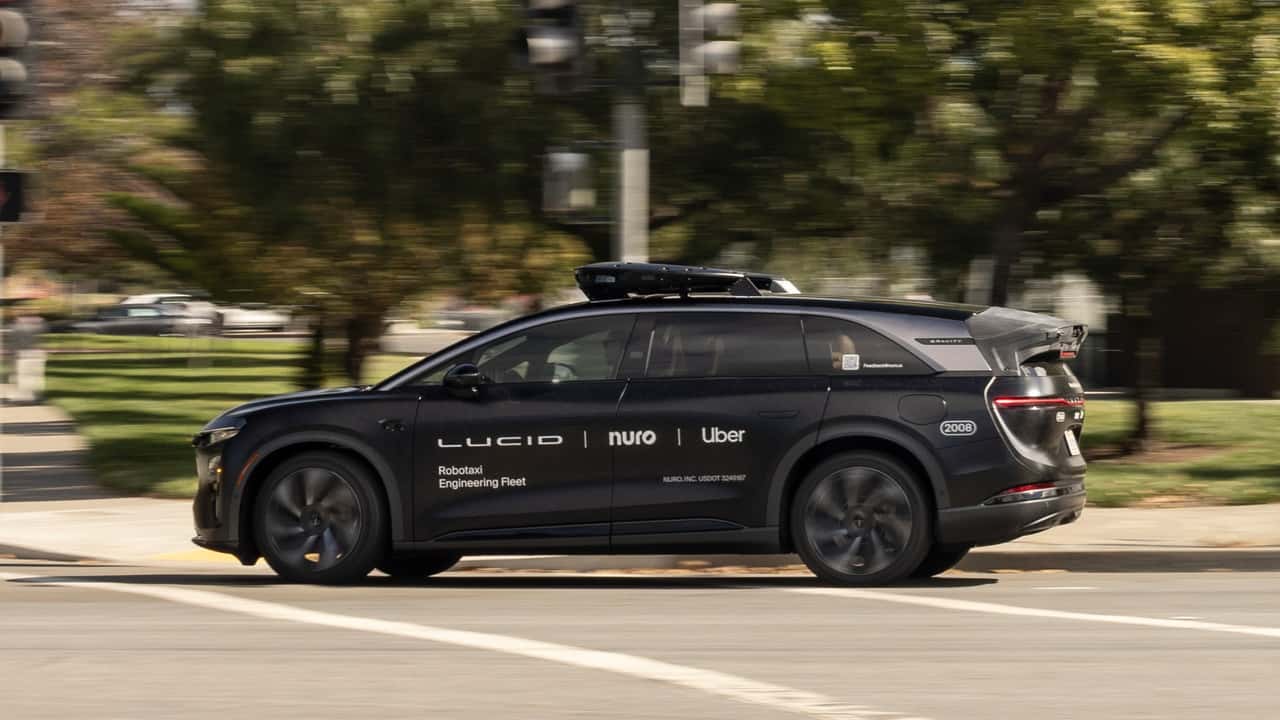
Lucid Motors has a new chief executive and a fresh injection of hundreds of millions of dollars, courtesy of Uber and its long-standing backer, Saudi Arabia's Public Investment Fund. The capital arrives at a moment when Lucid, maker of the Air sedan that routinely wins praise for its engineering, finds itself caught in the same trap that has snared nearly every premium EV startup: building a beautiful car is one thing, building a business around it is another entirely.
The funding round underscores just how capital-intensive the electric vehicle industry remains, even for companies that have already cleared the enormous hurdle of getting a car into production. Lucid delivered roughly 6,000 vehicles in 2023, a figure that sounds respectable until you hold it against the billions of dollars the company has burned to get there. General Motors or Toyota can spread fixed manufacturing costs across millions of units. Lucid is spreading them across thousands, which means every car it sells carries an enormous overhead burden that no amount of premium pricing can fully absorb.
Saudi Arabia's Public Investment Fund has been Lucid's financial spine since before the company went public via SPAC in 2021. The PIF owns a majority stake in Lucid, and its continued willingness to write checks reflects something larger than a simple investment thesis. For Riyadh, Lucid is part of Vision 2030, the kingdom's sweeping effort to diversify its economy away from oil. A thriving EV manufacturer, ideally one that eventually builds cars in Saudi Arabia, fits neatly into that narrative. The money flowing into Lucid is therefore not purely about return on capital. It is about national economic transformation, which means the PIF has incentives to keep Lucid alive that go well beyond what a conventional venture fund would tolerate.
That dynamic cuts both ways. On one hand, it gives Lucid a financial cushion that most startups could only dream of. On the other hand, it creates a dependency that could distort the company's strategic decisions. When your largest investor is a sovereign wealth fund with geopolitical goals, the pressure to site a factory in Riyadh or prioritize certain markets may not always align with what makes the most commercial sense.
Uber's involvement adds a different dimension. Ride-hailing platforms have long flirted with the idea of owning or influencing the vehicles on their networks, and a stake in a premium EV maker gives Uber optionality. Whether that means Lucid vehicles eventually appear in an Uber One luxury tier, or whether the investment is simply a financial play on EV adoption, remains to be seen. But the signal is clear enough: Uber sees value in having a seat at the table as the vehicle landscape shifts.
The deeper issue for Lucid, and the one that new leadership will have to confront directly, is that the EV market has become far more competitive and far more price-sensitive than it looked in 2021. Tesla has cut prices aggressively. Chinese manufacturers like BYD are producing compelling vehicles at costs that Western startups cannot match. And consumer enthusiasm for EVs, while still real, has moderated from the feverish optimism of a few years ago.
Lucid's answer to this has been to lean into its engineering credibility. The Air's range figures are genuinely impressive, and the company's powertrain technology is considered among the best in the industry. But technology alone does not build a sustainable business. Distribution, service networks, brand awareness, and financing options all matter enormously, and these are areas where Lucid is still catching up.
The second-order consequence worth watching here is what happens to the broader premium EV segment if Lucid cannot achieve meaningful scale within the next two to three years. A Lucid stumble would not just affect shareholders. It would send a chilling signal to other would-be entrants that the window for premium EV startups may be closing faster than anticipated, potentially consolidating the high-end electric market around Tesla and a handful of legacy automakers who have the manufacturing infrastructure to compete on cost. The new CEO inherits not just a company in need of growth, but a proof-of-concept moment for an entire category of vehicle maker.
Whether fresh capital and fresh leadership can bend that trajectory is the question that will define Lucid's next chapter, and perhaps shape who gets to compete in the EV market at all.
Discussion (0)
Be the first to comment.
Leave a comment