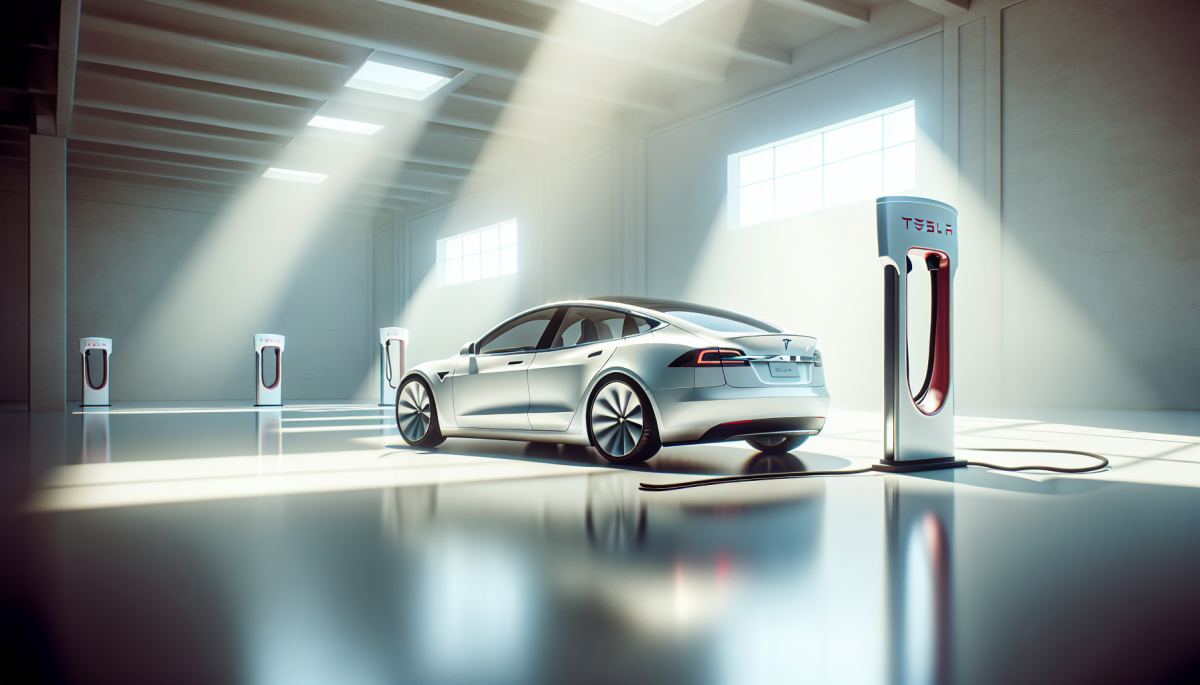
Tesla sold fewer cars in the first quarter of 2025 than it did a year ago. That much is not in dispute. What makes the story genuinely interesting is what happened to everyone else: they sold even fewer. In a shrinking market, relative strength can look a lot like winning, and right now Tesla is winning by default as much as by design.
The company reported a significant drop in U.S. deliveries for Q1 2025, a decline that would normally signal serious trouble for any automaker. But the broader electric vehicle market contracted at the same time, meaning Tesla's share of that market actually grew. When your competitors are bleeding faster than you are, the math works in your favor even when the absolute numbers look grim.
The EV market's contraction is not a random blip. It reflects a collision of forces that have been building for some time. Federal tax incentives under the Inflation Reduction Act remain complicated and income-capped, leaving a large swath of potential buyers either ineligible or confused. Interest rates, while easing from their peak, are still high enough to make financing a $45,000 vehicle a meaningful monthly commitment. And the used EV market has flooded with off-lease vehicles, giving cost-conscious buyers a cheaper entry point that pulls demand away from new car lots entirely.
Then there is the Elon Musk factor. His increasingly polarizing public profile, amplified by his role in the Trump administration's Department of Government Efficiency, has driven a measurable backlash among the progressive and urban consumers who were once Tesla's most reliable buyers. Protests at dealerships, viral social media campaigns, and anecdotal reports of buyers switching to Hyundai, BMW, or Rivian have all added noise to the signal. Whether that backlash is large enough to move the needle materially is debated, but it is almost certainly not helping.
What's kept Tesla's market share afloat despite all of this is the relative weakness of its competition. Legacy automakers like Ford and General Motors have pulled back on EV investment timelines, scaled down production targets, and in some cases quietly shelved models that were supposed to challenge Tesla directly. Ford's Mustang Mach-E and GM's Blazer EV have both faced production and quality headaches. Startups like Rivian are growing but remain subscale. The result is a market where Tesla, even diminished, still has no single dominant rival.
Here is where systems thinking becomes useful. Tesla's market share gain in a contracting market creates a feedback loop that could entrench its position further, but also one that carries hidden fragility.
On the reinforcing side: as competitors retreat, Tesla retains the largest charging network, the most mature software ecosystem, and the strongest brand recognition in the EV space. Buyers who do commit to an EV in 2025 are more likely to choose Tesla simply because the infrastructure around it is more developed. That network effect compounds over time. More Tesla owners means more pressure on competitors to build Supercharger-compatible vehicles, which in turn normalizes Tesla's technical standards across the industry, a dynamic already playing out as Ford, GM, and others adopted the NACS charging connector.
But the balancing loop is just as important. A shrinking EV market means fewer total vehicles on the road, slower buildout of the broader charging ecosystem, and reduced political momentum for EV-friendly policy. If the market stays depressed long enough, it could delay the cost curve improvements that make EVs genuinely mass-market. Tesla's dominance of a small pond is not the same as dominance of a large one.
The second-order consequence worth watching is what happens to EV supply chains if legacy automakers continue to retreat. Battery manufacturers, mining companies, and component suppliers built capacity on the assumption of rapid EV adoption. If that adoption stalls, some of those suppliers will consolidate or exit, making it harder and more expensive to scale back up when demand eventually returns. Tesla, with its vertical integration and Nevada gigafactory, is better insulated from that risk than most. But the industry around it is not.
The quarter's numbers tell a story of a company navigating a difficult moment better than its rivals. The more consequential question is whether the market it dominates will grow large enough to matter, or whether Tesla will spend the next few years winning races in a stadium that keeps getting smaller.
References
- Ewing, J. (2025) — Tesla Sales Drop Sharply, but It Gains Ground in a Shrinking E.V. Market
- Boudette, N. (2024) — Ford and G.M. Scale Back Electric Vehicle Plans
- U.S. Department of Energy (2024) — EV Adoption and Charging Infrastructure Report
- Korosec, K. (2023) — Why Automakers Are Adopting Tesla's NACS Charging Standard

Discussion (0)
Be the first to comment.
Leave a comment