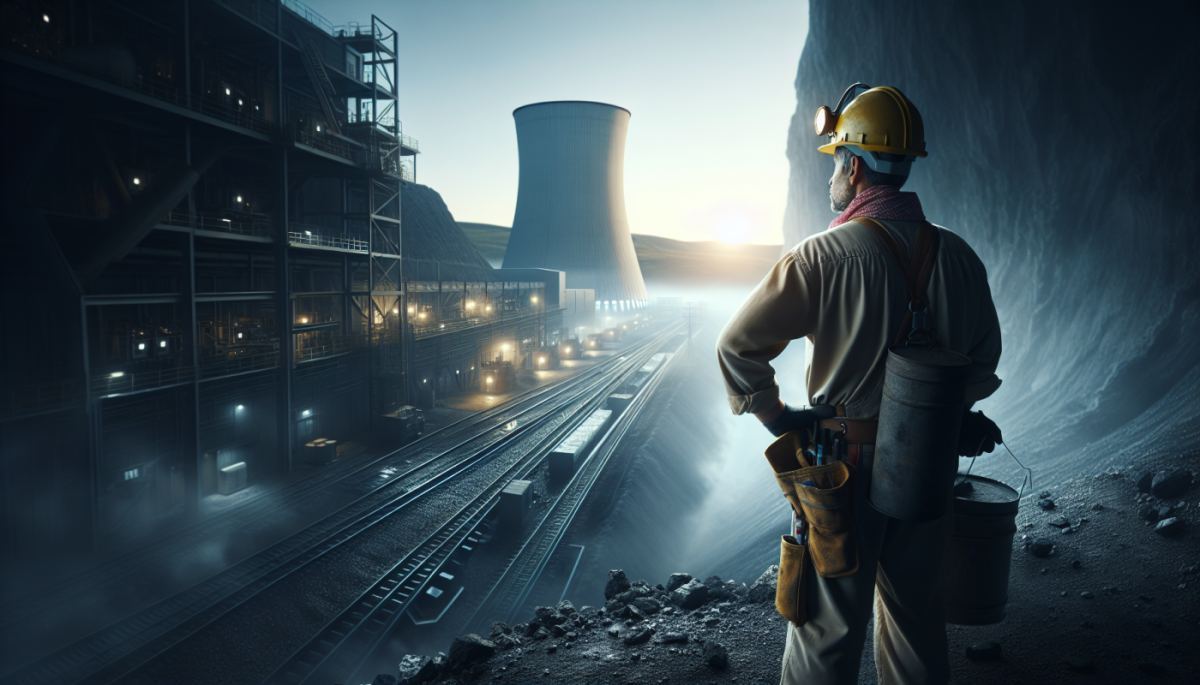
When coal plants close, they leave behind more than shuttered buildings and idle machinery. They leave behind entire communities whose economic identity was built around a single industry, and whose tax base, workforce, and civic life can unravel with startling speed. In Utah, some Republican lawmakers and local officials are now looking at a deeply unconventional answer to that hollowing out: becoming a national repository for nuclear waste.
The pitch, gaining traction under a Trump administration that has signaled openness to expanding nuclear infrastructure, is straightforward in its logic if not in its politics. Communities that once hosted coal plants already have the industrial zoning, the transmission infrastructure, and crucially, a workforce that understands how to work around hazardous materials and heavy equipment. Why not leverage those existing assets to attract a new, if controversial, industry? Proponents frame it as a once-in-a-lifetime opportunity, the kind of economic pivot that rarely presents itself to rural communities with few other options on the table.

The United States has struggled for decades to find a permanent or even interim solution to its nuclear waste problem. The country generates thousands of metric tons of spent nuclear fuel every year, and that material currently sits in temporary storage at more than 70 sites across 35 states, many of them aging facilities never designed for long-term containment. The collapse of the Yucca Mountain project in Nevada, which was supposed to be the nation's permanent repository before political opposition effectively killed it, left the entire waste management system in a kind of suspended animation. Interim consolidated storage facilities, or ICSFs, have been proposed as a bridge solution, but they have faced fierce regulatory and legal battles.
What makes Utah's position interesting from a systems perspective is the feedback loop it reveals between deindustrialization and risk tolerance. When a community loses its primary economic engine, its appetite for industries that wealthier or more economically diverse regions would reject tends to rise. This is not unique to nuclear waste. Hazardous waste facilities, industrial agriculture operations, and polluting manufacturing plants have long disproportionately ended up in economically distressed areas, a dynamic that environmental justice researchers have documented extensively. The difference here is that the communities themselves, through their elected representatives, are actively seeking this outcome rather than having it imposed on them.
That distinction matters politically and morally, but it does not necessarily change the underlying calculus of risk. Spent nuclear fuel, even in dry cask storage which is the current industry standard and widely considered safe, requires monitoring, security, and management over timescales that dwarf any economic planning horizon. A community that accepts a storage facility today is making a commitment that extends centuries into the future, long past any political administration or economic rationale that motivated the original decision.
The Trump administration's broader energy posture, which has emphasized domestic nuclear expansion alongside fossil fuel production, creates a permissive regulatory environment that could accelerate these conversations. The Nuclear Regulatory Commission has been under pressure to streamline licensing, and there is genuine bipartisan interest in keeping nuclear power viable as a low-carbon baseload source. But waste storage and power generation are politically distinct issues, and enthusiasm for one does not automatically translate into resolved policy on the other.
The second-order effect worth watching here is what happens to the broader national waste management debate if Utah moves forward. For years, the absence of any willing host community has been one of the central obstacles to solving the spent fuel problem. If a state actively courts storage facilities, it could break a political logjam that has persisted since the 1980s, potentially unlocking federal investment and creating a template that other coal-affected states might follow. Wyoming, West Virginia, and parts of Appalachia face similar post-coal economic pressures and similar political cultures that might find the trade-off acceptable.
That could be genuinely useful for the country's nuclear waste crisis. It could also create a race to the bottom in which the communities with the fewest alternatives end up bearing a disproportionate share of a national burden that wealthier states have successfully avoided. The question of who carries the long-term costs of the country's energy history, whether that is carbon emissions, mine reclamation, or radioactive waste, has never been answered equitably. Utah's moment of opportunity is also, depending on how the politics resolve, a stress test for whether that pattern is about to change or simply repeat itself in a new form.
References
- U.S. Nuclear Regulatory Commission (2023) — Backgrounder on Radioactive Waste
- U.S. Department of Energy (2023) — Spent Nuclear Fuel and High-Level Radioactive Waste
- Sovacool et al. (2017) — Contested Phenomenologies of Nuclear Power
- GAO (2021) — Spent Nuclear Fuel: Accumulating Quantities at Commercial Reactors Present Storage and Other Challenges
Discussion (0)
Be the first to comment.
Leave a comment