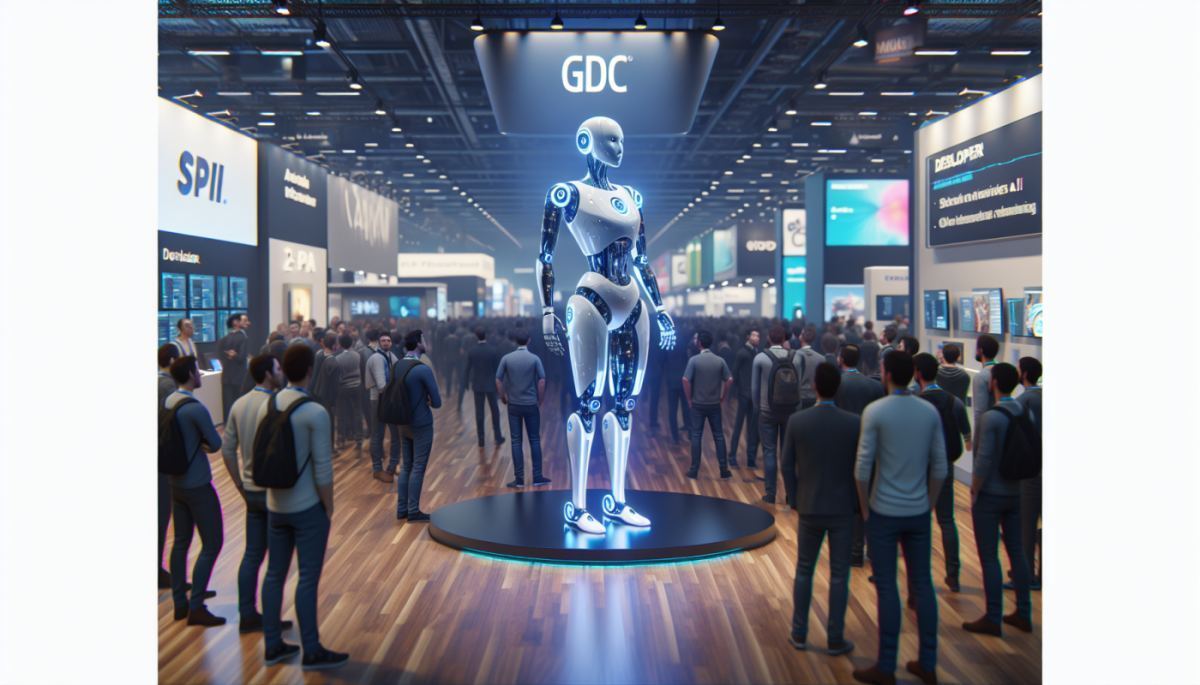
The Game Developers Conference has always been a reliable barometer of where the industry's money and anxiety are pointing at the same time. This year, the needle swung hard toward artificial intelligence — not inside the games being showcased, but around them, between them, and especially in the vendor halls where the real sales pitches happen.
Generative AI tools were everywhere at GDC's Festival of Gaming. Companies arrived with demos promising to reshape how games get built: AI-driven non-player characters capable of dynamic conversation, procedural world-generation pipelines, and platforms that claimed to let developers conjure entire game environments from a chat prompt. One of the more striking demonstrations came from Tencent, whose AI tools powered a pixel-art fantasy world that a reporter spent ten minutes exploring — a world assembled not by an artist with a tablet, but by a model responding to inputs. It was technically impressive. Whether it was fun is a different question, and that gap between technical capability and actual player experience is exactly where the tension in this story lives.

There is a structural reason AI showed up so aggressively in the exhibition space rather than in the playable demos. Vendors selling developer tools have a fundamentally different incentive than studios making games. A middleware company or a cloud AI platform needs to sell to developers, not players. Their audience at GDC is a procurement decision, not a consumer one. So the pitch is efficiency: cut your NPC dialogue budget, reduce your QA cycle, generate placeholder assets faster. These are real cost pressures in an industry that has spent the last two years watching mass layoffs ripple through studios large and small. When your workforce has been cut and your timeline hasn't, a tool that promises to fill the gap is going to get a serious look.
But that commercial logic creates a subtle distortion in how AI's role in gaming gets perceived. Because the tools are visible and the games built with them are not yet shipping, the conference optics suggest an industry in transformation when the reality may be more cautious. Most working developers are still figuring out where generative AI fits without alienating the creative staff they have left, without producing output that feels hollow to players, and without running into the unresolved legal questions around training data that continue to hang over the entire generative AI sector.
The more consequential dynamic here is not whether AI can generate a pixel-art dungeon — it clearly can — but what happens to the feedback loop between developers and players when the texture of a game world is no longer the product of human creative decisions. Games have always communicated authorship in subtle ways. The slightly odd enemy placement in a FromSoftware level, the specific rhythm of a Hades room, the way a particular indie game's color palette reflects its developer's aesthetic obsessions — these are signals players read, often unconsciously, as evidence that someone cared. They create the conditions for cult followings, speedrunning communities, and the kind of devoted player bases that sustain games for years after launch.
If procedural AI generation becomes a cost-cutting default rather than a deliberate creative tool, the second-order effect is not just aesthetic sameness. It is a potential erosion of the parasocial and interpretive relationship between players and the humans who made their games. Players do not just consume games — they read them, argue about them, and build identities around them. That process depends on there being intentional human choices to interpret. A world generated from a chat box may be technically coherent and visually acceptable, and still leave players with nothing to argue about.
The vendors at GDC were not selling that risk. They were selling speed and scale, which are genuinely valuable things in a capital-constrained industry. But the studios quietly watching from a distance may understand something the pitch decks do not account for: that the inefficiency of human creative labor is sometimes exactly what makes a game worth playing. How the industry resolves that tension — not in the vendor hall, but in the games that actually ship — will define the next several years of player culture in ways that no demo, however impressive, can yet predict.
Discussion (0)
Be the first to comment.
Leave a comment